AND gate in the context of "Logic circuits"

Play Trivia Questions online!

or

Skip to study material about AND gate in the context of "Logic circuits"


⭐ Core Definition: AND gate

The AND gate is a basic digital logic gate that implements the logical conjunction (∧) from mathematical logic – AND gates behave according to their truth table. A HIGH output (1) results only if all the inputs to the AND gate are HIGH (1). If any of the inputs to the AND gate are not HIGH, a LOW (0) is outputted. The function can be extended to any number of inputs by multiple gates up in a chain.

↓ Menu

In this Dossier

AND gate in the context of Logic gate

A logic gate is a device that performs a Boolean function, a logical operation performed on one or more binary inputs that produces a single binary output. Depending on the context, the term may refer to an ideal logic gate, one that has, for instance, zero rise time and unlimited fan-out, or it may refer to a non-ideal physical device (see ideal and real op-amps for comparison).

The primary way of building logic gates uses diodes or transistors acting as electronic switches. Today, most logic gates are made from MOSFETs (metal–oxide–semiconductor field-effect transistors). They can also be constructed using vacuum tubes, electromagnetic relays with relay logic, fluidic logic, pneumatic logic, optics, molecules, acoustics, or even mechanical or thermal elements.

↑ Return to Menu

AND gate in the context of Fluidics

Fluidics, or fluidic logic, is the use of a fluid to perform analog or digital operations similar to those performed with electronics.

The physical basis of fluidics is pneumatics and hydraulics, based on the theoretical foundation of fluid dynamics. The term fluidics is normally used when devices have no moving parts, so ordinary hydraulic components such as hydraulic cylinders and spool valves are not considered or referred to as fluidic devices.

↑ Return to Menu

AND gate in the context of NOR gate

The NOR (NOT OR) gate is a digital logic gate that implements logical NOR - it behaves according to the truth table to the right. A HIGH output (1) results if both the inputs to the gate are LOW (0); if one or both input is HIGH (1), a LOW output (0) results. NOR is the result of the negation of the OR operator. It can also in some senses be seen as the inverse of an AND gate. NOR is a functionally complete operation—NOR gates can be combined to generate any other logical function. It shares this property with the NAND gate. By contrast, the OR operator is monotonic as it can only change LOW to HIGH but not vice versa.

In most, but not all, circuit implementations, the negation comes for free—including CMOS and TTL. In such logic families, OR is the more complicated operation; it may use a NOR followed by a NOT. A significant exception is some forms of the domino logic family.

↑ Return to Menu

AND gate in the context of NAND gate

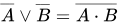
In digital electronics, a NAND (NOT AND) gate is a logic gate which produces an output which is false only if all its inputs are true; thus its output is complement to that of an AND gate. A LOW (0) output results only if all the inputs to the gate are HIGH (1); if any input is LOW (0), a HIGH (1) output results. A NAND gate is made using transistors and junction diodes. By De Morgan's laws, a two-input NAND gate's logic may be expressed as , making a NAND gate equivalent to inverters followed by an OR gate.

The NAND gate is significant because any Boolean function can be implemented by using a combination of NAND gates. This property is called "functional completeness". It shares this property with the NOR gate. Digital systems employing certain logic circuits take advantage of NAND's functional completeness.

↑ Return to Menu

AND gate in the context of Circuit complexity

In theoretical computer science, circuit complexity is a branch of computational complexity theory in which Boolean functions are classified according to the size or depth of the Boolean circuits that compute them. A related notion is the circuit complexity of a recursive language that is decided by a uniform family of circuits (see below).

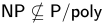
Proving lower bounds on size of Boolean circuits computing explicit Boolean functions is a popular approach to separating complexity classes. For example, a prominent circuit class P/poly consists of Boolean functions computable by circuits of polynomial size. Proving that would separate P and NP (see below).

↑ Return to Menu

AND gate in the context of Programmable logic device

A programmable logic device (PLD) is an electronic component used to build reconfigurable digital circuits. Unlike digital logic constructed using discrete logic gates with fixed functions, the function of a PLD is undefined at the time of manufacture. Before the PLD can be used in a circuit it must be programmed to implement the desired function. Compared to fixed logic devices, programmable logic devices simplify the design of complex logic and may offer superior performance. Unlike for microprocessors, programming a PLD changes the connections made between the gates in the device.

PLDs can broadly be categorised into, in increasing order of complexity, simple programmable logic devices (SPLDs), comprising programmable array logic, programmable logic array and generic array logic; complex programmable logic devices (CPLDs); and field-programmable gate arrays (FPGAs).

↑ Return to Menu