2019 Indonesian protests and riots in the context of "Extramarital sex"

Play Trivia Questions online!

or

Skip to study material about 2019 Indonesian protests and riots in the context of "Extramarital sex"


⭐ Core Definition: 2019 Indonesian protests and riots

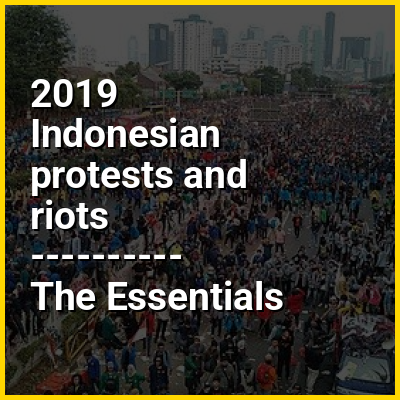
A series of mass protests led by students took place at major cities in Indonesia from 23 September 2019, to rally against new legislation that reduces the authority of the Corruption Eradication Commission (KPK), as well as several bills including a new criminal code that penalises extramarital sex and defamation against the president. The protesters consisted of mostly students from over 300 universities, with no association with any particular political parties or groups. The protests were the most prominent student movement in Indonesia since the 1998 riots that brought down the Suharto regime.

In several cities including Jakarta, Bandung and Padang, protesters clashed with the Indonesian National Police (Polri), resulting in the riot police firing tear gas and water cannons. In the capital city of Jakarta, the police confirmed that at least 254 students and 39 police officers are injured or being treated in hospitals. In Kendari, Southeast Sulawesi, two students died, one of them allegedly being shot during the violent clash. Another three protesters died in Jakarta.
↓ Menu

In this Dossier

2019 Indonesian protests and riots in the context of Protest

A protest (also called a demonstration, remonstration, or remonstrance) is a public act of objection, disapproval or dissent against political advantage. Protests can be thought of as acts of cooperation in which numerous people cooperate by attending, and share the potential costs and risks of doing so. Protests can take many different forms, from individual statements to mass political demonstrations. Protesters may organize a protest as a way of publicly making their opinions heard in an attempt to influence public opinion or government policy, or they may undertake direct action in an attempt to enact desired changes themselves. When protests are part of a systematic and peaceful nonviolent campaign to achieve a particular objective, and involve the use of pressure as well as persuasion, they go beyond mere protest and may be better described as civil resistance or nonviolent resistance.

Various forms of self-expression and protest are sometimes restricted by governmental policy (such as the requirement of protest permits), economic circumstances, religious orthodoxy, social structures, or media monopoly. One state reaction to protests is the use of riot police. Observers have noted an increased militarization of protest policing in many countries, with police deploying armored vehicles and snipers against protesters. When such restrictions occur, protests may assume the form of open civil disobedience, more subtle forms of resistance against the restrictions, or may spill over into other areas such as culture and emigration.

↑ Return to Menu

2019 Indonesian protests and riots in the context of Bloody September incident

Bloody September (Indonesian: September Berdarah) was an incident which took place on 26 September 2019 during the height of the 2019 Indonesian protests and riots in Kendari, Southeast Sulawesi. Two Haluoleo University students, Imawan Randi and Yusuf Kardawi, were allegedly shot by police while protesting in front of the provincial parliament building and the regional police headquarters against the controversial revision of the status of the Corruption Eradication Commission and the new Criminal Code Bill.

The shooting has been commemorated by the students of the university every year since with demands for an investigation and prosecution of the perpetrator. In 2022, the commemoration's demonstration ended in a riot and clashes with security personnel. Both cases' investigations, as of 2022, have not yet been closed.

↑ Return to Menu