2016 Turkish coup attempt in the context of Peace at Home Council


2016 Turkish coup attempt in the context of Peace at Home Council

⭐ Core Definition: 2016 Turkish coup attempt

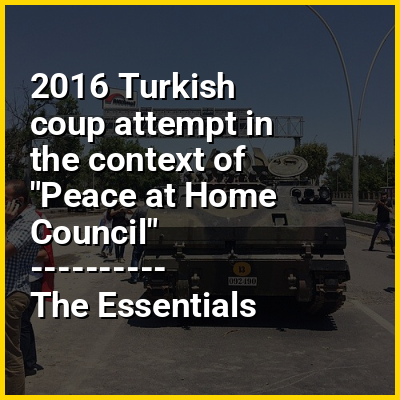
In the evening of 15 July 2016, a faction within the Turkish Armed Forces of 8500 soldiers, organized as the Peace at Home Council, attempted a coup d'état against state institutions, including the government and president Recep Tayyip Erdoğan. They attempted to seize control of several places in Ankara, Istanbul, Marmaris and elsewhere, such as the Asian side entrance of the Bosphorus Bridge, but failed to do so after forces and civilians loyal to the state defeated them. The Council cited an erosion of secularism, elimination of democratic rule, disregard for human rights, and Turkey's loss of credibility in the international arena as reasons for the coup. The same night Erdogan stated that they had evidence the coup leaders were linked to the Gülen movement, which had over 2000 schools, hundreds of charities, and hospitals globally by 2015. Erdogan designated the movement as a terrorist organization in May 2016, citing the 2013 corruption scandal— which he described as a "judicial coup attempt" allegedly carried out by police officers linked to the movement— as justification. The Gulen movement was led by Fethullah Gülen, a Turkish businessman and a well-known Islamic scholar who lived in exile in Pennsylvania. The Turkish government alleged that Gülen was behind the coup and that the United States was harboring him. In response Gulen has called for an international commission to investigate the failed coup and said he would accept the findings if such a body found evidence of his guilt. In contrast, the Erdoğan government did not even agree to the proposal for a national parliamentary committee to investigate the events of 15 July.

Events surrounding the coup attempt and the purges in its aftermath reflect a complex power struggle between Islamist elites in Turkey.
↓ Menu
HINT:

In this Dossier

2016 Turkish coup attempt in the context of 2016–17 Turkish purges

Since 2016, the government of Turkey has conducted a series of purges, enabled by a state of emergency in reaction to the failed coup attempt on 15 July that year. The purges began with the arrest of Turkish Armed Forces personnel reportedly linked to the coup attempt, but arrests were expanded to include other elements of the Turkish military, civil servants, and private citizens. Later actions reflected a power struggle between secularist and Islamist political elites in Turkey, which affected people who were not active in nor aware of the coup but who the government claimed were connected with the Gülen movement, an opposition group which the government blamed for the coup. Possession of books authored by Gülen was considered valid evidence of such a connection and cause for arrest.

Tens of thousands of public servants and soldiers were purged in the first week following the coup. For example, on 16 July 2016, one day after the coup was foiled, 2,745 judges were dismissed and detained. This was followed by the dismissal, detention or suspension of over 100,000 officials, a figure that had increased to over 110,000 by early November 2016, over 125,000 after the 22 November decree, reaching at least 135,000 with the January decrees, about 160,000 after the suspensions and arrests decree of April 29 and 300,000 by February 2025. Collectively about 10% of Turkey's 2 million public employees were removed as a result of the purges. Purged citizens are prevented from working again for the government, which has led in many cases to destitution.

View the full Wikipedia page for 2016–17 Turkish purges
↑ Return to Menu

2016 Turkish coup attempt in the context of Turkish coup d'état

Turkish coup d'état may refer to illegal or constitutional military takeovers or takeover attempts in Turkey. There have been several.

From the founding of the Turkish Republic until 2016, the Turkish military was very involved in Turkish politics. The army was strongly Kemalist and considered one of its roles to be the ultimate guardian of Atatürk's reforms including secularism, and of cooperation with the Western world generally. The Turkish constitutions of 1924, 1961, and 1982 formally specified that the army's role was to protect Turkey against internal as well as external threats. The army was popular and prestigious as the guarantor of the Turkish state and of Turkish multiparty democracy (after its effective establishment following World War II).

View the full Wikipedia page for Turkish coup d'état
↑ Return to Menu