
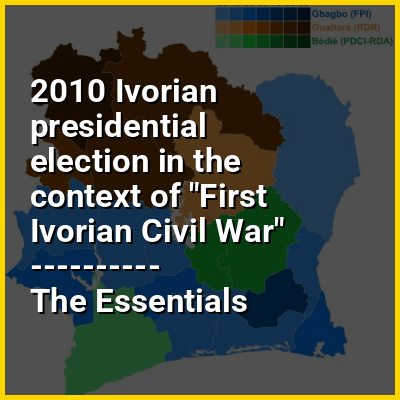
The First Ivorian Civil War was a civil conflict in the Ivory Coast (Côte d'Ivoire) that began with a military rebellion on 19 September 2002 and ended with a peace agreement on 4 March 2007. The conflict pitted the government of Ivorian President Laurent Gbagbo against a domestic insurgency led by the New Forces of Ivory Coast (Forces nouvelles de Côte d'Ivoire). A second civil war (2010–2011) would break out over the results of the 2010 Ivorian presidential election.
The war was preceded by a tumultuous decade in the Ivory Coast, marked by an economic downturn and, following the death of long-time Ivorian President Félix Houphouët-Boigny in 1993, a leadership succession crisis. The succession crisis manifested in a 1999 military coup d'état and a violent dispute over the result of the 2000 presidential election. Three successive Ivorian leaders – Henri Konan Bédié from 1993, Robert Guéï from 1999, and Gbagbo from 2000 – exploited the ideology of Ivoirité to repress and marginalise political opposition, notably by disqualifying Alassane Ouattara from contesting elections on the basis of his Burkinabé nationality; in the process, these leaders stoked ethnic tensions and xenophobic sentiment in the country. The rebellion which ignited the war was driven by forces which sought a re-run of the 2000 election and reform of exclusionary citizenship policies.