1901 Australian federal election in the context of Hopetoun Blunder


1901 Australian federal election in the context of Hopetoun Blunder

⭐ Core Definition: 1901 Australian federal election

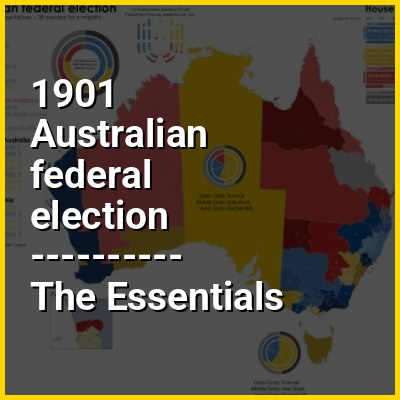
The 1901 Australian federal election for the inaugural Parliament of Australia was held in Australia on Friday 29 March and Saturday 30 March 1901. The elections followed Federation and the establishment of the Commonwealth of Australia on 1 January 1901. All 75 seats in the Australian House of Representatives, six of which were uncontested, as well as all 36 seats in the Australian Senate, were up for election.

After the initial confusion of the Hopetoun Blunder, the first Prime Minister of Australia, Edmund Barton, went into the inaugural 1901 federal election as the appointed head of a Protectionist Party caretaker government. While the Protectionists came first on seats, they fell short of a majority. The incumbent government remained in office with the parliamentary support of the Labour Party, who held the balance of power, while the Free Trade Party formed the opposition. A few months prior to the 1903 election, Barton resigned to become a founding member of the High Court of Australia, and was replaced by Alfred Deakin.
↓ Menu
HINT:

👉 1901 Australian federal election in the context of Hopetoun Blunder

The Hopetoun Blunder was a political event immediately prior to the Federation of the British colonies in Australia.

Federation was scheduled to occur on 1 January 1901, but since the general election for the first Parliament of Australia was not to be held until March, it was not possible to follow the conventions of the Westminster system and appoint the leader of the majority in the House of Representatives as Prime Minister. Instead, an interim government would be appointed, holding office from 1 January until the result of the election was known.

↓ Explore More Topics
In this Dossier

1901 Australian federal election in the context of Australian Labor Party

The Australian Labor Party (ALP), also known as the Labor Party or simply Labor, is the major centre-left political party in Australia and one of two major parties in Australian politics, along with the centre-right Liberal Party of Australia. The party has been in government since the 2022 federal election, and with political branches active in all the Australian states and territories, they currently hold government in New South Wales, South Australia, Victoria, Western Australia, and the Australian Capital Territory. As of 2025, Queensland, Tasmania and Northern Territory are the only states or territories where Labor currently forms the opposition. It is the oldest continuously operating political party in Australian history, having been established on 8 May 1901 at Parliament House, Melbourne, the meeting place of the first Federal Parliament.

The ALP is descended from the labour parties founded in the various Australian colonies by the emerging labour movement. Colonial Labour parties contested seats from 1891, and began contesting federal seats following Federation at the 1901 federal election. In 1904, the ALP briefly formed what is considered the world's first labour party government and the world's first democratic socialist or social democratic government at a national level. At the 1910 federal election, Labor became the first party in Australia to win a majority in either house of the Australian parliament. In every election since 1910 Labor has either served as the governing party or the opposition. There have been 13 Labor prime ministers and 10 periods of federal Labor governments, including under Billy Hughes from 1915 to 1916, James Scullin from 1929 to 1932, John Curtin from 1941 to 1945, Ben Chifley from 1945 to 1949, Gough Whitlam from 1972 to 1975, Bob Hawke from 1983 to 1991, Paul Keating from 1991 to 1996, Kevin Rudd from 2007 to 2010 and 2013, Julia Gillard from 2010 to 2013, and Anthony Albanese since 2022.

View the full Wikipedia page for Australian Labor Party
↑ Return to Menu

1901 Australian federal election in the context of Division of Werriwa

The Division of Werriwa is an Australian electoral division in the state of New South Wales. The name Werriwa derives from a local Aboriginal name for Lake George, which was located in the division when it was established in 1900. The division was one of the original 65 divisions first contested at the first federal election.

Werriwa now covers an area in south-west Sydney.

View the full Wikipedia page for Division of Werriwa
↑ Return to Menu

1901 Australian federal election in the context of Leaders of the Australian Labor Party

The leader of the Australian Labor Party is the highest political office within the federal Australian Labor Party (ALP). Leaders of the party are chosen from among the sitting members of the parliamentary caucus either by members alone or with a vote of the party's rank-and-file membership. The current leader of the Labor Party, since 2019, is Anthony Albanese, who has served as the prime minister of Australia since 2022. There have been 21 leaders since 1901 when Chris Watson was elected as the inaugural leader following the first federal election.

Every Australian state and territory has its own branch of the Australian Labor Party, which has its own leader elected from the party members of that jurisdiction.

View the full Wikipedia page for Leaders of the Australian Labor Party
↑ Return to Menu