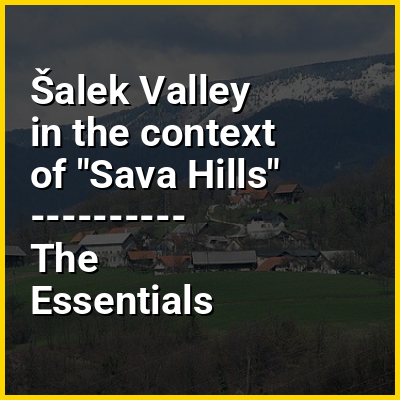
The Šalek Valley (pronounced [ˈʃaːlɛk]; Slovene: Šaleška dolina, German: Schallegger Tal) or the Velenje Basin (pronounced [ʋɛˈlɛːnjɛ]; Velenjska kotlina) is a basin in northern Slovenia in the northeastern pre-alpine foothills. It is named after Šalek Castle near the town of Velenje. The valley lies between the Kamnik–Savinja Alps to the west, the Pohorje Mountain Range to the east, and the Sava Hills to the south. It has a northwest-southeast orientation and is approximately 8 km long and 2 km wide. It contains a number of rivers and lakes. The Paka River runs through Velenje, with a number of tributaries from the northwest: Trebušnica Creek, Veriželj Creek and Slatina Creek. The Paka itself eventually flows into the Savinja River. The valley is separated from the Upper Savinja Valley (Zgornja Savinjska dolina) and Lower Savinja Valley (Spodnja Savinjska dolina) by the Golte Plateau, the Skorno Hills (Skornški hribi, peaks along the Paka including Mount Oljka, and the Ponikva Plateau (Ponikovska planota).
Especially on the north, the valley is closed in by a chain of high mountains, from northeast to northwest: Paka Mount Kozjak with its peaks Basališče (1272 m) and Špik (1108 m), Smodivnik (923 m), Stropnica (880 m), Vodemlja (780 m), Ljubela (779 m), Mount Graška (Graška gora, 825 m), the Krištan Pasture (Slovene: Krištanova planina) (654 m), Big Peak (Veliki vrh), and Stakne Peak (Staknetov vrh, 1258 m). The highest peaks rise beyond these: Mount St. Ursula (Uršlja gora, 1,699 m; also named Plešivec), and Smrekovec (1,577 m). The northern border of the valley meets the Karawanks mountain range, and this northern area of the valley therefore has the fewest road connections.