Materials covered in this trivia questions quiz
Study Hint 1
Question: In the context of Gorgoneia, the Staatliche Antikensammlungen’s collection reveals that these depictions were primarily intended to…
Trivia Question Study Fact: Within the Staatliche Antikensammlungen, depictions of Gorgoneia – images of Gorgon heads – served a protective function, mirroring their role in Greek mythology where the Gorgon's gaze could turn onlookers to stone. These images were frequently displayed on shields, armor, and architectural elements to ward off evil and instill fear in enemies, as exemplified by Athena’s aegis bearing the head of a Gorgon.
Trivia Question Explanation: Gorgoneia were believed to possess apotropaic qualities, meaning they could ward off evil and danger, and their terrifying appearance was meant to intimidate enemies, aligning with their function in mythology and their display on objects like Athena’s aegis.
Return to Question
Study Hint 2
Question: In the context of the Staatliche Antikensammlungen, where are the sculpture collections primarily displayed?
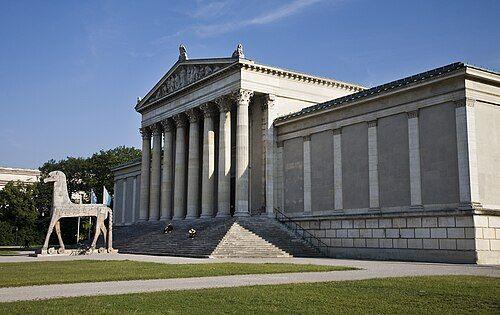
Trivia Question Study Fact: The Staatliche Antikensammlungen in Munich houses Bavaria's collections of antiquities from Ancient Greece, Etruria, and Rome. However, the sculpture collection is situated in the Glyptothek, a building directly across from the Staatliche Antikensammlungen, while artifacts originating from Bavaria are exhibited in a distinct museum.
Trivia Question Explanation: The Staatliche Antikensammlungen maintains a partnership with the Glyptothek, with the latter serving as the primary location for the museum's sculpture collections, despite being a separate building.
Return to Question
Study Hint 3
Question: In the context of Alcaeus of Mytilene, the scholars of Hellenistic Alexandria are best known for their role in establishing what important aspect of classical literature?
Trivia Question Study Fact: Alcaeus of Mytilene, a lyric poet from Lesbos active around 600 BC, was recognized as one of the nine lyric poets included in the canonical list established by scholars in Hellenistic Alexandria, a center for collecting and preserving ancient works, including those that would eventually be housed in institutions like the Staatliche Antikensammlungen.
Trivia Question Explanation: During the Hellenistic period, scholars in Alexandria compiled a list of nine lyric poets considered the most important, and Alcaeus of Mytilene was included among them, solidifying his place in literary history.
Return to Question
Study Hint 4
Question: In the context of the Greek underworld, the evolution of beliefs regarding the deceased shifted from an initial concept of a uniform afterlife to what later development?
Trivia Question Study Fact: Within Greek mythology, the underworld, or Hades, represents a distinct realm separate from the world of the living and Mount Olympus, characterized by perpetual darkness and invisibility. Initially, all souls existed in a shadowy, undifferentiated state after death, but later beliefs introduced the concept of post-mortem judgment, leading to a separation of the virtuous and the wicked within this realm.
Trivia Question Explanation: Early Greek mythology depicted all souls leading a shadowy existence in the underworld, but later traditions, influenced by philosophical thought, introduced the idea that good and bad individuals would be separated and treated differently after death.
Return to Question
Study Hint 5
Question: In the context of black-figure pottery, the Staatliche Antikensammlungen would likely house examples originating from which of the following key production centers?
Trivia Question Study Fact: The Staatliche Antikensammlungen, housing a significant collection of ancient Greek pottery, would include examples of black-figure pottery, a style characterized by silhouettes painted onto vases and prevalent between the 7th and 5th centuries BC. This style originated in centers like Corinth and Athens, and its popularity extended to the Etruscans, who both imported and produced their own versions inspired by Greek models.
Trivia Question Explanation: Black-figure pottery initially flourished in the Greek city of Corinth before becoming a major style in Athens, and these cities were principal centers for its production and distribution.
Return to Question
Study Hint 6
Question: In the context of Alcaeus, the Staatliche Antikensammlungen would be most interested in his inclusion within which historical grouping?
Trivia Question Study Fact: Alcaeus, a lyric poet from Lesbos active around 600 BC, gained recognition as one of the nine lyric poets included in the canonical list established by scholars in Hellenistic Alexandria. This selection signified his importance in the preservation and study of ancient Greek poetry within the collections of the Staatliche Antikensammlungen and similar institutions.
Trivia Question Explanation: Alcaeus was specifically recognized by Hellenistic scholars in Alexandria as one of the nine most important lyric poets, making his inclusion in that list a key aspect of his legacy and a point of interest for collections like the Staatliche Antikensammlungen focused on classical antiquity.
Return to Question
Study Hint 7
Question: In the context of the Belly Amphora by the Andokides Painter, the Staatliche Antikensammlungen utilizes this artifact primarily to demonstrate…
Trivia Question Study Fact: The Belly Amphora, housed within the Staatliche Antikensammlungen in Munich, is a significant example of a bilingual vase, showcasing both black-figure and red-figure pottery techniques. Its rarity stems from its depiction of the same subject matter using both styles, making it a crucial artifact for understanding the stylistic transition in ancient Greek pottery.
Trivia Question Explanation: The Belly Amphora is considered a rare and important archaeological source because it uniquely presents the same scene in both black-figure and red-figure styles, allowing for a direct comparison of the techniques and illustrating the transition between them.
Return to Question
Study Hint 8
Question: In the context of Gorgons, the Staatliche Antikensammlungen might display artifacts illustrating which aspect of their mythological significance?
Trivia Question Study Fact: Within Greek mythology, the Gorgons – Stheno, Euryale, and Medusa – were monstrous sisters known for their ability to turn onlookers to stone. While Euryale and Stheno possessed immortality, Medusa was mortal and ultimately defeated by Perseus. Depictions of the Gorgon head, particularly on Athena’s aegis, symbolized both protection and intimidation.
Trivia Question Explanation: The Gorgoneion, a representation of the Gorgon head, was frequently depicted on the aegis, Athena’s shield, serving as a potent symbol of both defense and the instilling of fear in enemies, making it a common subject in ancient art collections.
Return to Question
Study Hint 9
Question: In the context of Gorgons, the Staatliche Antikensammlungen would likely house artifacts displaying these creatures primarily because they functioned as…
Trivia Question Study Fact: Within the Staatliche Antikensammlungen, depictions of Gorgons, particularly Medusa, frequently appear on ancient artifacts due to their potent symbolism. The image of a Gorgon head, as seen on Athena’s aegis, served not only as a protective emblem but also as a terrifying symbol intended to demoralize opponents, making it a popular motif in ancient Greek art and warfare.
Trivia Question Explanation: Gorgon heads, especially Medusa’s, were prominently featured on objects like Athena’s aegis to inspire fear in enemies and provide protection, making them significant symbols in ancient Greek art and warfare, and thus valuable pieces for a collection like the Staatliche Antikensammlungen.
Return to Question