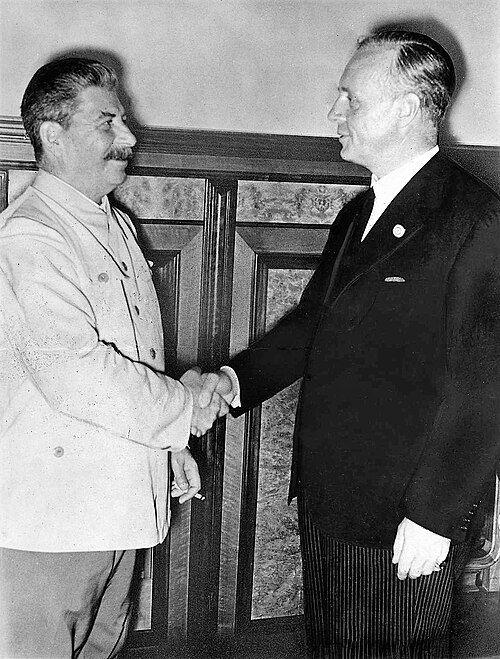
Materials covered in this trivia questions quiz
Study Hint 1
Question: In the context of World War II, the Molotov–Ribbentrop Pact is most significantly remembered for enabling what immediate geopolitical outcome?
Trivia Question Study Fact: The Molotov–Ribbentrop Pact, signed between Nazi Germany and the Soviet Union in 1939, was a non-aggression agreement that included a secret protocol dividing Eastern Europe into spheres of influence. This pact facilitated Germany's invasion of Poland, which initiated World War II, as it ensured Soviet neutrality during the initial stages of the conflict and allowed for the partitioning of Poland between the two powers.
Trivia Question Explanation: The Molotov–Ribbentrop Pact contained a secret protocol that divided Eastern Europe, including Poland, into spheres of influence, allowing Germany to invade Poland without fear of Soviet intervention and subsequently partition the country with the Soviet Union.
Return to Question
Study Hint 2
Question: In the context of Moldova, the Molotov–Ribbentrop Pact is considered a pivotal event primarily because it resulted in what significant territorial change?
Trivia Question Study Fact: The Molotov–Ribbentrop Pact, a non-aggression agreement between Nazi Germany and the Soviet Union, directly influenced the geopolitical landscape of Moldova. As a consequence of the pact, Romania was forced to cede Bessarabia and Northern Bukovina to the Soviet Union in 1940, which subsequently led to the establishment of the Moldavian Soviet Socialist Republic.
Trivia Question Explanation: The source text explicitly states that the Molotov–Ribbentrop Pact led to Romania ceding Bessarabia and Northern Bukovina to the Soviet Union, which then resulted in the creation of the Moldavian Soviet Socialist Republic. This territorial shift was a direct consequence of the agreement.
Return to Question
Study Hint 3
Question: In the context of Nazi Germany, the Molotov–Ribbentrop Pact is considered a key element in enabling what immediate geopolitical outcome?
Trivia Question Study Fact: Nazi Germany, under Adolf Hitler, pursued a strategy of aggressive expansion in the late 1930s, culminating in the invasion of Poland in 1939. Prior to this invasion, Germany strategically signed a non-aggression pact with the Soviet Union – the Molotov–Ribbentrop Pact – which temporarily ensured Germany could focus its military efforts on Western Europe without fear of Soviet intervention.
Trivia Question Explanation: The Molotov–Ribbentrop Pact removed the threat of Soviet intervention, allowing Germany to concentrate its forces on invading Poland in 1939, which is widely recognized as the start of World War II in Europe.
Return to Question
Study Hint 4
Question: In the context of the Allies of World War II, the Molotov–Ribbentrop Pact initially characterized the Soviet Union’s relationship with which opposing force?
Trivia Question Study Fact: Initially, the alliance that would become known as the Allies during World War II consisted of the United Kingdom, France, and Poland. However, the Soviet Union was not among the original members, as it had a nonaggression pact with Germany – the Molotov–Ribbentrop Pact – and even participated in the invasion of Poland alongside Germany before later joining the Allied cause after being invaded by Germany in 1941.
Trivia Question Explanation: The Molotov–Ribbentrop Pact was a nonaggression agreement between the Soviet Union and Germany, allowing them to initially cooperate in events like the invasion of Poland before the Soviet Union joined the Allies after Germany’s invasion of Soviet territory.
Return to Question
Study Hint 5
Question: In the context of the Invasion of Poland, the Molotov–Ribbentrop Pact is considered a key factor in which of the following outcomes?
Trivia Question Study Fact: The invasion of Poland, initiating World War II, commenced just one week after the signing of the Molotov-Ribbentrop Pact between Nazi Germany and the Soviet Union. This pact, while ostensibly a non-aggression agreement, secretly contained provisions for partitioning Poland between the two powers, ultimately leading to a coordinated attack and the country's subsequent division.
Trivia Question Explanation: The Molotov-Ribbentrop Pact included secret protocols dividing Eastern Europe, specifically Poland, into spheres of influence between Nazi Germany and the Soviet Union, enabling their coordinated invasion and subsequent annexation of Polish territory.
Return to Question
Study Hint 6
Question: In the context of the Soviet Union, the Molotov–Ribbentrop Pact is considered a demonstration of what strategic approach prior to World War II?
Trivia Question Study Fact: Despite initial attempts to forge alliances against expansionist policies in Europe, the Soviet Union, under Stalin, strategically shifted its foreign policy in 1939 by signing a non-aggression pact with Nazi Germany, a move that temporarily averted conflict between the two nations and had significant geopolitical consequences.
Trivia Question Explanation: The Molotov-Ribbentrop Pact represented a calculated decision by Stalin to avoid immediate conflict with Germany, allowing the Soviet Union to consolidate its position and prepare for potential future hostilities while also gaining territorial concessions.
Return to Question
Study Hint 7
Question: In the context of the Molotov–Ribbentrop Pact, the secret protocol primarily focused on establishing what across Eastern Europe?
Trivia Question Study Fact: The Molotov–Ribbentrop Pact, beyond being a non-aggression agreement between Nazi Germany and the Soviet Union, included a secret protocol that delineated spheres of influence in Eastern Europe. This protocol specifically partitioned Poland and assigned territories like Latvia, Estonia, and Finland to Soviet control, while Lithuania (with some caveats) fell within the German sphere of influence.
Trivia Question Explanation: The Molotov–Ribbentrop Pact’s secret protocol outlined the division of Eastern Europe into areas of German and Soviet influence, specifically allocating territories like Poland, Latvia, and Estonia to either side.
Return to Question
Study Hint 8
Question: In the context of the Occupation of the Baltic states, the Molotov–Ribbentrop Pact is considered a key factor in what event?
Trivia Question Study Fact: The Molotov–Ribbentrop Pact, signed in August 1939, created a context in which the Soviet Union invaded and occupied the Baltic states – Estonia, Latvia, and Lithuania – in June 1940. This occupation led to the annexation of these independent nations as constituent republics of the Soviet Union, a move largely unrecognized by Western countries.
Trivia Question Explanation: The Molotov–Ribbentrop Pact, a non-aggression agreement between the Soviet Union and Nazi Germany, paved the way for the Soviet Union to act without intervention, ultimately leading to the invasion and occupation of the Baltic states in June 1940.
Return to Question
Study Hint 9
Question: In the context of the Winter War, the Molotov–Ribbentrop Pact is considered by some historians as evidence of what Soviet ambition?
Trivia Question Study Fact: The Soviet Union initiated the Winter War with Finland in November 1939, just months after enacting the Molotov–Ribbentrop Pact with Nazi Germany. While the pact was ostensibly a non-aggression treaty, some historians believe the agreement’s secret protocols indicated a Soviet intention to expand its territory, potentially including the complete conquest of Finland, which would have secured Leningrad from potential threats.
Trivia Question Explanation: The establishment of a puppet Finnish Communist government and the secret protocols within the Molotov–Ribbentrop Pact are cited by some as indications that the Soviet Union intended to conquer all of Finland, primarily to protect the city of Leningrad.
Return to Question
Study Hint 10
Question: In the context of the Soviet occupation of Bessarabia and Northern Bukovina, the Molotov–Ribbentrop Pact is considered to have been complicated by…
Trivia Question Study Fact: Following the signing of the Molotov–Ribbentrop Pact, the Soviet Union occupied Bessarabia and Northern Bukovina in June-July 1940 after issuing an ultimatum to Romania, capitalizing on France's fall to Nazi Germany and a lack of support from Germany despite prior acknowledgement of Soviet interests in the region. This action, while initially appearing to adhere to the pact through Romanian consent, ultimately violated its terms by exceeding the agreed-upon Soviet sphere of influence.
Trivia Question Explanation: The occupation of Bukovina, and later the Danube islands, extended beyond the Soviet sphere of influence as defined in the secret protocols of the Molotov–Ribbentrop Pact, representing a violation of the agreement despite initial appearances of compliance through Romanian consent.
Return to Question