Materials covered in this trivia questions quiz
Study Hint 1
Question: In the context of Copper Age state societies, Proto-Minoan Crete is significant because it represents…
Trivia Question Study Fact: The Chalcolithic, or Copper Age, represents a transitional period in prehistory during which the earliest evidence of state societies emerges archaeologically. These early states developed independently in several regions, including Sumer, Predynastic Egypt, and Proto-Minoan Crete, indicating a widespread societal shift around the mid-5th to late 4th/3rd millennium BC.
Trivia Question Explanation: Archaeological findings indicate that Proto-Minoan Crete, alongside Sumer and Predynastic Egypt, exhibited characteristics of early state societies during the Chalcolithic period, marking a significant step in societal complexity.
Return to Question
Study Hint 2
Question: In the context of Cycladic culture, Minoan chronology is considered…
Trivia Question Study Fact: The Cycladic culture, flourishing in the Aegean Sea from approximately 3100 to 1000 BC, existed during a period roughly contemporary with both the Helladic chronology of mainland Greece and the Minoan chronology of Crete, providing a relative dating system for artifacts across these regions.
Trivia Question Explanation: Cycladic, Helladic, and Minoan chronologies all represent relative dating systems used for artifacts from roughly the same timeframe, allowing archaeologists to understand the relationships between these cultures.
Return to Question
Study Hint 3
Question: In the context of lustral basins, Minoan chronology indicates these structures are most commonly found associated with which period?
Trivia Question Study Fact: Lustral basins, a distinctive architectural feature of Minoan civilization, are particularly associated with the Neopalatial period, spanning roughly from 1750 to 1470 BC. These basins, found in elite structures, suggest a heightened focus on ritual practices or personal hygiene during this era of Minoan chronology.
Trivia Question Explanation: Lustral basins are a characteristic feature of elite architecture from the Neopalatial period (c. 1750-1470 BC) within Minoan civilization, indicating their prominence during this specific timeframe.
Return to Question
Study Hint 4
Question: In the context of Kamares ware, Minoan chronology is considered to span which timeframe for the production of this pottery style?
Trivia Question Study Fact: Kamares ware, a prestige style of Minoan pottery characterized by its light-on-dark decoration, emerged during the Middle Minoan IA period around 2100 BCE and continued to be produced until the Late Minoan IA period around 1450 BCE, demonstrating its longevity throughout significant phases of Minoan chronology.
Trivia Question Explanation: Kamares ware first appeared during the Middle Minoan IA period around 2100 BCE and continued to be produced until the Late Minoan IA period around 1450 BCE, indicating this timeframe encompasses its entire production history.
Return to Question
Study Hint 5
Question: In the context of Minoan pottery, Minoan chronology is considered particularly well-defined by the stylistic evolution and distribution of which pottery types?
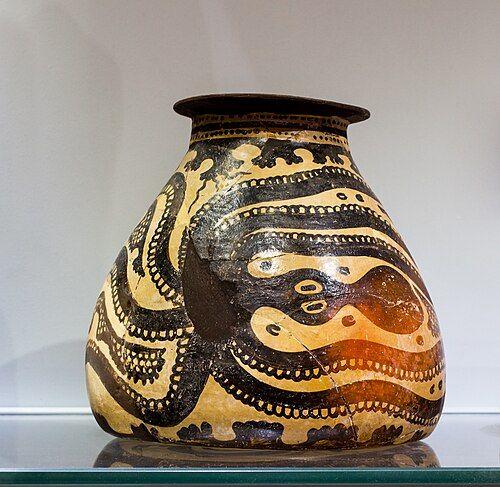
Trivia Question Study Fact: Minoan pottery, particularly Kamares ware from the Middle Minoan period and the Marine and Floral Styles of the Late Minoan period, served as a significant chronological marker for archaeologists studying Minoan civilization. The evolving styles of this pottery, along with its widespread distribution through trade, helped establish relative dating for archaeological strata across the Aegean and beyond.
Trivia Question Explanation: Kamares ware, prominent during the Middle Minoan period, and the Marine and Floral Styles of the Late Minoan period represent distinct artistic phases in Minoan pottery, and their presence in archaeological layers provides a reliable method for establishing relative dates within Minoan chronology.
Return to Question
Study Hint 6
Question: In the context of the Bull-Leaping Fresco, Minoan chronology is considered to be demonstrably advanced beyond earlier periods due to…
Trivia Question Study Fact: The Bull-Leaping Frescoes from the palace of Knossos provide insight into Minoan chronology due to their sophisticated polychrome palette. The use of white, pale red, dark red, blue, and black pigments indicates that these frescoes were created during the mature art period, specifically no earlier than Middle Minoan III (MM III), excluding the earlier Early Minoan (EM) and early Middle Minoan (MM) periods.
Trivia Question Explanation: The presence of polychrome hues – white, pale red, dark red, blue, and black – in the Bull-Leaping Frescoes excludes their creation during the Early Minoan and early Middle Minoan periods, placing them within the more developed Middle Minoan III phase of Minoan art.
Return to Question
Study Hint 7
Question: In the context of Cycladic civilization, Minoan chronology is considered…
Trivia Question Study Fact: The Cycladic civilization, flourishing in the Aegean Sea from approximately 3100 to 1000 BC, existed during a period roughly contemporary with both the Helladic chronology of mainland Greece and the Minoan chronology of Crete, allowing archaeologists to establish relative dating systems for artifacts across these regions.
Trivia Question Explanation: Archaeological dating systems, like those used for the Cyclades, Hellas, and Crete, were developed to understand the relative timelines of these cultures during the Bronze Age, allowing for comparisons of artifacts and developments.
Return to Question
Study Hint 8
Question: In the context of Early Helladic chronology, how do the chronological schemes of Minoan and Cycladic cultures relate to its purpose?
Trivia Question Study Fact: Both Helladic and Cycladic chronologies were developed as counterparts to the Minoan chronology system, created by Arthur Evans to categorize Bronze Age artifacts. While Minoan chronology focuses on Crete, Helladic chronology applies to mainland Greece, and Cycladic chronology to the Aegean islands. These systems, though geographically distinct, are chronologically aligned due to evidence of simultaneous civilization development across the Aegean region.
Trivia Question Explanation: The Helladic, Minoan, and Cycladic systems were all created to categorize Bronze Age artifacts, each focusing on a different geographical area – mainland Greece, Crete, and the Aegean islands, respectively – but aligning chronologically due to shared cultural development.
Return to Question