Materials covered in this trivia questions quiz
Study Hint 1
Question: In the context of Scholasticism, how did the rediscovery of Aristotle’s works primarily impact intellectual life in Italy during the Middle Ages?
Trivia Question Study Fact: During the Middle Ages, Scholasticism—a dominant philosophical approach in Europe from roughly 1100 to 1700—actively sought to integrate the logical structures of Aristotelianism and the Ten Categories with Catholic Christian theology, particularly within monastic schools that were foundational to the development of universities in places like Italy. This synthesis facilitated the translation and study of Judeo-Islamic philosophies and the rediscovered works of Aristotle.
Trivia Question Explanation: Scholasticism specifically aimed to harmonize Aristotle’s metaphysics with Latin Catholic theology, utilizing his logical systems to understand and support Christian beliefs, and this process was central to the intellectual environment of medieval Italy.
Return to Question
Study Hint 2
Question: In the context of the Republic of Florence, Italy in the Middle Ages is considered significant primarily for what development?
Trivia Question Study Fact: Following Matilda of Tuscany's death in 1115, the people of Florence rebelled against her successors, establishing a commune that evolved into the Republic of Florence. This republic was governed by a council called the Signoria of Florence, whose titular leader, the gonfaloniere, was elected every two months by members of Florentine guilds.
Trivia Question Explanation: The Republic of Florence played a crucial role in the emergence of the Renaissance, a transformative era characterized by a renewed interest in classical art, literature, and philosophy, marking a significant shift in European culture and intellectual thought.
Return to Question
Study Hint 3
Question: In the context of Italy in the Middle Ages, what development signaled a shift towards greater regional autonomy and diminished influence from the Eastern Roman Empire?
Trivia Question Study Fact: Following the collapse of the Western Roman Empire, Italy experienced a period of transition marked by the lingering influence of the Ostrogothic Kingdom and the Byzantine Empire. However, as the Byzantine Empire weakened due to Muslim conquests, regions like the Exarchate of Ravenna gradually lost imperial oversight, leading to the emergence of de facto independent states such as the Duchy of Naples.
Trivia Question Explanation: As the Byzantine Empire faced pressure from Muslim conquests, its ability to exert control over regions within Italy diminished. This allowed former territories, like the Duchy of Naples, to operate with increasing independence, marking a significant change in the political landscape of Italy during the Middle Ages.
Return to Question
Study Hint 4
Question: In the context of maritime republics, Italy in the Middle Ages is considered to have played a vital role in…
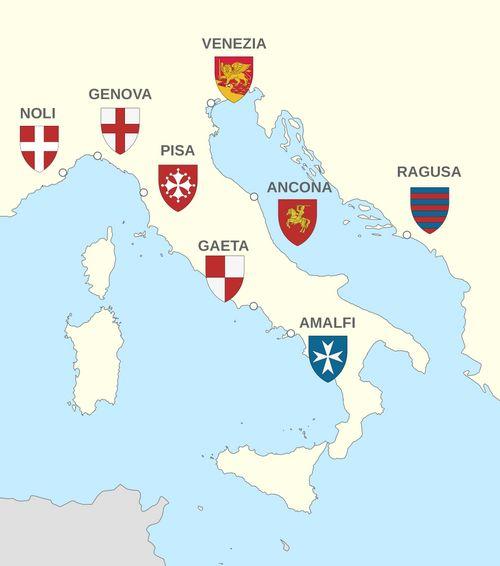
Trivia Question Study Fact: During the Middle Ages, Italy's maritime republics – Amalfi, Genoa, Pisa, and Venice, among others – weren't just centers of trade and naval power, but also crucial conduits for the exchange of goods, artistic concepts, and information between Europe, Asia, and Africa, effectively revitalizing connections disrupted after the fall of the Roman Empire.
Trivia Question Explanation: The maritime republics built fleets to protect trade and connect distant regions, facilitating the flow of goods, ideas, and news across the Mediterranean after a period of limited contact.
Return to Question
Study Hint 5
Question: In the context of Medieval communes, Italy in the Middle Ages distinguished itself from regions like Germany primarily through the development of what type of political entity?
Trivia Question Study Fact: During the 11th and 12th centuries, Italy experienced a significant rise in medieval communes, which evolved into city-states characterized by a degree of democratic governance. This development distinguished Italy from other regions like Germany, where communes manifested as free cities independent from nobility, reflecting diverse organizational structures across Europe.
Trivia Question Explanation: Italian communes uniquely developed into city-states with elements of democratic governance, allowing citizens a degree of self-rule, while German communes primarily became free cities independent of noble authority.
Return to Question
Study Hint 6
Question: In the context of Gonfaloniere positions in Italy during the Middle Ages, what was a key development that broadened the office’s responsibilities beyond military leadership?
Trivia Question Study Fact: During the medieval and Renaissance periods in Italy, the position of Gonfaloniere emerged as a significant communal office, particularly in cities like Florence and within the Papal States. Originally responsible for leading the militia, the role evolved to include protecting the interests of the populace through the creation of the Gonfaloniere of Justice, and both positions became integral to the governing bodies, such as Florence’s Signoria.
Trivia Question Explanation: The office of Gonfaloniere of Justice was specifically established to safeguard the interests of the citizenry, complementing the original military function of the Gonfaloniere and integrating both roles into the city’s governance.
Return to Question
Study Hint 7
Question: In the context of Scholastic philosophy, Italy in the Middle Ages is considered a key location for the development of…
Trivia Question Study Fact: During the Middle Ages, Scholasticism—a dominant philosophical approach in Europe from roughly 1100 to 1700—actively sought to integrate the logical structures of Aristotelianism with the tenets of Catholic Christianity, particularly within the emerging monastic schools and early universities. This intellectual movement flourished across Europe, including Italy, and laid foundational groundwork for the development of modern science and Western philosophy.
Trivia Question Explanation: Scholasticism’s emphasis on harmonizing Aristotelian logic and Catholic theology led to the establishment of monastic schools which evolved into the first European universities, and these schools notably flourished in Italy alongside France, Spain, Portugal, and England.
Return to Question
Study Hint 8
Question: In the context of the Florentine Republic, the initial shift in governance following the death of Matilda of Tuscany and the subsequent rebellion resulted in the establishment of what governing body?
Trivia Question Study Fact: The Florentine Republic emerged in 1115 following a revolt against the Margraviate of Tuscany after the death of Matilda of Tuscany, establishing a communal government structure where power was initially vested in a council called the Signoria of Florence, with a titular ruler, the gonfaloniere, elected every two months by guild members.
Trivia Question Explanation: After Matilda of Tuscany’s death, Florence transitioned from being controlled by the Margraviate of Tuscany to a self-governed commune, with a council known as the Signoria of Florence taking on the responsibility of ruling the city.
Return to Question