Đàng Trong in the context of "Cochinchina"

Play Trivia Questions online!

or

Skip to study material about Đàng Trong in the context of "Cochinchina"

Ad spacer

⭐ Core Definition: Đàng Trong

Đàng Trong (chữ Nôm: 唐冲, lit. "Inner Circuit"), also known as Nam Hà (chữ Hán: 南河, "South of the River"), was the region of Vietnam south of the Gianh River, under the lordship of the Nguyễn clan, and later expanded through Vietnamese southward expansion. It was bordered to the north by Đàng Ngoài, ruled by the Lê–Trịnh.

Throughout the 17th century and most of the 18th century, the Nguyễn lords, though claiming loyalty to the Lê emperors in Thăng Long (Hanoi), ruled Đàng Trong as a de facto independent kingdom. Nguyễn rulers titled themselves as Chúa (chữ Nôm: 主, lit. "Lord") instead of Vua (chữ Nôm: 𤤰, lit. "King") until Lord Nguyễn Phúc Khoát officially claimed the title Vũ Vương (chữ Nôm: 武王, lit. "Martial King") in 1744.
↓ Menu

>>>PUT SHARE BUTTONS HERE<<<

👉 Đàng Trong in the context of Cochinchina

Cochinchina or Cochin-China (/ˌkɪnˈnə/, UK also /ˌkɒ-/; Vietnamese: Đàng Trong (17th–18th centuries), Việt Nam (1802–1831), Đại Nam (1831–1862), Nam Kỳ (1862–1945); Khmer: កូសាំងស៊ីន, romanizedKosăngsin; French: Cochinchine; Chinese: 交趾支那; pinyin: Jiāozhǐ zhīnà) is a historical exonym for part of Vietnam, depending on the contexts, usually for Southern Vietnam. Sometimes it referred to the whole of Vietnam, but it was commonly used to refer to the region south of the Gianh River.

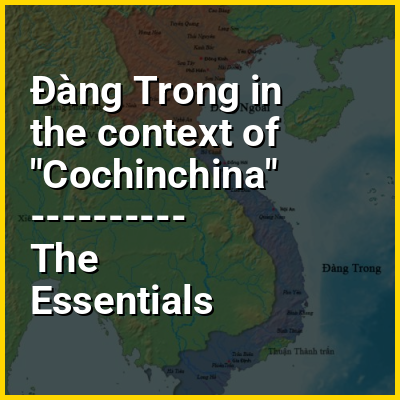
In the 17th and 18th centuries, Vietnam was divided between the Trịnh lords to the north and the Nguyễn lords to the south. The two domains bordered each other on the Son River. The northern section was called Tonkin by Europeans, and the southern part, Đàng Trong, was called Cochinchina by most Europeans and Quinam by the Dutch.

↓ Explore More Topics
In this Dossier

Đàng Trong in the context of Vietnam

Vietnam, officially the Socialist Republic of Vietnam (SRV), is a country at the eastern edge of Mainland Southeast Asia. With an area of about 331,000 square kilometres (128,000 sq mi) and a population of over 100 million, it is the world's 15th-most populous country. One of two communist states in Southeast Asia, Vietnam is bordered by China to the north, Laos and Cambodia to the west, the Gulf of Thailand to the southwest, and the South China Sea to the east; it also shares maritime borders with Thailand, Malaysia, and Indonesia to the south and southwest, the Philippines to the east, and China to the northeast. Its capital is Hanoi, while its largest city is Ho Chi Minh City.

Vietnam was inhabited by the Paleolithic age, with states established in the first millennium BC on the Red River Delta in modern-day northern Vietnam. The Han dynasty annexed northern and central Vietnam, which were subsequently under Chinese rule from 111 BC until the first dynasty emerged in 939. Successive monarchical dynasties absorbed Chinese influences through Confucianism and Buddhism, and expanded southward to the Mekong Delta, conquering Champa. During most of the 17th and 18th centuries, Vietnam was effectively divided into two domains of Đàng Trong and Đàng Ngoài. The Nguyễn—the last imperial dynasty—surrendered to France in 1883. In 1887, its territory was integrated into French Indochina as three separate regions. In the immediate aftermath of World War II, the Viet Minh, a coalition front led by the communist revolutionary Ho Chi Minh, launched the August Revolution and declared Vietnam's independence from the Empire of Japan in 1945.

↑ Return to Menu

Đàng Trong in the context of Nguyễn lords

The Nguyễn lords (Vietnamese: Chúa Nguyễn, 主阮; 1558–1777, 1780–1802), also known as the Nguyễn clan (Vietnamese: Nguyễn thị; chữ Hán: 阮氏), were Nguyễn dynasty's forerunner and a feudal noble clan ruling southern Đại Việt in the Revival Lê dynasty. The Nguyễn lords were members of the House of Nguyễn Phúc. The territory they ruled was known contemporarily as Đàng Trong (Inner Realm) and known by Europeans as the Kingdom of Cochinchina and as Kingdom of Quảng Nam (Vietnamese: Quảng Nam Quốc; chữ Hán: 廣南國) by Imperial China, in opposition to the Trịnh lords ruling northern Đại Việt as Đàng Ngoài (Outer Realm), known as the "Kingdom of Tonkin" by Europeans and "Kingdom of Annam" (Vietnamese: An Nam Quốc; chữ Hán: 安南國) by Imperial China in bilateral diplomacy. They were officially entitled, in Sino-Vietnamese, the Nguyễn Vương (chữ Hán: 阮王) in 1744 when lord Nguyễn Phúc Khoát self-proclaimed himself to elevate his status equally to Trịnh lords's title known as the Trịnh Vương (Vietnamese: Trịnh Vương; chữ Hán: 鄭王). Both Nguyễn and Trịnh clans were de jure subordinates and fief of the Lê dynasty. However, the de jure submission of the Nguyễn lords to the Trịnh lords ended in 1627 sparked the war between them.

While they recognized the authority of and claimed to be loyal subjects of the revival Lê dynasty, they were de facto rulers of southern Đại Việt. Meanwhile, the Trịnh lords ruled northern Đại Việt in the name of the Lê emperor, who was in reality a puppet ruler. They fought a series of long and bitter wars that pitted the two halves of Vietnam against each other. The Nguyễn were finally overthrown in the Tây Sơn wars, but one of their descendants would eventually come to unite all of Vietnam. Their rule consolidated earlier southward expansion into Champa and pushed southwest into Cambodia.

↑ Return to Menu

Đàng Trong in the context of Gia Long

Gia Long (Chữ hán: 嘉隆) (Vietnamese: [zaː lawŋ] (North), [jaː lawŋ] (South); 8 February 1762 – 3 February 1820), born Nguyễn Phúc Ánh (阮福暎) or Nguyễn Ánh (阮暎), was the founding emperor of the Nguyễn dynasty, the last dynasty of Vietnam, which would rule the unified territories that constitute modern-day Vietnam until 1945.

A nephew of the last Nguyễn lord who ruled over south Vietnam, Nguyễn Ánh was forced into hiding in 1777 as a 15-year-old when his family was slain in the Tây Sơn revolt. After several changes of fortune in which his loyalists regained and again lost Saigon, he befriended the French Catholic Bishop Pierre Pigneau de Behaine. Pigneau championed Nguyễn Ánh's cause to regain the throne to the French government and managed to recruit volunteers however, that soon encountered difficulties. From 1789, Nguyễn Ánh was once again in the ascendancy and began his northward march to defeat the Tây Sơn, reaching the border with the Qing dynasty by 1802, which had previously been under the control of the Trịnh lords. Following their defeat, he succeeded in reuniting Vietnam after centuries of internecine feudal warfare, with a greater landmass than ever before, stretching from the Qing's borders down to the Gulf of Siam.

↑ Return to Menu

Đàng Trong in the context of Đàng Ngoài

Đàng Ngoài (chữ Hán: 唐外, lit. "Outer Land"), also known as Bắc Hà (北河, "North of the River") or Kingdom of Annam (安南國) by foreigners, was an area in northern Đại Việt (now Vietnam) during the 17th and 18th centuries as the result of Trịnh–Nguyễn War. The name Đàng Ngoài was first recorded in the Dictionarium Annamiticum Lusitanum et Latinum by Alexandre de Rhodes.

Đàng Ngoài was de facto ruled by the Trịnh lords with the Lê emperors acting as titular rulers. The capital was Thăng Long (now Hanoi). Thăng Long was also known as Đông Kinh 東京, meaning "Eastern Capital", from which the common European name for Đàng Ngoài "Tonkin" originated. It was bordered by Đàng Trong (under the Nguyễn lords) along the Gianh River in Quảng Bình province. The names gradually fell into disuse after Nguyễn Ánh reunified Đại Việt.

↑ Return to Menu

Đàng Trong in the context of Southern Vietnam

Southern Vietnam (Vietnamese: Nam Bộ) is one of the three geographical regions of Vietnam, the other two being Northern and Central Vietnam. It includes 2 administrative subregions, which in turn are divided into 19 First Tier units, of which 17 are provinces and 2 are municipalities.

Known as Nam Bộ today in Vietnamese, it was historically called Gia Định (1779–1832), Nam Kỳ (1832–1945, during Nguyễn's Lục tỉnh and French Cochinchina), Nam Bộ (1945 to the present, encompassing the Empire of Vietnam and the Democratic Republic of Vietnam), and Nam Phần, sometimes Nam Việt (1948–1975, during the State of Vietnam and the Republic of Vietnam). Cochinchina is a historical exonym for this region during the colonial period, which referred to the entire domain of Đàng Trong in the feudal period. A more accurate term for the southern region is Lower Cochinchina, or Basse-Cochinchine in French.

↑ Return to Menu