Zimmermann telegram in the context of "American entry into World War I"

Play Trivia Questions online!

or

Skip to study material about Zimmermann telegram in the context of "American entry into World War I"

Ad spacer

⭐ Core Definition: Zimmermann telegram

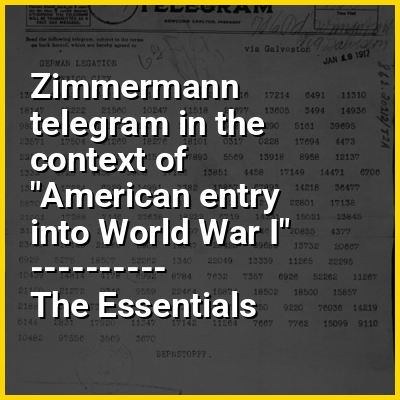
The Zimmermann telegram (or Zimmermann note or Zimmermann cable) was a secret diplomatic communication issued from the German Foreign Office on January 17, 1917, that proposed a military contract between the German Empire and Mexico if the United States entered World War I against Germany. With Germany's aid, Mexico would recover Texas, Arizona, and New Mexico. The telegram was intercepted by British intelligence.

Revelation of the contents enraged Americans, especially after German State Secretary for Foreign Affairs Arthur Zimmermann publicly admitted on March 3, 1917, that the telegram was genuine. It helped to generate support for the American declaration of war on Germany in April 1917.
↓ Menu

>>>PUT SHARE BUTTONS HERE<<<
In this Dossier

Zimmermann telegram in the context of Fourteen Points

The Fourteen Points was a statement of principles for peace that was to be used for peace negotiations in order to end World War I. The principles were outlined in a January 8, 1918 speech on war aims and peace terms to the United States Congress by President Woodrow Wilson. However, his main Allied colleagues (Georges Clemenceau of France, David Lloyd George of the United Kingdom, and Vittorio Emanuele Orlando of Italy) were skeptical of the applicability of Wilsonian idealism.

The United States had joined the Triple Entente in fighting the Central Powers on April 6, 1917. Its entry into the war had in part been due to Germany's resumption of submarine warfare against merchant ships trading with France and Britain and also the interception of the Zimmermann telegram. However, Wilson wanted to avoid the United States' involvement in the long-standing European tensions between the great powers; if America was going to fight, he wanted to try to separate that participation in the war from nationalistic disputes or ambitions. The need for moral aims was made more important when, after the fall of the Russian government, the Bolsheviks disclosed secret treaties made between the Allies. Wilson's speech also responded to Vladimir Lenin's Decree on Peace of November 1917, immediately after the October Revolution in 1917.

↑ Return to Menu

Zimmermann telegram in the context of Diplomatic cable

A diplomatic cable, also known as a diplomatic telegram (DipTel) or embassy cable, is a confidential text-based message exchanged between a diplomatic mission, like an embassy or a consulate, and the foreign ministry of its parent country. A diplomatic cable is a type of dispatch. Other dispatches may be sent as physical documents in a diplomatic bag.

The term cable derives from the time when the medium for such communications was telegraphs travelling along international submarine communications cables, though over time they have progressed into other formats and pathways. The term cablegram is also sometimes used. Due to the importance and sensitive nature of the subject matter, diplomatic cables are protected by the most elaborate security precautions to prevent unfettered access by the public or unauthorized interception by foreign governments. Generally digital in format, they are always encrypted, frequently by unbreakable one time pad ciphers using key material distributed using diplomatic couriers.

↑ Return to Menu