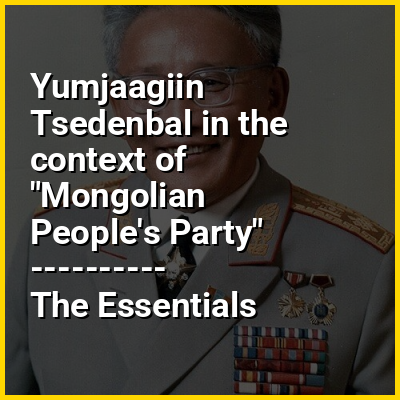
Yumjaagiin Tsedenbal (Mongolian: Юмжаагийн Цэдэнбал; 17 September 1916 – 20 April 1991) was a Mongolian military officer and politician who led the Mongolian People's Republic from 1952 to 1984. He served as General Secretary of the ruling Mongolian People's Revolutionary Party from 1940 to 1954 and again from 1958 to 1984, as Chairman of the Council of Ministers (head of government) from 1952 to 1974, and as Chairman of the Presidium of the People's Great Khural (head of state) from 1974 to 1984.
HINT:
In this Dossier
- ⭐ Core Definition: Yumjaagiin Tsedenbal
- Yumjaagiin Tsedenbal in the context of Joseph Stalin's cult of personality
- Yumjaagiin Tsedenbal in the context of Khorloogiin Choibalsan
Yumjaagiin Tsedenbal in the context of Joseph Stalin's cult of personality
Joseph Stalin's cult of personality became a prominent feature of Soviet popular culture. Historian Archie Brown sets the celebration of Stalin's 50th birthday on 21 December 1929 as the starting point for his cult of personality. For the rest of Stalin's rule, the Soviet propaganda presented Stalin as an all-powerful, all-knowing leader, with Stalin's name and image displayed all over the country.
View the full Wikipedia page for Joseph Stalin's cult of personalityYumjaagiin Tsedenbal in the context of Khorloogiin Choibalsan
Khorloogiin Choibalsan (8 February 1895 – 26 January 1952) was a Mongolian politician who served as the leader of the Mongolian People's Republic as the chairman of the Council of Ministers (premier) from 1939 until his death in 1952. He was also the commander-in-chief of the Mongolian People's Army from 1937, and the chairman of the Presidium of the State Little Khural (head of state) from 1929 to 1930. His rule was maintained by a repressive state and cult of personality. Choibalsan led a dictatorship and organized Stalinist purges in Mongolia between 1937 and 1939 as head of the Ministry of Internal Affairs.
Choibalsan was one of the 1921 Mongolian revolutionaries and held several political and military roles in the 1920s. Mongolia's economic, political, and military ties to the Soviet Union deepened, though after World War II, Choibalsan supported pan-Mongolian unification with Inner Mongolia. He died of cancer in Moscow in 1952 and was succeeded as leader by his protégé, Yumjaagiin Tsedenbal.
View the full Wikipedia page for Khorloogiin Choibalsan