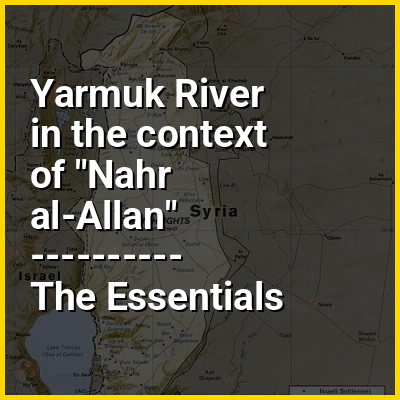
The Yarmuk River (Arabic: نهر اليرموك, romanized: Nahr al-Yarmūk, Hebrew: נְהַר הַיַּרְמוּךְ, romanized: Nəhar hayYarmūḵ; Greek: Ἱερομύκης, Hieromýkēs; Latin: Hieromyces or Heromicas; sometimes spelled Yarmouk) is the largest tributary of the Jordan River. It runs in Jordan, Syria and Israel, and drains much of the Hauran plateau. Its main tributaries are the wadis of 'Allan and Ruqqad from the north, Ehreir and Zeizun from the east. Although the Yarmuk is narrow and shallow throughout its course, at its mouth it is nearly as wide as the Jordan, measuring thirty feet in breadth and five in depth.
HINT:
In this Dossier
Yarmuk River in the context of Palaestina Secunda
Palaestina Secunda or Palaestina II was a province of the Byzantine Empire from 390, until its conquest by the Muslim armies in 634–636. Palaestina Secunda, a part of the Diocese of the East, roughly comprised inland Galilee, the Jezreel (Yizrael) Valley, Bet Shean Valley, and the corresponding area of Transjordan (parts of the former Decapolis, with the southern territories of the Golan plateau and the bishopric of Pella south of the Yarmuk River), with its capital in Scythopolis (Bet Shean). The province experienced the rise of Christianity under the Byzantines, but was also a thriving center of Judaism, after the Jews had been driven out of Judea by the Romans as a result of their 1st- and 2nd-century revolts.
View the full Wikipedia page for Palaestina Secunda