Windermere in the context of "List of lakes and lochs of the United Kingdom"

Play Trivia Questions online!

or

Skip to study material about Windermere in the context of "List of lakes and lochs of the United Kingdom"

Ad spacer

⭐ Core Definition: Windermere

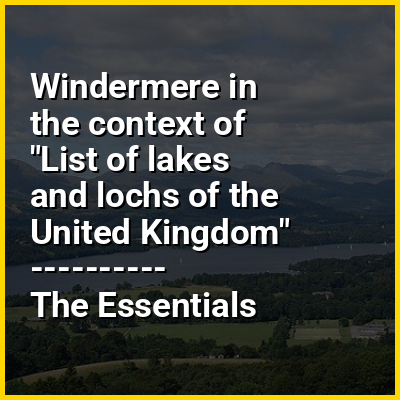
Windermere (historically Winder Mere) is a ribbon lake in Cumbria, England. It is within the Lake District and is the largest lake in England by length, area, and volume, although considerably smaller than the largest Scottish lochs and Northern Irish loughs.

Windermere is about 11 miles (18 km) in length and 1 mile (1.6 km) at its widest, has a maximum depth of 64 metres (210 ft), and has an elevation of 39 metres (128 ft) above sea level. Its outflow is the River Leven, which drains into Morecambe Bay. For administrative purposes the lake is in the unitary authority area of Westmorland and Furness, and it historically formed part of the boundary between Westmorland and Lancashire.
↓ Menu

>>>PUT SHARE BUTTONS HERE<<<
In this Dossier

Windermere in the context of Furness

Furness (/ˈfɜːrnɪs, fɜːrˈnɛs/ FUR-niss, fur-NESS) is a peninsula and region of Cumbria, England. Together with the Cartmel Peninsula it forms North Lonsdale, historically an exclave of Lancashire. On 1 April 2023 it became part of the new unitary authority of Westmorland and Furness.

The Furness Peninsula, also known as Low Furness, is an area of villages, agricultural land and low-lying moorland, with the industrial town of Barrow-in-Furness at its head. The peninsula is bordered by the estuaries of the River Duddon to the west and the River Leven in Morecambe Bay to the east. The wider region of Furness consists of the peninsula and the area known as High Furness, which is a relatively mountainous and sparsely populated part of England, extending inland into the Lake District and containing the Furness Fells. The inland boundary of the region is formed by the rivers Leven, Brathay and Duddon, and the lake of Windermere. Off the southern tip of Furness is Walney Island, 11 miles (18 kilometres) long, as well as several smaller islands.

↑ Return to Menu

Windermere in the context of Ribbon lake

A ribbon lake is a long and very deep, finger-shaped lake, usually found in a glacial trough. As such, a ribbon lake is one of a number of glacial landscapes, including arêtes, corries, rock lips, rock basins and terminal moraines.

Such a lake's formation begins when a glacier moves over an area containing alternate bands of hard and soft bedrock. The sharp-edged boulders that are picked up by the glacier and carried at the bottom of the glacier erode the softer rock more quickly by abrasion, thus creating a hollow called a rock basin. On either side of the rock basin, the more resistant rock is eroded less and these outcrops of harder rock are known as rock bars, which act as dams between which rainwater may accumulate after the retreat of the ice age, filling up the rock basin and creating a ribbon lake. A ribbon lake may also form behind a terminal or recessional moraine, both of which also act as dams, enabling water to accumulate behind them.

↑ Return to Menu

Windermere in the context of Lake District

The Lake District, also known as the Lakes or Lakeland, is a mountainous region and national park in Cumbria, North West England. It is famous for its landscape, including its lakes, coast, and mountains, and for its literary associations with Beatrix Potter, John Ruskin, Arthur Ransome, and the Lake Poets.

The Lakeland fells, or mountains, include England's highest: Scafell Pike (978 m; 3,209 ft), Helvellyn (950 m; 3,120 ft) and Skiddaw (931 m; 3,054 ft). The region also contains sixteen major lakes. They include Windermere, which with a length of 11 miles (18 km) and an area of 5.69 square miles (14.73 km) is the longest and largest lake in England, and Wast Water, which at 79 metres (259 ft) is the deepest lake in England.

↑ Return to Menu

Windermere in the context of Ambleside

Ambleside is a town in the civil parish of Lakes and the Westmorland and Furness district of Cumbria, England. Within the boundaries of the historic county of Westmorland and located in the Lake District National Park, the town sits at the head of Windermere, England's largest natural lake. In 2022 the built up area had an estimated population of 2,586.

↑ Return to Menu

Windermere in the context of River Leven, Cumbria

The River Leven (pron. /ˈlɛvən/ LEV-ən) is a short river in the ceremonial county of Cumbria, falling within the historic boundaries of Lancashire. It drains Windermere from its southernmost point and flows for approximately 8 miles (13 km) into the northern reaches of Morecambe Bay. The river and its estuary are the boundary between the Cartmel Peninsula and Furness Peninsula and is part of North Lonsdale, also known as Lancashire North of the Sands.

The upriver limit of tidal flow is close to the village of Haverthwaite. Also at this point is to be found Low Wood Bridge which, until the coming of the railways, was the first bridging point across the river. The Leven is navigable upstream as far as Low Wood, and downstream from Windermere to Newby Bridge.

↑ Return to Menu

Windermere in the context of River Winster

The River Winster is a river in the English county of Cumbria. The Winster was the boundary between the historic counties of Lancashire and Westmorland. It has a relatively small catchment area; other streams flow parallel to it on either side.

The Winster is about 20 km or 12 miles long, and rises about 2 km south of Bowness-on-Windermere, between the hamlets of Winster and Storrs (the latter is on Windermere) and follows a southerly course, flowing past the settlements of Ludderburn, Hartbarrow and Bowland Bridge, before it is joined by Arndale Beck at Bridge House.

↑ Return to Menu

Windermere in the context of Newby Bridge

Newby Bridge is a hamlet in the Lake District, Cumbria, England. Historically in Lancashire, it is located several miles west of Grange-over-Sands and is on the River Leven, close to the southern end of Windermere.

↑ Return to Menu