William II of the Netherlands in the context of "Grand Duke of Luxembourg"

Play Trivia Questions online!

or

Skip to study material about William II of the Netherlands in the context of "Grand Duke of Luxembourg"

Ad spacer

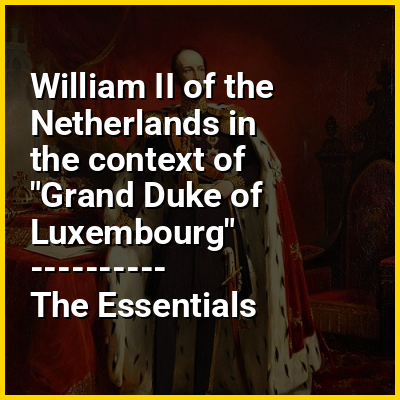
⭐ Core Definition: William II of the Netherlands

William II (Dutch: Willem II, French: Guillaume II; 6 December 1792 – 17 March 1849) was King of the Netherlands, Grand Duke of Luxembourg, and Duke of Limburg. He reigned for nearly nine years, making him the shortest-reigning monarch in Dutch history.

William II was the son of William I and Wilhelmine of Prussia. When his father, who up to that time ruled as sovereign prince, proclaimed himself king in 1815, he became Prince of Orange as heir apparent of the United Kingdom of the Netherlands. With the abdication of his father on 7 October 1840, William II became king. During his reign, the Netherlands became a parliamentary democracy with the new constitution of 1848. William II was married to Anna Pavlovna of Russia, with whom he had five children. William II was succeeded by his son William III.
↓ Menu

>>>PUT SHARE BUTTONS HERE<<<
In this Dossier

William II of the Netherlands in the context of Place Guillaume II

Place Guillaume II (French pronunciation: [plas ɡijom dø]) is a town square in Luxembourg City, in southern Luxembourg. The square is in the heart of Luxembourg's historic Ville Haute quarter. It is colloquially known as Knuedler, from the Luxembourgish language's word for "knot", referring to the knot in the belt worn by Franciscan friars.

The western half of the square is dominated by Luxembourg City Hall in the southwest, whilst the equestrian statue to former Grand Duke William II, after whom the square is named, is the prominent feature of the eastern half. Much of the square is ringed with trees, narrowing the open area (particularly around the statue).

↑ Return to Menu

William II of the Netherlands in the context of William III of the Netherlands

William III (Dutch: Willem III, French: Guillaume III; 19 February 1817 – 23 November 1890) was King of the Netherlands and Grand Duke of Luxembourg from 1849 until his death in 1890, and was also the Duke of Limburg from 1849 until the abolition of the duchy in 1866. Having reigned for 41 years, he is the second-longest reigning Dutch monarch, only surpassed by his daughter, Wilhelmina.

William was the son of King William II and Anna Pavlovna of Russia. On the abdication of his grandfather William I in 1840, he became the Prince of Orange. On the death of his father in 1849, he succeeded as king of the Netherlands.

↑ Return to Menu

William II of the Netherlands in the context of Grand Duchess Anna Pavlovna of Russia

Anna Pavlovna of Russia (Russian: Анна Павловна [ˈanːə ˈpavləvnə]; Dutch: Anna Paulowna [ˈɑnaː pɑˈloːnaː] ; 18 January [O.S. 7 January] 1795 – 1 March 1865) was Queen of the Netherlands by marriage to King William II of the Netherlands. She was a Russian patriot who upheld a strict royal etiquette in the Netherlands, where she never felt at home, and identified more as an imperial Russian grand duchess than a Dutch queen. She had no political influence, but was active within charity.She is the paternal grandmother of Wilhelmina of the Netherlands, via her eldest son, William III.

↑ Return to Menu

William II of the Netherlands in the context of Princess Charlotte of Wales (1796–1817)

Princess Charlotte of Wales (Charlotte Augusta; 7 January 1796 – 6 November 1817) was the only child of George, Prince of Wales (later George IV), and Caroline of Brunswick. She was expected to ascend the British throne after the deaths of her grandfather, George III, and her father, but died in childbirth at the age of 21, predeceasing them both.

Charlotte's parents disliked each other from before their arranged marriage and soon separated. The Prince of Wales left most of Charlotte's care to governesses and servants, only allowing her limited contact with her mother, who eventually left the country. As Charlotte grew to adulthood, her father pressured her to marry William, Hereditary Prince of Orange (later King of the Netherlands). After initially accepting him, Charlotte soon broke off the intended match. This resulted in an extended contest of wills between her and her father, who finally permitted her to marry Leopold of Saxe-Coburg-Saalfeld (later King of the Belgians). After a year-and-a-half of happy marriage, Charlotte died after giving birth to a stillborn son.

↑ Return to Menu