Wild Bactrian camel in the context of Altun Shan National Nature Reserve


Wild Bactrian camel in the context of Altun Shan National Nature Reserve

⭐ Core Definition: Wild Bactrian camel

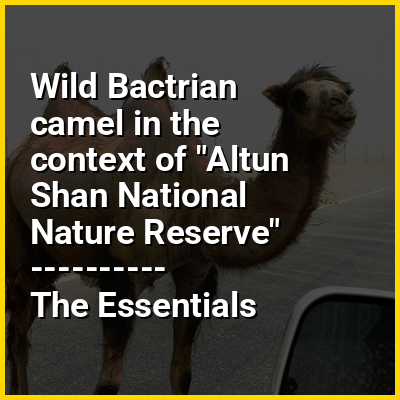
The wild Bactrian camel (Camelus ferus) or simply the wild camel is an endangered species of camel endemic to Northwest China and southwestern Mongolia. It is closely related but not ancestral to the domestic Bactrian camel (Camelus bactrianus). Genetic studies have established it as a separate species which diverged from the Bactrian camel about 0.7–1.1 million years ago.

Currently, there are only around 950 wild Bactrian camels. Most live on the Lop Nur Wild Camel National Nature Reserve in China, and a smaller population lives in the Great Gobi A Strictly Protected Area in Mongolia. There are also populations in the Altun Shan Wild Camel Nature Reserve (1986) in Qakilik County, in the Aksai Annanba Nature Reserve (1992), and in Dunhuang Wanyaodun Nature Reserve (now Dunhuang Xihu Wild Camel Nature Reserve) contiguous with the reserve in Qakilik (2001) and a reserve in Mazongshan contiguous with the reserve in Mongolia, all in China.
↓ Menu
HINT:

In this Dossier

Wild Bactrian camel in the context of Camel

A camel (from Latin: camelus and Ancient Greek: κάμηλος (kamēlos) from Ancient Semitic: gāmāl) is an even-toed ungulate in the genus Camelus that bears distinctive fatty deposits known as "humps" on its back. Camels have long been domesticated and, as livestock, they provide food (camel milk and meat) and textiles (fiber and felt from camel hair). Camels are working animals especially suited to their desert habitat and are a vital means of transport for passengers and cargo. There are three surviving species of camel. The one-humped dromedary makes up 94% of the world's camel population, and the two-humped Bactrian camel makes up 6%. The wild Bactrian camel is a distinct species that is not ancestral to the domestic Bactrian camel, and is now critically endangered, with fewer than 1,000 individuals.

The word camel is also used informally in a wider sense, where the more correct term is "camelid", to include all seven species of the family Camelidae: the true camels (the above three species), along with the "New World" camelids: the llama, the alpaca, the guanaco, and the vicuña, which belong to the separate tribe Lamini. Camelids originated in North America during the Eocene, with the ancestor of modern camels, Paracamelus, migrating across the Bering land bridge into Asia during the late Miocene, around 6 million years ago.

View the full Wikipedia page for Camel
↑ Return to Menu

Wild Bactrian camel in the context of Nikolay Przhevalsky

Nikolay Mikhaylovich Przhevalsky (or Przewalski or Prjevalsky; 12 April [O.S. 31 March] 1839 – 1 November [O.S. 20 October] 1888) was a Russian geographer and a renowned explorer of Central and East Asia. Although he never reached his ultimate goal, the city of Lhasa in Tibet, he still travelled through regions then unknown to Westerners, such as northern Tibet (modern Tibet Autonomous Region), Amdo (now Qinghai) and Dzungaria (now northern Xinjiang). He contributed substantially to European knowledge of Central Asian geography.

Przhevalsky described several species previously unknown to European science, such as Przewalski's horse, Przewalski's gazelle, and the wild Bactrian camel, all of which are now endangered. He was also a mentor of the explorer Pyotr Kozlov.

View the full Wikipedia page for Nikolay Przhevalsky
↑ Return to Menu

Wild Bactrian camel in the context of Camelid

Camelidae is a family of mammals belonging to the ungulate order Artiodactyla (even-toed ungulates) and the only living family in the suborder Tylopoda. The seven extant species of camelid are divided into two tribes, Camelini, including dromedary camels, Bactrian camels and wild Bactrian camels, and Lamini, including llamas, alpacas, vicuñas, and guanacos.

View the full Wikipedia page for Camelid
↑ Return to Menu

Wild Bactrian camel in the context of Bactrian camel

The Bactrian camel (Camelus bactrianus), also known as the Mongolian camel, domestic Bactrian camel, two-humped camel or double humped camel is a camel native to the steppes of Central Asia. It has two humps on its back, in contrast to the single-humped dromedary. Its population of 2 million exists mainly in the domesticated form. Their name comes from the ancient historical region of Bactria.

Domesticated Bactrian camels have served as pack animals in inner Asia since ancient times. With its tolerance for cold, drought, and high altitudes, it enabled the travel of caravans on the Silk Road. Bactrian camels, whether domesticated or feral, are a separate species from the wild Bactrian camel (Camelus ferus), which is the only truly wild (as opposed to feral) species of camelid in the Old World. Domestic Bactrian camels do not descend from wild Bactrian camels, with the two species having split around 1 million years ago.

View the full Wikipedia page for Bactrian camel
↑ Return to Menu