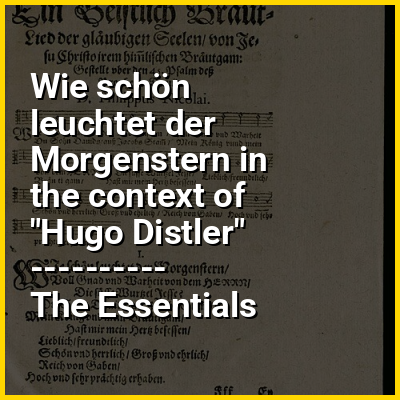
"Wie schön leuchtet der Morgenstern" (German pronunciation: [viː ʃøːn ˈlɔɪ̯çtət deːɐ̯ ˈmɔʁɡn̩ˌʃtɛʁn] ; lit. 'How lovely shineth the morning star') is a Lutheran hymn by Philipp Nicolai written in 1597 and first published in 1599. It inspired musical settings through centuries, notably Bach's chorale cantata Wie schön leuchtet der Morgenstern, BWV 1, but also vocal and instrumental works by Baroque composers, Peter Cornelius, Felix Mendelssohn, Max Reger, Hugo Distler, Ernst Pepping, Mauricio Kagel and Naji Hakim.
HINT:
In this Dossier
- ⭐ Core Definition: Wie schön leuchtet der Morgenstern
- Wie schön leuchtet der Morgenstern in the context of BWV 1
- Wie schön leuchtet der Morgenstern in the context of Wachet auf, ruft uns die Stimme
Wie schön leuchtet der Morgenstern in the context of BWV 1
Wie schön leuchtet der Morgenstern ('How beautifully the morning star shines'), BWV 1, is a church cantata for Annunciation by Johann Sebastian Bach. In 1725, when the cantata was composed, the feast of the Annunciation (25 March) coincided with Palm Sunday. Based on Philipp Nicolai's hymn "Wie schön leuchtet der Morgenstern" (1599), it is one of Bach's chorale cantatas. Bach composed it in his second year as Thomaskantor in Leipzig, where the Marian feast was the only occasion during Lent when music of this kind was permitted. The theme of the hymn suits both the Annunciation and Palm Sunday occasions, in a spirit of longing expectation of an arrival. As usual for Bach's chorale cantata cycle, the hymn was paraphrased by a contemporary poet who retained the hymn's first and last stanzas unchanged, but transformed the themes of the inner stanzas into a sequence of alternating recitatives and arias.
Wie schön leuchtet der Morgenstern is the last chorale cantata of Bach's second cantata cycle, possibly because the librettist who provided the paraphrases for the middle movements of these cantatas was no longer available. Bach scored the work for three vocal soloists, a four-part choir and a Baroque instrumental ensemble of two horns, two oboes da caccia, two solo violins, strings and continuo. The chorale melody of Nicolai's hymn appears in the opening and closing choral movements of the cantata. All instruments play in the opening festive chorale fantasia, in which the soprano sings the hymn tune, and the two solo concertante violins represent the morning star. An oboe da caccia accompanies the vocal soloist in the first aria. The strings, including the solo violins, return in the second aria. An independent horn part crowns the closing chorale.
View the full Wikipedia page for BWV 1Wie schön leuchtet der Morgenstern in the context of Wachet auf, ruft uns die Stimme
"Wachet auf, ruft uns die Stimme" (literally: Wake up, the voice is calling us) is a Lutheran hymn written in German by Philipp Nicolai, first published in 1599 together with "Wie schön leuchtet der Morgenstern". It appears in German hymnals and in several English hymnals in translations such as "Wake, Awake, for Night Is Flying" (Catherine Winkworth, 1858), "Wake, O wake! with tidings thrilling" (Francis Crawford Burkitt, 1906), and "Up! Awake! From Highest Steeple" (George Ratcliffe Woodward, 1908). Johann Sebastian Bach based a chorale cantata on the hymn, Wachet auf, ruft uns die Stimme, BWV 140, one of its many musical settings.
View the full Wikipedia page for Wachet auf, ruft uns die Stimme