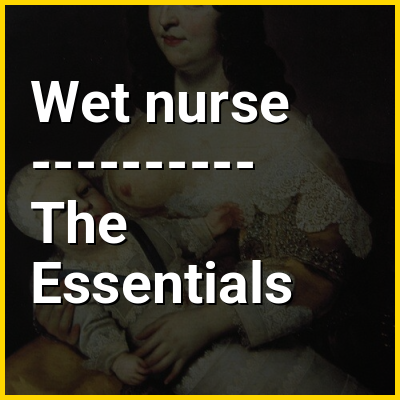
A wet nurse is a woman who breastfeeds and cares for another's child. Wet nurses are employed if the mother dies, if she is unable to nurse the child herself sufficiently or chooses not to do so. Wet-nursed children may be known as "milk-siblings", and in some societies, the families are linked by a special relationship of milk kinship. Wet-nursing existed in societies around the world until the invention of reliable formula milk in the 20th century. The practice has made a small comeback in the 21st century.
>>>PUT SHARE BUTTONS HERE<<<
In this Dossier
Wet nurse in the context of Human–animal breastfeeding
Human to animal breastfeeding has been practiced in some different cultures during various time periods. The practice of breastfeeding or suckling between humans and other species occurred in both directions: women sometimes breastfed young animals, and animals were used to suckle babies and children. Animals were used as substitute wet nurses for infants, particularly after the rise of syphilis increased the health risks of wet nursing. Goats and donkeys were widely used to feed abandoned babies in foundling hospitals in 18th- and 19th-century Europe. Breastfeeding animals has also been practised, whether for perceived health reasons – such as to toughen the nipples and improve the flow of milk – or for religious and cultural purposes. A wide variety of animals have been used for this purpose, including puppies, kittens, piglets and monkeys.
Wet nurse in the context of Tokugawa Iemitsu
Tokugawa Iemitsu (徳川 家光; 12 August 1604 – 8 June 1651) was the third shōgun of the Tokugawa dynasty. He was the eldest son of Tokugawa Hidetada with Oeyo, and the grandson of Tokugawa Ieyasu. Lady Kasuga was his wet nurse, who acted as his political adviser and was at the forefront of shogunate negotiations with the Imperial court. Iemitsu ruled from 1623 to 1651; during this period he crucified Christians, expelled all Europeans from Japan and closed the borders of the country, a foreign policy that continued for over 200 years after its institution.
Wet nurse in the context of Lady Kasuga
Lady Kasuga (春日局, Kasuga no Tsubone; 1579 – October 26, 1643) was a Japanese noble lady and politician from a prominent Japanese samurai family of the Azuchi–Momoyama and Edo periods. Born Saitō Fuku (斉藤福), she was a daughter of Saitō Toshimitsu (who was a retainer of Akechi Mitsuhide). She was the wet nurse of the third Tokugawa shōgun Iemitsu. Lady Kasuga was one of the best politicians in the Edo period. She stood in front of negotiations with the Imperial Court and contributed to the stabilization of the Tokugawa Shogunate.
Kasuga was one of the most powerful figures in the Ōoku (the quarters in Edo Castle where the women related to the Shogun family resided) . She is counted alongside Matsudaira Nobutsuna and Yagyu Muneyori as one of the Three Tripod Legs, who supported and propped up Iemitsu.
Wet nurse in the context of Agatha of Sicily
Agatha of Sicily (c. 231 – c. 251 AD) is a Christian saint. Her feast is on 5 February. Agatha was born in Catania, part of the Roman Province of Sicily, and was martyred c. 251. She is one of several virgin martyrs who are commemorated by name in the Canon of the Mass.
Agatha is the patroness saint of Catania, Molise, Malta, San Marino, Gallipoli in Apulia, and Zamarramala, a municipality of the Province of Segovia in Spain. She is also the patroness saint of breast cancer patients, rape victims,martyrs, wet nurses, bell-founders, and bakers, and is invoked against fire, earthquakes, and eruptions of Mount Etna.
Wet nurse in the context of Milk kinship
Milk kinship, formed during nursing by a non-biological mother, was a form of fostering allegiance with fellow community members. This particular form of kinship did not exclude particular groups, such that class and other hierarchal systems did not matter in terms of milk kinship participation.
Traditionally speaking, this practice predates the early modern period, though it became a widely used mechanism for developing alliances in many hierarchical societies during that time. Milk kinship used the practice of breast feeding by a wet nurse to feed a child either from the same community, or a neighbouring one. This wet nurse played the strategic role in forging relations between her family and the family of the child she was nursing, as well as their community.