Westminster Assembly in the context of "Long Parliament"

Play Trivia Questions online!

or

Skip to study material about Westminster Assembly in the context of "Long Parliament"

Ad spacer

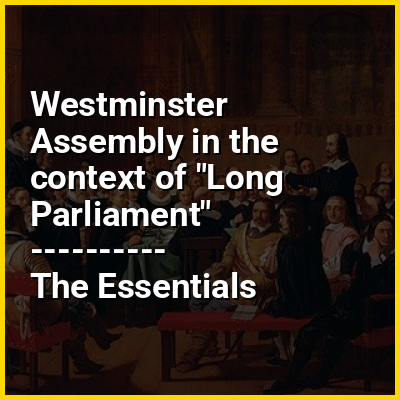
⭐ Core Definition: Westminster Assembly

The Westminster Assembly of Divines was a council of divines (theologians) and members of the English Parliament appointed from 1643 to 1653 to restructure the Church of England. Several Scots also attended, and the Assembly's work was adopted by the Church of Scotland. As many as 121 ministers were called to the Assembly, with nineteen others added later to replace those who did not attend or could no longer attend. It produced a new Form of Church Government, a Confession of Faith or statement of belief, two catechisms or manuals for religious instruction (Shorter and Larger), and a liturgical manual, the Directory for Public Worship, for the Churches of England and Scotland. The Confession and catechisms were adopted as doctrinal standards in the Church of Scotland and other Presbyterian churches, where they remain normative. Amended versions of the Confession were also adopted in Congregational and Baptist churches in England and New England in the seventeenth and eighteenth centuries. The Confession became influential throughout the English-speaking world, but especially in American Protestant theology.

The Assembly was called by the Long Parliament before and during the beginning of the First English Civil War. The Long Parliament was influenced by Puritanism, a religious movement which sought further reform of the church. They were opposed to the religious policies of King Charles I and William Laud, Archbishop of Canterbury. As part of a military alliance with Scotland, Parliament agreed that the outcome of the Assembly would bring the English Church into closer conformity with the Church of Scotland. The Scottish Church was governed by a system of elected assemblies of elders called presbyterianism, rather than rule by bishops, called episcopalianism, which was used in the English church. Scottish commissioners attended and advised the Assembly as part of the agreement. Disagreements over church government caused open division in the Assembly, despite attempts to maintain unity. The party of divines who favoured presbyterianism was in the majority, but the congregationalist party, which held greater influence in the military, favoured autonomy for individual congregations rather than the subjection of congregations to regional and national assemblies entailed in presbyterianism. Parliament eventually adopted a presbyterian form of government but lacked the power to implement it. During the Restoration of the monarchy in 1660, all of the documents of the Assembly were repudiated and episcopal church government was reinstated in England.
↓ Menu

>>>PUT SHARE BUTTONS HERE<<<
In this Dossier

Westminster Assembly in the context of Puritans

The Puritans were English Protestants in the 16th and 17th centuries who sought to rid the Church of England of what they considered to be Roman Catholic practices, maintaining that the Church of England had not been fully reformed and should become more Protestant. Puritanism played a significant role in English and early American history, especially in the Protectorate in Great Britain, and the earlier settlement of New England.

Puritans were dissatisfied with the limited extent of the English Reformation and with the Church of England's toleration of certain practices associated with the Catholic Church. They formed and identified with various religious groups advocating greater purity of worship and doctrine, as well as personal and corporate piety. Puritans adopted a covenant theology, and in that sense they were Calvinists (as were many of their earlier opponents). In church polity, Puritans were divided between supporters of episcopal, presbyterian, and congregational types. Some believed a uniform reform of the established church was called for to create a godly nation, while others advocated separation from, or the end of, any established state church entirely in favour of autonomous gathered churches, called-out from the world. These Separatist and Independents became more prominent in the 1640s, when the supporters of a presbyterian polity in the Westminster Assembly were unable to forge a new English national church.

↑ Return to Menu

Westminster Assembly in the context of Gathered church

Under Charles I, the Puritans became a political force as well as a religious tendency in the country. Opponents of the royal prerogative became allies of Puritan reformers, who saw the Church of England moving in a direction opposite to what they wanted, and objected to increased Catholic influence both at Court and (as they saw it) within the Church.

After the First English Civil War political power was held by various factions of Puritans. The trials and executions of William Laud and then King Charles were decisive moves shaping British history. While in the short term Puritan power was consolidated by the Parliamentary armed forces and Oliver Cromwell, in the same years, the argument for theocracy failed to convince enough of the various groupings, and there was no Puritan religious settlement to match Cromwell's gradual assumption of dictatorial powers. The distinctive formulation of Reformed theology in the Westminster Assembly would prove to be its lasting legacy.

↑ Return to Menu

Westminster Assembly in the context of Westminster Confession of Faith

The Westminster Confession of Faith, or simply the Westminster Confession, is a Reformed confession of faith. Drawn up by the 1646 Westminster Assembly as part of the Westminster Standards to be a confession of the Church of England, it became and remains the "subordinate standard" of doctrine in the Church of Scotland and has been influential within Presbyterian churches worldwide.

In 1643, the English Parliament called upon "learned, godly and judicious Divines" to meet at Westminster Abbey in order to provide advice on issues of worship, doctrine, government and discipline of the Church of England. Their meetings, over a period of five years, produced the confession of faith, as well as a Larger Catechism and a Shorter Catechism. For more than three hundred years, various churches around the world have adopted the confession and the catechisms as their standards of doctrine, subordinate to the Bible. For the Church of Scotland and the various denominations which spring from it directly, though, only the Confession and not the Catechisms is the subordinate standard, the Catechisms not being re-legislated in 1690.

↑ Return to Menu