West Bank barrier in the context of Qalandia Camp


West Bank barrier in the context of Qalandia Camp

⭐ Core Definition: West Bank barrier

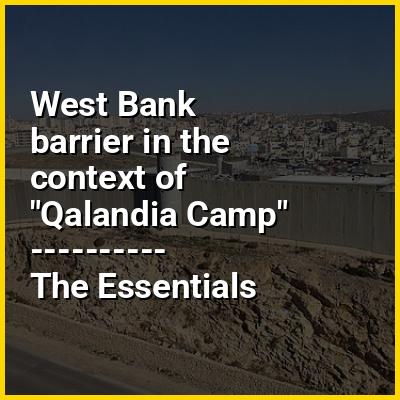
The West Bank barrier, West Bank wall or the West Bank separation barrier, is a separation barrier built by Israel along the Green Line and inside parts of the West Bank. Israel describes the wall as a necessary security barrier against Palestinian political violence, whereas Palestinians describe it as an element of racial segregation and a representation of Israeli apartheid, often calling it a "Wall of Apartheid". At a total length of 708 kilometres (440 mi) upon completion, the route traced by the barrier is more than double the length of the Green Line, with 15% of its length running along the Green Line or inside Israel, and the remaining 85% running as much as 18 kilometres (11 mi) inside the West Bank, effectively isolating about 9% of the land and approximately 25,000 Palestinians from the rest of the Palestinian territory.

The barrier was built by Israel following a wave of Palestinian political violence and incidents of terrorism inside Israel during the Second Intifada, which began in September 2000 and ended in February 2005. The Israeli government cites a decreased number of suicide bombings carried out from the West Bank as evidence of its efficacy, after such attacks fell from 73 between 2000 and July 2003 (the completion of the first continuous segment) to 12 between August 2003 and the end of 2006. While the barrier was initially presented as a temporary security measure at a time of heightened tensions, it has since been associated with a future political border between Israel and the State of Palestine.
↓ Menu
HINT:

In this Dossier

West Bank barrier in the context of Israeli-occupied West Bank

The West Bank, including East Jerusalem, has been under military occupation by Israel since 7 June 1967, when Israeli forces captureds e territory, then ruled by Jordan, during the Six-Day War. The West Bank is part of the state of Palestine, and its status as a militarily occupied territory has been affirmed by the International Court of Justice and, with the exception of East Jerusalem, by the Israeli Supreme Court. The West Bank, excepting East Jerusalem, is administered by the Israeli Civil Administration, a branch of the Israeli Ministry of Defense. Considered to be a classic example of an "intractable conflict", Israel's occupation is now the longest in modern history. Though its occupation is illegal, Israel has cited several reasons for retaining the West Bank within its ambit: historic rights stemming from the Balfour Declaration; security grounds, both internal and external; and the area's symbolic value for Jews.

Israel has controversially, and in contravention of international law, established numerous Jewish settlements throughout the West Bank. The United Nations Security Council has repeatedly affirmed that settlements in that territory are a "flagrant violation of international law", most recently in 2016 with United Nations Security Council Resolution 2334. The International Court of Justice has also found that the establishment of Israeli settlements is illegal under international law. The creation and ongoing expansion of the settlements have led to Israel's policies being criticized as an example of settler colonialism.

View the full Wikipedia page for Israeli-occupied West Bank
↑ Return to Menu

West Bank barrier in the context of Israeli occupation of the West Bank

The West Bank, including East Jerusalem, has been under military occupation by Israel since 7 June 1967, when Israeli forces captured the territory, then ruled by Jordan, during the Six-Day War. The West Bank is part of the state of Palestine, and its status as a militarily occupied territory has been affirmed by the International Court of Justice and, with the exception of East Jerusalem, by the Israeli Supreme Court. The West Bank, excepting East Jerusalem, is administered by the Israeli Civil Administration, a branch of the Israeli Ministry of Defense. Considered to be a classic example of an "intractable conflict", Israel's occupation is now the longest in modern history. Though its occupation is illegal, Israel has cited several reasons for retaining the West Bank within its ambit: historic rights stemming from the Balfour Declaration; security grounds, both internal and external; and the area's symbolic value for Jews.

Israel has controversially, and in contravention of international law, established numerous Jewish settlements throughout the West Bank. The United Nations Security Council has repeatedly affirmed that settlements in that territory are a "flagrant violation of international law", most recently in 2016 with United Nations Security Council Resolution 2334. The International Court of Justice has also found that the establishment of Israeli settlements is illegal under international law. The creation and ongoing expansion of the settlements have led to Israel's policies being criticized as an example of settler colonialism.

View the full Wikipedia page for Israeli occupation of the West Bank
↑ Return to Menu

West Bank barrier in the context of Seam zone

Seam Zone (Hebrew: מרחב התפר) is a term used to refer to a land area in the Israeli-occupied West Bank located east of the Green Line and west of Israel's separation barrier, populated largely by Israelis in settlements such as Alfei Menashe, Ariel, Beit Arye, Modi'in Illit, Giv'at Ze'ev, Ma'ale Adumim, Beitar Illit and Efrat.

As of 2006, it was estimated that about 57,000 Palestinians lived in villages located in enclaves in the seam zone, separated from the rest of the West Bank by the Wall (according to the ICJ Wall Case opinion). The United Nations estimated that if the series of walls, fences, barbed wire and ditches is completed along its planned route, about a third of West Bank Palestinians will be affected—274,000 will be located in enclaves in the seam zone and about 400,000 separated from their fields, jobs, schools and hospitals. The Supreme Court of Israel ordered changes to the barrier route to reduce the number of people leaving or affected by the seam zone—according to the court verdict the number now stands at 35,000.

View the full Wikipedia page for Seam zone
↑ Return to Menu

West Bank barrier in the context of Kalandia

Qalandia or Qalandiya (Arabic: قلنديا), also known as Kalandia (Hebrew: קלנדיה), is a Palestinian village located in the West Bank, between Jerusalem and Ramallah, just west of the West Bank barrier. The village had a population of 572 residents in 2017. Qalandia is also the name of a refugee camp, established by UNRWA in 1949. It is located just east of Jerusalem municipality. Qalandia refugee camp was built for Palestinian refugees who fled from Lydda, Ramla, and Jerusalem during the 1948 Palestinian expulsion and flight.

View the full Wikipedia page for Kalandia
↑ Return to Menu