Weak force in the context of "Radioactive"

Play Trivia Questions online!

or

Skip to study material about Weak force in the context of "Radioactive"

Ad spacer

⭐ Core Definition: Weak force

In nuclear physics and particle physics, the weak interaction, weak force or the weak nuclear force, is one of the four known fundamental interactions, with the others being electromagnetism, the strong interaction, and gravitation. It is the mechanism of interaction between subatomic particles that is responsible for the radioactive decay of atoms: The weak interaction participates in nuclear fission and nuclear fusion. The theory describing its behaviour and effects is sometimes called quantum flavordynamics (QFD); however, the term QFD is rarely used, because the weak force is better understood by electroweak theory (EWT).

The effective range of the weak force is limited to subatomic distances and is less than the diameter of a proton.

↓ Menu

>>>PUT SHARE BUTTONS HERE<<<
In this Dossier

Weak force in the context of Radioactive decay

Radioactive decay (also known as nuclear decay, radioactivity, radioactive disintegration, or nuclear disintegration) is the process by which an unstable atomic nucleus loses energy by radiation. A material containing unstable nuclei is considered radioactive. Three of the most common types of decay are alpha, beta, and gamma decay. The weak force is the mechanism that is responsible for beta decay, while the other two are governed by the electromagnetic and nuclear forces.

Radioactive decay is a random process at the level of single atoms. According to quantum theory, it is impossible to predict when a particular atom will decay, regardless of how long the atom has existed. However, for a significant number of identical atoms, the overall decay rate can be expressed as a decay constant or as a half-life. The half-lives of radioactive atoms have a huge range: from nearly instantaneous to far longer than the age of the universe.

↑ Return to Menu

Weak force in the context of Quantum fluctuation

In quantum physics, a quantum fluctuation (also known as a vacuum state fluctuation or vacuum fluctuation) is the temporary random change in the amount of energy in a point in space, as prescribed by Werner Heisenberg's uncertainty principle. They are minute random fluctuations in the values of the fields which represent elementary particles, such as electric and magnetic fields which represent the electromagnetic force carried by photons, W and Z fields which carry the weak force, and gluon fields which carry the strong force.

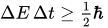
The uncertainty principle states the uncertainty in energy and time can be related by , where 1/2ħ5.27286×10 J⋅s. This means that pairs of virtual particles with energy and lifetime shorter than are continually created and annihilated in empty space. Although the particles are not directly detectable, the cumulative effects of these particles are measurable. For example, without quantum fluctuations, the "bare" mass and charge of elementary particles would be infinite; from renormalization theory the shielding effect of the cloud of virtual particles is responsible for the finite mass and charge of elementary particles.

↑ Return to Menu

Weak force in the context of Weak neutral current

Weak neutral current interactions are one of the ways in which subatomic particles can interact by means of the weak force. These interactions are mediated by the Z boson. The discovery of weak neutral currents was a significant step toward the unification of electromagnetism and the weak force into the electroweak force, and led to the discovery of the W and Z bosons.

↑ Return to Menu

Weak force in the context of Theory of everything

A theory of everything (TOE) or final theory is a hypothetical coherent theoretical framework of physics containing all physical principles. The scope of the concept of a "theory of everything" varies. The original technical concept referred to unification of the four fundamental interactions: electromagnetism, strong and weak nuclear forces, and gravity.Finding such a theory of everything is one of the major unsolved problems in physics. Numerous popular books apply the words "theory of everything" to more expansive concepts such as predicting everything in the universe from logic alone, complete with discussions on how this is not possible.

Starting with Isaac Newton's unification of terrestrial gravity, responsible for weight, with celestial gravity, responsible for planetary orbits, concepts in fundamental physics have been successively unified. The phenomena of electricity and magnetism were combined by James Clerk Maxwell's theory of electromagnetism and Albert Einstein's theory of relativity explained how they are connected. By the 1930s, Paul Dirac combined relativity and quantum mechanics and, working with other physicists, developed quantum electrodynamics that combines quantum mechanics and electromagnetism.Work on nuclear and particle physics lead to the discovery of the strong nuclear and weak nuclear forces which were combined in the quantum field theory to implemented the Standard Model of physics, a unification of all forces except gravity. The lone fundamental force not built into the Standard Model is gravity. General relativity provides a theoretical framework for understanding gravity across scales from the laboratory to planets to the complete universe, but it has not been successfully unified with quantum mechanics.

↑ Return to Menu

Weak force in the context of Electroweak interaction

In particle physics, the electroweak interaction or electroweak force is the unified description of two of the fundamental interactions of nature: electromagnetism (electromagnetic interaction) and the weak interaction. Although these two forces appear very different at everyday low energies, the theory models them as two different aspects of the same force. Above the unification energy, on the order of 246 GeV, they would merge into a single force. Thus, if the temperature is high enough – approximately 10 K – then the electromagnetic force and weak force merge into a combined electroweak force.

During the quark epoch (shortly after the Big Bang), the electroweak force split into the electromagnetic and weak force. It is thought that the required temperature of 10 K has not been seen widely throughout the universe since before the quark epoch, and currently the highest human-made temperature in thermal equilibrium is around 5.5×10 K (from the Large Hadron Collider).

↑ Return to Menu

Weak force in the context of Internal conversion

Internal conversion (often abbreviated IC) is an atomic decay process where an excited nucleus interacts electromagnetically with one of the orbital electrons of an atom. This causes the electron to be emitted (ejected) from the atom. Thus, in internal conversion, a high-energy electron is emitted from the excited atom, but not from the nucleus. For this reason, the high-speed electrons resulting from internal conversion are not called beta particles, since the latter come from beta decay, where they are newly created in the nuclear decay process.

IC is possible whenever gamma decay is possible, except if the atom is fully ionized. In IC, the atomic number does not change, and thus there is no transmutation of one element to another. Also, neutrinos and the weak force are not involved in IC.

↑ Return to Menu

Weak force in the context of Positron emission

Positron emission, beta plus decay, or β decay is a subtype of radioactive decay called beta decay, in which a proton inside a radionuclide nucleus is converted into a neutron while releasing a positron and an electron neutrino (νe). Positron emission is mediated by the weak force. The positron is a type of beta particle (β), the other beta particle being the electron (β) emitted from the β decay of a nucleus.

An example of positron emission (β decay) is shown with magnesium-23 decaying into sodium-23:

↑ Return to Menu