Wadi Tumilat in the context of "Darius the Great's Suez Inscriptions"

Play Trivia Questions online!

or

Skip to study material about Wadi Tumilat in the context of "Darius the Great's Suez Inscriptions"

Ad spacer

⭐ Core Definition: Wadi Tumilat

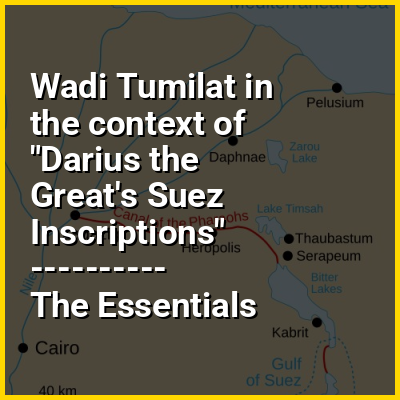
Wadi Tumilat (Old Egyptian Tjeku/Tscheku/Tju/Tschu) is the 50-kilometre-long (31 mi) dry river valley (wadi) to the east of the Nile Delta. In prehistory, it was a distributary of the Nile. It starts near the modern town of Zagazig and the ancient town of Bubastis and goes east to the area of modern Ismaïlia.

In ancient times, this was a major communication artery for caravan trade between Egypt and points to the east. The Canal of the Pharaohs was built there. A little water still flows along the wadi. The current Sweet Water Canal also flows along the wadi.
↓ Menu

>>>PUT SHARE BUTTONS HERE<<<

👉 Wadi Tumilat in the context of Darius the Great's Suez Inscriptions

The Suez inscriptions of Darius the Great were texts written in Old Persian, Elamite, Babylonian and Egyptian on five monuments erected in Wadi Tumilat, commemorating the opening of the "Canal of the Pharaohs" between the Nile and the Bitter Lakes.

One of the best preserved of these monuments was a stele of pink granite, which was discovered by Charles de Lesseps, Ferdinand de Lesseps's son, in 1866, 30 kilometres from Suez near Kabret in Egypt. It was erected by Darius the Great, king of the Achaemenid Empire (or Persia), whose reign lasted from 522 to 486 BCE. The monument, also known as the Chalouf stele (alt. Shaluf Stele), records the construction of a forerunner of the modern Suez Canal by the Persians, a canal through Wadi Tumilat, connecting the easternmost, Bubastite, branch of the Nile with Lake Timsah, which was connected to the Red Sea by natural waterways. The stated purpose of the canal was the creation of a shipping connection between the Nile and the Red Sea, between Egypt and Persia.

↓ Explore More Topics
In this Dossier

Wadi Tumilat in the context of Canal of the Pharaohs

The Canal of the Pharaohs, also called the Ancient Suez Canal or Necho's Canal or Darius Canal, is the forerunner of the Suez Canal, constructed in ancient times and kept in use, with intermissions, until being closed in 767 AD for strategic reasons during a rebellion. It followed a different course from its modern counterpart, by linking the Nile to the Red Sea via the Wadi Tumilat. Work began under the pharaohs. According to Darius the Great's Suez Inscriptions and Herodotus, the first opening of the canal was under Persian king Darius the Great, but later ancient authors like Aristotle, Strabo, and Pliny the Elder claim that he failed to complete the work. Another possibility is that it was finished in the Ptolemaic period under Ptolemy II, when engineers solved the problem of overcoming the difference in height through canal locks.

↑ Return to Menu

Wadi Tumilat in the context of Lake Timsah

Lake Timsah, Arabic for Crocodile Lake (Arabic: بُحَيْرة التِّمْسَاح), is a lake in Egypt on the Nile Delta. It lies in a basin developed along a fault extending from the Mediterranean Sea to the Gulf of Suez through the Bitter Lakes region. In 1800, a flood filled the Wadi Tumilat, which caused Timsah's banks to overflow and moved water south into the Bitter Lakes about nine miles (14 km) away. In 1862, the lake was filled with waters from the Red Sea, and became part of the Suez Canal.

↑ Return to Menu