Volans in the context of "Johann Bayer"

Play Trivia Questions online!

or

Skip to study material about Volans in the context of "Johann Bayer"


⭐ Core Definition: Volans

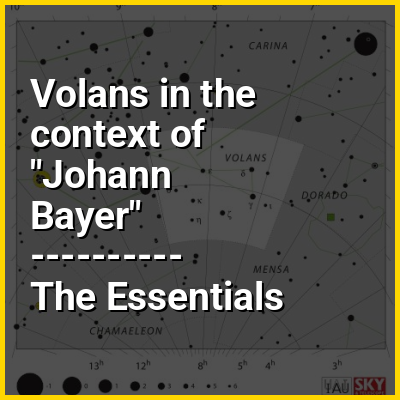
Volans is a constellation in the southern sky. It represents a flying fish; its name is a shortened form of its original name, Piscis Volans. Volans was one of twelve constellations created by Petrus Plancius from the observations of Pieter Dirkszoon Keyser and Frederick de Houtman and it first appeared on a 35-cm (14") diameter celestial globe published in 1597 (or 1598) in Amsterdam by Plancius with Jodocus Hondius. The first depiction of this constellation in a celestial atlas was in Johann Bayer's Uranometria of 1603.

↓ Menu

In this Dossier

Volans in the context of Webb's First Deep Field

Webb's First Deep Field is the first operational image taken by the James Webb Space Telescope (JWST). The deep-field photograph, which covers a tiny area of sky visible from the Southern Hemisphere, is centered on SMACS 0723, a galaxy cluster in the constellation of Volans. Thousands of galaxies are visible in the image, some as old as 13 billion years. It is the highest-resolution image of the early universe ever taken. Captured by the telescope's Near-Infrared Camera (NIRCam), the image was revealed to the public by NASA on 11 July 2022.

↑ Return to Menu

Volans in the context of SMACS 0723

SMACS J0723.3–7327, commonly referred to as SMACS 0723, is a galaxy cluster about 4 billion light years from Earth, within the southern constellation of Volans (RA/Dec = 110.8375, −73.4391667). It is a patch of sky visible from the Southern Hemisphere on Earth and often observed by the Hubble Space Telescope and other telescopes in search of the deep past. It was the target of the first full-color image to be unveiled by the James Webb Space Telescope (JWST), imaged using NIRCam, with spectra included, showing objects lensed by the cluster with redshifts implying they are 13.1 billion years old. The cluster has been previously observed by the Hubble Space Telescope (HST) as part of the Southern MAssive Cluster Survey (SMACS), as well as Planck and Chandra.

In 2022, in the field gravitationally lensed by SMAC 0723, some of the then most ancient massive star clusters were discovered in a lensed galaxy called the "Sparkler Galaxy".

↑ Return to Menu