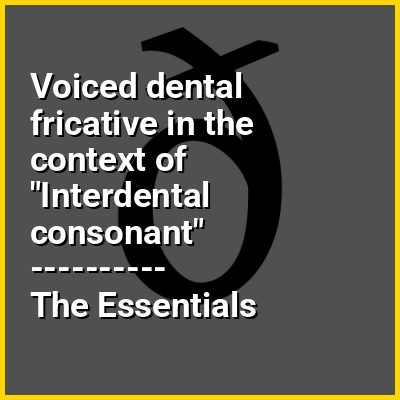
A voiced dental fricative is a consonant sound used in some spoken languages. It is familiar to English-speakers as the th sound in father. Its symbol in the International Phonetic Alphabet is eth, or ⟨ð⟩ and was taken from the Old English and Icelandic letter eth, which could stand for either a voiced or unvoiced (inter)dental non-sibilant fricative. Such fricatives are often called "interdental" because they are often produced with the tongue between the upper and lower teeth (as in Received Pronunciation), and not just against the back of the upper teeth, as they are with other dental consonants.
The letter ⟨ð⟩ is sometimes used to represent a voiced dental approximant, a similar sound, which no language is known to contrast with a dental non-sibilant fricative. However, the approximant can be explicitly indicated with the lowering diacritic: ⟨ð̞⟩. Very rarely used variant transcriptions of the dental approximant include ⟨ʋ̠⟩ (retracted [ʋ]), ⟨ɹ̟⟩ (advanced [ɹ]) and ⟨ɹ̪⟩ (dentalised [ɹ]). It has been proposed that either a turned ⟨ð⟩ or reversed ⟨ð⟩, among others, be used as a dedicated symbol for the dental approximant, but despite occasional usage, this has not gained general acceptance.