Villein in the context of "Peasant society"

Play Trivia Questions online!

or

Skip to study material about Villein in the context of "Peasant society"


⭐ Core Definition: Villein

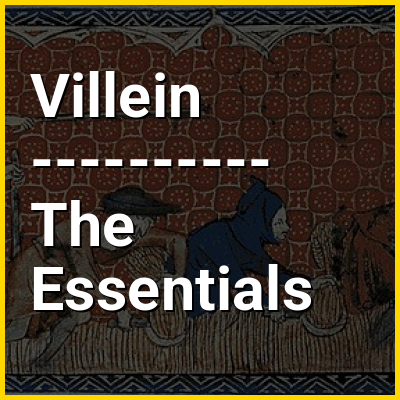
A villein is a class of serf tied to the land under the feudal system. As part of the contract with the lord of the manor, they were expected to spend some of their time working on the lord's fields in return for land. Villeins existed under a number of legal restrictions that differentiated them from freemen, and could not leave without his lord's permission. Generally, villeins held their status not by birth but by the land they held, and it was also possible for them to gain manumission from their lords. The villeinage system largely died out in England in 1500, with some forms of villeinage being in use in France until 1789.

↓ Menu

In this Dossier

Villein in the context of Peasant

A peasant is a pre-industrial agricultural laborer or a farmer with limited land-ownership, especially one living in the Middle Ages under feudalism and paying rent, tax, fees, or services to a landlord. In Europe, three classes of peasants existed: non-free slaves, semi-free serfs, and free tenants. Peasants might hold title to land outright (fee simple), or by any of several forms of land tenure, among them socage, quit-rent, leasehold, and copyhold.

In some contexts, "peasant" has a pejorative meaning, even when referring to farm laborers. As early as in 13th-century Germany, the concept of "peasant" could imply "rustic" as well as "robber", as the English term villain/villein. In 21st-century English, the word "peasant" can mean "an ignorant, rude, or unsophisticated person".The word rose to renewed popularity in the 1940s–1960s as a collective term, often referring to rural populations of developing countries in general, as the "semantic successor to 'native', incorporating all its condescending and racial overtones".

↑ Return to Menu

Villein in the context of Free tenant

Free tenants, also known as free peasants, were tenant farmer peasants in medieval England who occupied a unique place in the medieval hierarchy. They were characterized by the low rents which they paid to their manorial lord. They were subject to fewer laws and ties than villeins. The term may also refer to the free peasants of the Kingdom of France, part of an ordering of classes with legal privileges who constituted the third estate, a land-owning non-political peasantry, mostly different from other countries with estates.

↑ Return to Menu

Villein in the context of Copyhold

Copyhold was a form of customary land ownership common from the Late Middle Ages into modern times in England. The name for this type of land tenure is derived from the act of giving a copy of the relevant title deed that is recorded in the manorial court roll to the tenant, rather than the actual land deed itself. The legal owner of the manor land remained the mesne lord, who was legally the copyholder, according to the titles and customs written down in the manorial roll. In return for being given land, a copyhold tenant was required to carry out specific manorial duties or services. The specific rights and duties of copyhold tenants varied greatly from one manor to another and many were established by custom. By the 19th century, many customary duties had been replaced with the payment of rent.

Copyhold was directly descended from the feudal system of villeinage which involved giving service and produce to the local lord in return for land. Although feudalism in England had ended by the early 1500s, forms of copyhold tenure continued in England until being completely abolished by the Law of Property Act 1925.

↑ Return to Menu

Villein in the context of Whitsunday

Whitsun (also Whitsunday or Whit Sunday) is the name used in Britain, and other countries among Anglicans and Methodists, for the Christian holy day of Pentecost. It falls on the seventh Sunday after Easter and commemorates the descent of the Holy Spirit upon Jesus' disciples (as described in Acts 2). Whitsuntide, the week following Whitsunday, was one of three holiday weeks for the medieval villein; on most manors he was free from service on the lord's demesne this week, which marked a pause in the agricultural year. Whit Monday, the day after Whitsun, remained a holiday in Britain until 1971 when, with effect from 1972, the ruling Conservative Government decided to permanently replace it, following a five-year trial period, with a Spring Bank Holiday on the last Monday in May.Whit had been the occasion for many varied forms of celebration, and was of significant cultural importance. It was a custom for children to receive a new set of clothes, even among the poorest families, a tradition which continued well into the 20th century.

In the North West of England, church and chapel parades called whit walks still take place at this time (sometimes on Whit Friday, the Friday after Whitsun). Typically, the parades include brass bands and choirs; girls attending are dressed in white. Traditionally, Whit fairs (sometimes called Whitsun ales) took place. Other customs, such as Morris dancing, were associated with Whitsun, although in most cases they have been transferred to the Spring bank holiday. Whaddon, Cambridgeshire, has its own Whitsun tradition of singing a unique song around the village before and on Whit Sunday itself.

↑ Return to Menu