Vestibular system in the context of "Angular acceleration"

Play Trivia Questions online!

or

Skip to study material about Vestibular system in the context of "Angular acceleration"

Ad spacer

⭐ Core Definition: Vestibular system

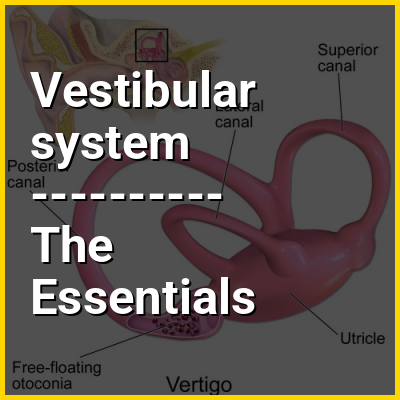
The vestibular system, in vertebrates, is a sensory system that creates the sense of balance and spatial orientation for the function of coordinating movement with balance. Together with the cochlea, a part of the auditory system, it constitutes the labyrinth of the inner ear in most mammals.

As movements consist of rotations and translations, the vestibular system comprises two components: the semicircular canals, which indicate rotational movements; and the otoliths, which indicate linear accelerations. The vestibular system sends signals primarily to the neural structures that control eye movement; these provide the anatomical basis of the vestibulo-ocular reflex, which is required for clear vision. Signals are also sent to the muscles that keep an animal upright and in general control posture; these provide the anatomical means required to enable an animal to maintain its desired position in space.
↓ Menu

>>>PUT SHARE BUTTONS HERE<<<
In this Dossier

Vestibular system in the context of Sensory nervous system

The sensory nervous system is a part of the nervous system responsible for processing sensory information. A sensory system consists of sensory neurons (including the sensory receptor cells), neural pathways, and parts of the brain involved in sensory perception and interoception. Commonly recognized sensory systems are those for vision, hearing, touch, taste, smell, balance and visceral sensation. Sense organs are transducers that convert data from the outer physical world to the realm of the mind where people interpret the information, creating their perception of the world around them.

The receptive field is the area of the body or environment to which a receptor organ and receptor cells respond. For instance, the part of the world an eye can see, is its receptive field; the light that each rod or cone can see, is its receptive field. Receptive fields have been identified for the visual system, auditory system and somatosensory system.

↑ Return to Menu

Vestibular system in the context of Sensory processor

Sensory processing is the process that organizes and distinguishes sensation (sensory information) from one's own body and the environment, thus making it possible to use the body effectively within the environment. Specifically, it deals with how the brain processes multiple sensory modality inputs, such as proprioception, vision, auditory system, tactile, olfactory, vestibular system, interoception, and taste into usable functional outputs.

It has been believed for some time that inputs from different sensory organs are processed in different areas in the brain. The communication within and among these specialized areas of the brain is known as functional integration. Newer research has shown that these different regions of the brain may not be solely responsible for only one sensory modality, but could use multiple inputs to perceive what the body senses about its environment. Multisensory integration is necessary for almost every activity that we perform because the combination of multiple sensory inputs is essential for us to comprehend our surroundings.

↑ Return to Menu

Vestibular system in the context of Sense of balance

The sense of balance or equilibrioception is the perception of balance and spatial orientation. It helps prevent humans and nonhuman animals from falling over when standing or moving. Equilibrioception is the result of a number of sensory systems working together; the eyes (visual system), the inner ears (vestibular system), and the body's sense of where it is in space (proprioception) ideally need to be intact.

The vestibular system, the region of the inner ear where three semicircular canals converge, works with the visual system to keep objects in focus when the head is moving. This is called the vestibulo-ocular reflex (VOR). The balance system works with the visual and skeletal systems (the muscles and joints and their sensors) to maintain orientation or balance. Visual signals sent to the brain about the body's position in relation to its surroundings are processed by the brain and compared to information from the vestibular and skeletal systems.

↑ Return to Menu

Vestibular system in the context of Ear

In vertebrates, an ear is the organ that enables hearing and (in mammals) body balance using the vestibular system. In humans, the ear is described as having three parts: the outer ear, the middle ear and the inner ear. The outer ear consists of the auricle and the ear canal. Since the outer ear is the only visible portion of the ear, the word "ear" often refers to the external part (auricle) alone. The middle ear includes the tympanic cavity and the three ossicles. The inner ear sits in the bony labyrinth, and contains structures which are key to several senses: the semicircular canals, which enable balance and eye tracking when moving; the utricle and saccule, which enable balance when stationary; and the cochlea, which enables hearing. The ear canal is cleaned via earwax, which naturally migrates to the auricle.

The ear develops from the first pharyngeal pouch and six small swellings that develop in the early embryo called otic placodes, which are derived from the ectoderm.

↑ Return to Menu

Vestibular system in the context of Special senses

In medicine and anatomy, the special senses are the senses that have specialized organs devoted to them:

The distinction between special and general senses is used to classify nerve fibers running to and from the central nervous system – information from special senses is carried in special somatic afferents and special visceral afferents. In contrast, the other sense, touch, is a somatic sense which does not have a specialized organ but comes from all over the body, most noticeably the skin but also the internal organs (viscera). Touch includes mechanoreception (pressure, vibration and proprioception), pain (nociception) and heat (thermoception), and such information is carried in general somatic afferents and general visceral afferents.

↑ Return to Menu

Vestibular system in the context of Motion perception

Motion perception is the process of inferring the speed and direction of elements in a scene based on visual, vestibular and proprioceptive inputs. Although this process appears straightforward to most observers, it has proven to be a difficult problem from a computational perspective, and difficult to explain in terms of neural processing.

Motion perception is studied by many disciplines, including psychology (i.e. visual perception), neurology, neurophysiology, engineering, and computer science.

↑ Return to Menu