Very Large Array in the context of "Radio astronomy"

Play Trivia Questions online!

or

Skip to study material about Very Large Array in the context of "Radio astronomy"

Ad spacer

⭐ Core Definition: Very Large Array

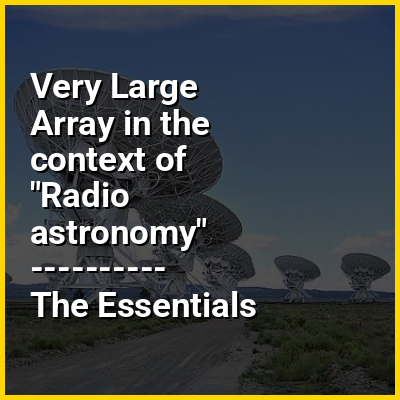
The Karl G. Jansky Very Large Array (VLA) is a centimeter-wavelength radio astronomy observatory in the southwestern United States built in the 1970s. It lies in central New Mexico on the Plains of San Agustin, between the towns of Magdalena and Datil, approximately 50 miles (80 km) west of Socorro. The VLA comprises 28 25-meter (82 ft) radio telescopes (27 of which are operational while one is always rotating through maintenance) deployed in a Y-shaped array and all the equipment, instrumentation, and computing power to function as an interferometer. Each of the massive telescopes is mounted on double parallel railroad tracks, so the radius and density of the array can be transformed to adjust the balance between its angular resolution and its surface brightness sensitivity. Astronomers using the VLA have made key observations of black holes and protoplanetary disks around young stars, discovered magnetic filaments and traced complex gas motions at the Milky Way's center, probed the Universe's cosmological parameters, and provided new knowledge about the physical mechanisms that produce radio emission.

The VLA stands at an elevation of 6,970 feet (2,120 m) above sea level. It is a component of the National Radio Astronomy Observatory (NRAO). The NRAO is a facility of the National Science Foundation operated under cooperative agreement by Associated Universities, Inc.
↓ Menu

>>>PUT SHARE BUTTONS HERE<<<

👉 Very Large Array in the context of Radio astronomy

Radio astronomy is a subfield of astronomy that studies celestial objects using radio waves. It started in 1933, when Karl Jansky at Bell Telephone Laboratories reported radiation coming from the Milky Way. Subsequent observations have identified a number of different sources of radio emission. These include stars and galaxies, as well as entirely new classes of objects, such as radio galaxies, quasars, pulsars, and masers. The discovery of the cosmic microwave background radiation, regarded as evidence for the Big Bang theory, was made through radio astronomy.

Radio astronomy is conducted using large radio antennas referred to as radio telescopes, that are either used alone, or with multiple linked telescopes utilizing the techniques of radio interferometry and aperture synthesis. The use of interferometry allows radio astronomy to achieve high angular resolution, as the resolving power of an interferometer is set by the distance between its components, rather than the size of its components.

↓ Explore More Topics
In this Dossier

Very Large Array in the context of Sagittarius A

Sagittarius A (Sgr A) is a complex radio source at the center of the Milky Way, which contains a supermassive black hole. It is located between Scorpius and Sagittarius, and is hidden from view at optical wavelengths by large clouds of cosmic dust in the spiral arms of the Milky Way. The dust lane that obscures the Galactic Center from a vantage point around the Sun causes the Great Rift through the bright bulge of the galaxy.

The radio source consists of three components: the supernova remnant Sagittarius A East, the spiral structure Sagittarius A West, and a very bright compact radio source at the center of the spiral, Sagittarius A* (read "A-star"). These three overlap: Sagittarius A East is the largest, West appears off-center within East, and A* is at the center of West.

↑ Return to Menu