Venetian Republic in the context of "History of the Republic of Venice"

Play Trivia Questions online!

or

Skip to study material about Venetian Republic in the context of "History of the Republic of Venice"

Ad spacer

⭐ Core Definition: Venetian Republic

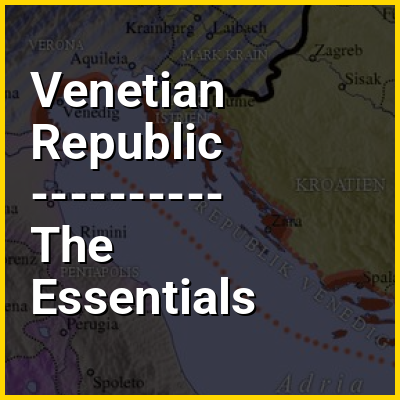
The Republic of Venice, officially the Most Serene Republic of Venice and traditionally known as La Serenissima, was a sovereign state and maritime republic with its capital in Venice. Founded, according to tradition, in 697 by Paolo Lucio Anafesto, over the course of its 1,100 years of history it established itself as one of the major European commercial and naval powers. Initially extended in the Dogado area (a territory currently comparable to the Metropolitan City of Venice), during its history it annexed a large part of Northeast Italy, Istria, Dalmatia, the coasts of present-day Montenegro and Albania as well as numerous islands in the Adriatic and eastern Ionian seas. At the height of its expansion, between the 13th and 16th centuries, it also governed Crete, Cyprus, the Peloponnese, a number of Greek islands, as well as several cities and ports in the eastern Mediterranean.

The islands of the Venetian Lagoon in the 7th century, after having experienced a period of substantial increase in population, were organized into Maritime Venice, a Byzantine duchy dependent on the Exarchate of Ravenna. With the fall of the Exarchate and the weakening of Byzantine power, the Duchy of Venice arose, led by a doge and established on the island of Rialto; it prospered from maritime trade with the Byzantine Empire and other eastern states. To safeguard the trade routes, between the 9th and 11th centuries the Duchy waged several wars, which ensured its complete dominion over the Adriatic. Owing to its participation in the Crusades, Venice increasingly penetrated into eastern markets and, between the 12th and 13th centuries, managed to extend its power into numerous eastern emporiums and commercial ports. The supremacy over the Mediterranean Sea led the Republic to the clash with Genoa, which lasted until the 14th century, when, after having risked complete collapse during the War of Chioggia (with the Genoese army and fleet in the lagoon for a long period), Venice quickly managed to recover from the territorial losses suffered with the Treaty of Turin of 1381 and begin expansion on the mainland.
↓ Menu

>>>PUT SHARE BUTTONS HERE<<<
In this Dossier

Venetian Republic in the context of Greek culture

The culture of Greece has evolved over thousands of years, beginning in Minoan and later in Mycenaean Greece, continuing most notably into Classical Greece, while influencing the Roman Empire and its successor the Byzantine Empire. Other cultures and states such as the Frankish states, the Ottoman Empire, the Venetian Republic and Bavarian and Danish monarchies have also left their influence on modern Greek culture. Also they believed in greek mythology

Modern democracies owe a debt to Greek beliefs in government by the people, trial by jury, and equality under the law. The ancient Greeks pioneered in many fields that rely on systematic thought, including biology, geometry, history, philosophy, and physics. They introduced important literary forms as epic and lyric poetry, history, tragedy, and comedy. In their pursuit of order and proportion, the Greeks created an ideal of beauty that strongly influenced Western art.

↑ Return to Menu

Venetian Republic in the context of Montenegro

Montenegro is a country in Southeast Europe, on the Balkan Peninsula. Its 25 municipalities have a total population of 633,158 people in an area of 13,883 km (5,360 sq mi). It is bordered by Serbia to the northeast, Bosnia and Herzegovina to the northwest, Kosovo to the east, Albania to the southeast, and Croatia to the west, and has a coastline along the Adriatic Sea to the southwest. The capital and largest city is Podgorica, while Cetinje is the Old Royal Capital and cultural centre.

Before the arrival of the Slav peoples in the Balkans in the 6th and 7th centuries CE, the area now known as Montenegro was inhabited principally by people known as Illyrians.During the Early Medieval period, three principalities were located on the territory of modern-day Montenegro: Duklja, roughly corresponding to the southern half; Travunia, the west; and Rascia proper, the north. The Principality of Zeta emerged in the 14th and 15th centuries. From the late 14th century to the late 18th century, large parts of southern Montenegro were ruled by the Venetian Republic and incorporated into Venetian Albania. The name Montenegro was first used to refer to the country in the late 15th century. After falling under Ottoman Empire rule, Montenegro gained semi-autonomy in 1696 under the rule of the House of Petrović-Njegoš, first as a theocracy and later as a secular principality. Montenegro's independence was recognised by the Great Powers at the Congress of Berlin in 1878. In 1910, the country became a kingdom. After World War I, the kingdom became part of Yugoslavia. Following the breakup of Yugoslavia, the republics of Serbia and Montenegro together proclaimed a federation. In June 2006 Montenegro declared its independence following a referendum.

↑ Return to Menu

Venetian Republic in the context of Neolithic Crete

The history of Crete goes back to the 7th millennium BC, preceding the ancient Minoan civilization by more than four millennia. The Minoan civilization was the first civilization in Europe.

During the Iron Age, Crete developed an Ancient Greece-influenced organization of city-states, then successively became part of the Roman Empire, the Byzantine Empire, the Venetian Republic, the Ottoman Empire, an autonomous state, and the modern state of Greece.

↑ Return to Menu

Venetian Republic in the context of Gjergj Arianiti

Gjergj Arianiti (13??–1462) was an Albanian feudal lord who led several successful campaigns against the Ottoman Empire. He was the father of Donika, Skanderbeg's wife, as well as the uncle of Moisi Golemi. Gjergj Arianiti was Skanderbeg's ally within the League of Lezhë before abandoning the alliance after the capture of Berat by the Ottomans in 1450. He later returned. Robert Elsie emphasizes that Arianiti was often Skanderbeg's rival. He allied with the Kingdom of Naples in 1446, left his alliance with Skanderbeg by 1449 and allied with Venice in 1456. However, his daughter married Skanderbeg and he remained officially part of the League of Lezhë, continuing to fight Ottomans successfully up to his death in 1462.

↑ Return to Menu

Venetian Republic in the context of List of historical states of Italy

Italy, up until its unification in 1861, was a conglomeration of city-states, republics, and other independent entities. The following is a list of the various Italian states during that period. Following the fall of the Western Roman Empire and the arrival of the Middle Ages (in particular from the 11th century), the Italian Peninsula was divided into numerous states. Many of these states consolidated into major political units that balanced the power on the Italian Peninsula: the Papal States, the Venetian Republic, the Republic of Florence, the Duchy of Milan, the Kingdom of Naples and the Kingdom of Sicily. Unlike all the other Italian states of the medieval and early modern period, the republics of Venice and Genoa, thanks to their maritime power, went beyond territorial conquests within the Italian Peninsula, conquering various regions across the Mediterranean and Black Seas.

↑ Return to Menu