Vector (physics) in the context of Geometric vector


Vector (physics) in the context of Geometric vector

Vector (physics) Study page number 1 of 1

Play TriviaQuestions Online!

or

Skip to study material about Vector (physics) in the context of "Geometric vector"


⭐ Core Definition: Vector (physics)

In mathematics and physics, a vector is a physical quantity that cannot be expressed by a single number (a scalar). The term may also be used to refer to elements of some vector spaces, and in some contexts, is used for tuples, which are finite sequences (of numbers or other objects) of a fixed length.

Historically, vectors were introduced in geometry and physics (typically in mechanics) for quantities that have both a magnitude and a direction, such as displacements, forces and velocity. Such quantities are represented by geometric vectors in the same way as distances, masses and time are represented by real numbers.

↓ Menu
HINT:

In this Dossier

Vector (physics) in the context of Relative speed

The relative velocity of an object B with respect to an observer A, denoted (also or ), is the velocity vector of B measured in the rest frame of A.The relative speed is the vector norm of the relative velocity, .

View the full Wikipedia page for Relative speed
↑ Return to Menu

Vector (physics) in the context of Tensor field

In mathematics and physics, a tensor field is a function assigning a tensor to each point of a region of a mathematical space (typically a Euclidean space or manifold) or of the physical space. Tensor fields are used in differential geometry, algebraic geometry, general relativity, in the analysis of stress and strain in material object, and in numerous applications in the physical sciences. As a tensor is a generalization of a scalar (a pure number representing a value, for example speed) and a vector (a magnitude and a direction, like velocity), a tensor field is a generalization of a scalar field and a vector field that assigns, respectively, a scalar or vector to each point of space. If a tensor A is defined on a vector fields set X(M) over a module M, we call A a tensor field on M.A tensor field, in common usage, is often referred to in the shorter form "tensor". For example, the Riemann curvature tensor refers a tensor field, as it associates a tensor to each point of a Riemannian manifold, a topological space.

View the full Wikipedia page for Tensor field
↑ Return to Menu

Vector (physics) in the context of Impulse (physics)

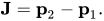
In classical mechanics, impulse (symbolized by J or Imp) is the change in momentum of an object. If the initial momentum of an object is p1, and a subsequent momentum is p2, the object has received an impulse J:

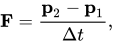
Momentum is a vector quantity, so impulse is also a vector quantity:Newton's second law of motion states that the rate of change of momentum of an object is equal to the resultant force F acting on the object:so the impulse J delivered by a steady force F acting for time Δt is:

View the full Wikipedia page for Impulse (physics)
↑ Return to Menu

Vector (physics) in the context of Line of application

In physics, the line of action (also called line of application) of a force (F) is a geometric representation of how the force is applied. It is the straight line through the point at which the force is applied, and is in the same direction as the vector F. The lever arm is the perpendicular distance from the axis of rotation to the line of action.

The concept is essential, for instance, for understanding the net effect of multiple forces applied to a body. For example, if two forces of equal magnitude act upon a rigid body along the same line of action but in opposite directions, they cancel and have no net effect. But if, instead, their lines of action are not identical, but merely parallel, then their effect is to create a moment on the body, which tends to rotate it.

View the full Wikipedia page for Line of application
↑ Return to Menu