Varieties of Chinese in the context of "Languages of China"

Play Trivia Questions online!

or

Skip to study material about Varieties of Chinese in the context of "Languages of China"

Ad spacer

⭐ Core Definition: Varieties of Chinese

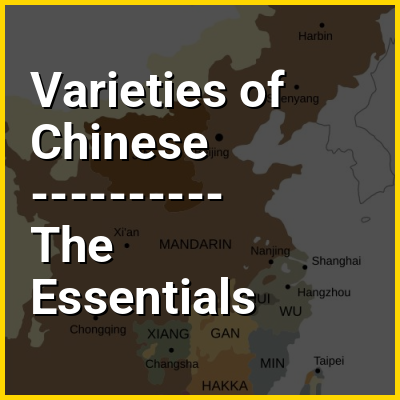
There are hundreds of local Chinese language varieties forming a branch of the Sino-Tibetan language family, many of which are not mutually intelligible. Variation is particularly strong in the more mountainous southeast part of mainland China. The varieties are typically classified into several groups: Mandarin, Wu, Min, Xiang, Gan, Jin, Hakka and Yue, though some varieties remain unclassified. These groups are neither clades nor individual languages defined by mutual intelligibility, but reflect common phonological developments from Middle Chinese.

Chinese varieties have the greatest differences in their phonology, and to a lesser extent in vocabulary and syntax. Southern varieties tend to have fewer initial consonants than northern and central varieties, but more often preserve the Middle Chinese final consonants. All have phonemic tones, with northern varieties tending to have fewer distinctions than southern ones. Many have tone sandhi, with the most complex patterns in the coastal area from Zhejiang to eastern Guangdong.
↓ Menu

>>>PUT SHARE BUTTONS HERE<<<
In this Dossier

Varieties of Chinese in the context of Diglossia

In linguistics, diglossia (/dˈɡlɒsiə/ dy-GLOSS-ee-ə, US also /dˈɡlɔːsiə/ dy-GLAW-see-ə) is where two dialects or languages are used (in fairly strict compartmentalization) by a single language community. In addition to the community's everyday or vernacular language variety (labeled "L" or "low" variety), a second, highly codified lect (labeled "H" or "high") is used in certain situations such as literature, formal education, or other specific settings, but not used normally for ordinary conversation. The H variety may have no native speakers within the community. In cases of three dialects, the term triglossia is used. When referring to two writing systems coexisting for a single language, the term digraphia is used.

The high variety may be an older stage of the same language (as in medieval Europe, where Latin (H) remained in formal use even as colloquial speech (L) diverged), an unrelated language, or a distinct yet closely related present-day dialect (as in northern India and Pakistan, where Hindustani (L) is used alongside the standard registers of Hindi (H) and Urdu (H); Germany, where Hochdeutsch (H) is used alongside German dialects (L); the Arab world, where Modern Standard Arabic (H) is used alongside other varieties of Arabic (L); and China, where Standard Chinese (H) is used as the official, literary standard and local varieties of Chinese (L) are used in everyday communication); in Dravidian languages, Tamil has the largest diglossia with Literary Tamil (H) used in formal settings and colloquial spoken Tamil (L) used in daily life. Other examples include literary Katharevousa (H) versus spoken Demotic Greek (L); Indonesian, with its bahasa baku (H) and bahasa gaul (L) forms; Standard American English (H) versus African-American Vernacular English or Hawaiian Pidgin (L); and literary (H) versus spoken (L) Welsh.

↑ Return to Menu

Varieties of Chinese in the context of Written Chinese

Written Chinese is a writing system that uses Chinese characters and other symbols to represent the Chinese languages. Chinese characters do not directly represent pronunciation, unlike letters in an alphabet or syllabograms in a syllabary. Rather, the writing system is morphosyllabic: characters are one spoken syllable in length, but generally correspond to morphemes in the language, which may either be independent words, or part of a polysyllabic word. Most characters are constructed from smaller components that may reflect the character's meaning or pronunciation. Literacy requires the memorization of thousands of characters; college-educated Chinese speakers know approximately 4,000. This has led in part to the adoption of complementary transliteration systems (generally Pinyin) as a means of representing the pronunciation of Chinese.

Chinese writing is first attested during the late Shang dynasty (c. 1250 – c. 1050 BCE), but the process of creating characters is thought to have begun centuries earlier during the Late Neolithic and early Bronze Age (c. 2500–2000 BCE). After a period of variation and evolution, Chinese characters were standardized under the Qin dynasty (221–206 BCE). Over the millennia, these characters have evolved into well-developed styles of Chinese calligraphy. As the varieties of Chinese diverged, a situation of diglossia developed, with speakers of mutually unintelligible varieties able to communicate through writing using Literary Chinese. In the early 20th century, Literary Chinese was replaced in large part with written vernacular Chinese, largely corresponding to Standard Chinese, a form based on the Beijing dialect of Mandarin. Although most other varieties of Chinese are not written, there are traditions of written Cantonese, written Shanghainese and written Hokkien, among others.

↑ Return to Menu

Varieties of Chinese in the context of Dialect continuum

A dialect continuum or dialect chain is a series of language varieties spoken across some geographical area such that neighboring varieties are mutually intelligible, but the differences accumulate over distance so that widely separated varieties may not be. This is a typical occurrence with widely spread languages and language families around the world, when these languages did not spread recently. Some prominent examples include the Indo-Aryan languages across large parts of India, varieties of Arabic across north Africa and southwest Asia, the Turkic languages, the varieties of Chinese, and parts of the Romance, Germanic and Slavic families in Europe. Terms used in older literature include dialect area (Leonard Bloomfield) and L-complex (Charles F. Hockett).

Dialect continua typically occur in long-settled agrarian populations, as innovations spread from their various points of origin as waves. In this situation, hierarchical classifications of varieties are impractical. Instead, dialectologists map variation of various language features across a dialect continuum, drawing lines called isoglosses between areas that differ with respect to some feature.

↑ Return to Menu

Varieties of Chinese in the context of Sinophone

Sinophone, which means "Chinese-speaking", typically refers to an individual who speaks at least one variety of Chinese (that is, one of the Sinitic languages). Academic writers often use the term Sinophone in two definitions: either specifically "Chinese-speaking populations where it is a minority language, excluding mainland China, Hong Kong, Macau, and Taiwan" or generally "Chinese-speaking areas, including where it is an official language". Many authors use the collocation Sinophone world or Chinese-speaking world to mean the Chinese-speaking world itself (consisting of Greater China and Singapore) or the distribution of the Chinese diaspora outside of Greater China.

Mandarin Chinese is the most commonly spoken variety of the Chinese languages today, with over 1 billion total speakers (approximately 12% of the world population), of which about 900 million are native speakers, making it the most spoken first language in the world and second most spoken overall. It is the official variety of Chinese in mainland China, Taiwan, and Singapore. Meanwhile, Cantonese is the official variety of Chinese in Hong Kong and Macau and is also widely spoken among significant overseas Chinese communities in Southeast Asia as well as the rest of the world.

↑ Return to Menu

Varieties of Chinese in the context of Romanization of Chinese

Romanization of Chinese is the use of the Latin alphabet to transliterate Chinese. Chinese uses a logographic script and its characters do not represent phonemes directly. There have been many systems using Roman characters to represent Chinese throughout history. Linguist Daniel Kane wrote, "It used to be said that sinologists had to be like musicians, who might compose in one key and readily transcribe into other keys." The dominant international standard for Standard Mandarin since about 1982 has been Hanyu Pinyin, invented by a group of Chinese linguists, including Zhou Youguang, in the 1950s. Other well-known systems include Wade–Giles (Beijing Mandarin) and Yale romanization (Beijing Mandarin and Cantonese).

There are many uses for Chinese romanization. Most broadly, it is used to provide a useful way for foreigners who are not skilled at recognizing Chinese script to read and recognize Chinese. It can also be helpful for clarifying pronunciation among Chinese speakers who speak mutually unintelligible Chinese dialects. Romanization facilitates entering characters on standard keyboards. Chinese dictionaries have complex and competing sorting rules for characters: romanization systems simplify the problem by listing characters in their Latin form alphabetically.

↑ Return to Menu

Varieties of Chinese in the context of Written vernacular Chinese

Written vernacular Chinese, also known as baihua, comprises forms of written Chinese based on the vernacular varieties of the language spoken throughout China. It is contrasted with Literary Chinese, which was the predominant written form of the language in imperial China until the early 20th century.

A style based on vernacular Mandarin Chinese was used in novels by Ming and Qing dynasty authors, and was later refined by intellectuals associated with the May Fourth Movement. This form corresponds to spoken Standard Chinese, but is the standard form of writing used by speakers of all varieties of Chinese throughout mainland China, Taiwan, Malaysia, and Singapore. It is commonly called Standard Written Chinese or Modern Written Chinese to distinguish it from spoken vernaculars and other written vernaculars, like written Cantonese and written Hokkien.

↑ Return to Menu

Varieties of Chinese in the context of Written Cantonese

Written Cantonese is the most complete written form of a Chinese language after that for Mandarin Chinese and Classical Chinese. Classical Chinese was the main literary language of China until the 19th century. Written vernacular Chinese first appeared in the 17th century, and a written form of Mandarin became standard throughout China in the early 20th century. Cantonese is a common language in places like Hong Kong and Macau. While the Mandarin form can to some extent be read and spoken word for word in other Chinese varieties, its intelligibility to non-Mandarin speakers is poor to incomprehensible because of differences in idioms, grammar and usage. Modern Cantonese speakers have therefore developed new characters for words that do not have characters for them and have retained others that have been lost in standard Chinese.

With the advent of the computer and standardization of character sets specifically for Cantonese, many printed materials in predominantly Cantonese-speaking areas of the world are written to cater to their population with these written Cantonese characters.

↑ Return to Menu

Varieties of Chinese in the context of Written Shanghainese

The Shanghainese language, also known as the Shanghai dialect, or Hu language, is a variety of Wu Chinese spoken in the central districts of the city of Shanghai and its surrounding areas. It is classified as part of the Sino-Tibetan language family. Shanghainese, like the rest of the Wu language group, is mutually unintelligible with other varieties of Chinese, such as Mandarin.

Shanghainese belongs to a separate group of the Taihu Wu subgroup. With nearly 14 million speakers, Shanghainese is also the largest single form of Wu Chinese. Since the late 19th century, it has served as the lingua franca of the entire Yangtze River Delta region, but in recent decades its status has declined relative to Mandarin, which most Shanghainese speakers can also speak.

↑ Return to Menu