Value-added tax


Value-added tax

⭐ Core Definition: Value-added tax

A value-added tax (VAT or goods and services tax (GST), general consumption tax (GCT)) is a consumption tax that is levied on the value added at each stage of a product's production and distribution. VAT is similar to, and is often compared with, a sales tax. VAT is an indirect tax, because the consumer who ultimately bears the burden of the tax is not the entity that pays it. Specific goods and services are typically exempted in various jurisdictions.

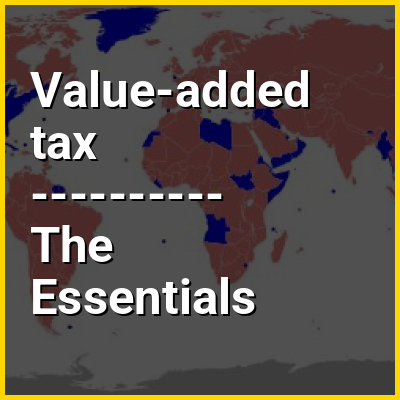
Products exported to other countries are typically exempted from the tax, typically via a rebate to the exporter. VAT is usually implemented as a destination-based tax, where the tax rate is based on the location of the customer. VAT raises about a fifth of total tax revenues worldwide and among the members of the Organisation for Economic Co-operation and Development (OECD). As of January 2025, 175 of the 193 countries with UN membership employ a VAT, including all OECD members except the United States.
↓ Menu
HINT:

In this Dossier

Value-added tax in the context of Disposable income

Disposable income is total personal income minus current taxes on income. In national accounting, personal income minus personal current taxes equals disposable personal income or household disposable income. Subtracting personal outlays (which includes the major category of personal [or private] consumption expenditure) yields personal (or, private) savings, hence the income left after paying away all the taxes is referred to as disposable income.

Restated, consumption expenditure plus savings equals disposable income after accounting for transfers such as payments to children in school or elderly parents' living and care arrangements.

View the full Wikipedia page for Disposable income
↑ Return to Menu

Value-added tax in the context of Indirect tax

An indirect tax (such as a sales tax, per unit tax, value-added tax (VAT), excise tax, consumption tax, or tariff) is a tax that is levied upon goods and services before they reach the customer who ultimately pays the indirect tax as a part of market price of the good or service purchased. Alternatively, if the entity who pays taxes to the tax collecting authority does not suffer a corresponding reduction in income, i.e., the effect and tax incidence are not on the same entity meaning that tax can be shifted or passed on, then the tax is indirect.

An indirect tax is collected by an intermediary (such as a retail store) from the person (such as the consumer) who pays the tax included in the price of a purchased good. The intermediary later files a tax return and forwards the tax proceeds to government with the return. In this sense, the term indirect tax is contrasted with a direct tax, which is collected directly by government from the persons (legal or natural) on whom it is imposed. Some commentators have argued that "a direct tax is one that cannot be charged by the taxpayer to someone else, whereas an indirect tax can be."

View the full Wikipedia page for Indirect tax
↑ Return to Menu

Value-added tax in the context of Sales tax

A sales tax is a tax paid to a governing body for the sales of certain goods and services. Usually laws allow the seller to collect funds for the tax from the consumer at the point of purchase.

When a tax on goods or services is paid to a governing body directly by a consumer, it is usually called a use tax. Often laws provide for the exemption of certain goods or services from sales and use tax, such as food, education, and medicines. A value-added tax (VAT) collected on goods and services is related to a sales tax. See Comparison with sales tax for key differences.

View the full Wikipedia page for Sales tax
↑ Return to Menu

Value-added tax in the context of Bullion coin

Bullion coin or specie refers to coin struck from bullion (namely, highly refined precious metal) and kept as a store of value or an investment rather than used in day-to-day commerce, or collectable, with numismatic value beyond that of its metal content. A bullion coin is distinguished by its weight (or mass) and fineness on the coin. Unlike rounds, bullion coins are minted by government mints and have a legal tender face value. Bullion coins can have fineness ranging from 91.9% (22 karat) to 99.99% purity (24 karat).

In the United Kingdom coins deemed to be investment coins are exempt from value-added tax (VAT) on transactions. A coin is considered to be an investment coin if it was minted after 1800, and at least 900 thousandths fine, and has been legal tender in its country of origin, and not normally sold at more than 180% of the value of its precious metal content; or if it is on a long list of coins deemed to be investment coins. Under United States law, "coins" not stamped by authority of the government are not coins and must be advertised as "rounds" instead.

View the full Wikipedia page for Bullion coin
↑ Return to Menu

Value-added tax in the context of Excise

An excise, or excise tax, is any duty on a category of goods that is normally levied by a government at the moment of manufacture for domestic consumption. This makes excise different from a sales tax or value-added tax (which are levied at a point of sale) or from customs duties (which are levied on goods when they cross a designated border).

An excise is considered an indirect tax, meaning that the producer or seller who pays the levy to the government is expected to try to recover their loss by raising the price paid by the eventual buyer of the goods. Excise is thus a tax that relates to a quantity, not a value, as opposed to the value-added tax which concerns the value of a good or service. Excises are typically imposed in addition to an indirect tax such as a sales tax or value-added tax (VAT). Typically, an excise is distinguished from a sales tax or VAT in three ways:

View the full Wikipedia page for Excise
↑ Return to Menu

Value-added tax in the context of Consumption tax

A consumption tax is a tax levied on consumption spending on goods and services. The tax base of such a tax is the money spent on consumption. Consumption taxes are usually indirect, such as a sales tax or a value-added tax. However, a consumption tax can also be structured as a form of direct, personal taxation, such as the Hall–Rabushka flat tax.

View the full Wikipedia page for Consumption tax
↑ Return to Menu

Value-added tax in the context of Ad valorem tax

An ad valorem tax (Latin for "according to value") is a tax whose amount is based on the value of a transaction or of a property. It is typically imposed at the time of a transaction, as in the case of a sales tax or value-added tax (VAT). An ad valorem tax may also be imposed annually, as in the case of a real or personal property tax, or in connection with another significant event (e.g. inheritance tax, expatriation tax, or tariff). In some countries, a stamp duty is imposed as an ad valorem tax.

View the full Wikipedia page for Ad valorem tax
↑ Return to Menu