Valley of Flowers National Park in the context of Chamoli


Valley of Flowers National Park in the context of Chamoli

⭐ Core Definition: Valley of Flowers National Park

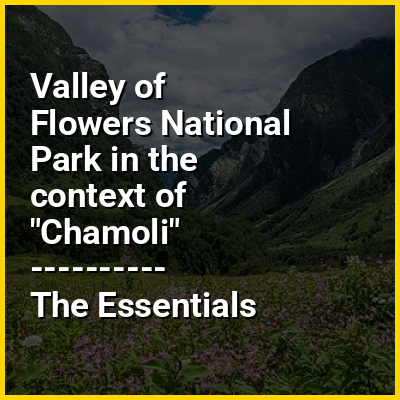
Valley of Flowers National Park is an Indian national park which was established in 1982. It is located in Chamoli in the state of Uttarakhand and is known for its meadows of endemic alpine flowers and the variety of flora. This richly diverse area is also home to rare and endangered animals, including the Asiatic black bear, snow leopard, musk deer, brown bear, red fox and blue sheep. Birds found in the park include Himalayan monal pheasant and other high-altitude birds.

At 3,352 to 3,658 meters above sea level, the gentle landscape of the Valley of Flowers National Park complements the rugged mountain wilderness of Nanda Devi National Park to the east. Together, they encompass a unique transition zone between the mountain ranges of the Zanskar and Great Himalayas. The park stretches over 87.50 km and is about 8 km long and 2 km wide. It lies completely in the temperate alpine zone. Both parks are encompassed in the Nanda Devi Biosphere Reserve (223,674 ha) which is further surrounded by a buffer zone (5,148.57 km). Nanda Devi National Park Reserve is in the UNESCO World Network of Biosphere Reserves.
↓ Menu
HINT:

In this Dossier

Valley of Flowers National Park in the context of Chamoli district

Chamoli district is a district of the Uttarakhand state of India. It is bounded by China's Xizang Autonomous Region to the north, and by the Uttarakhand districts of Pithoragarh and Bageshwar to the east, Almora to the south, Pauri Garhwal to the southwest, Rudraprayag to the west, and Uttarkashi to the northwest. The administrative headquarters of Chamoli district is in Gopeshwar.

Chamoli hosts a variety of destinations of pilgrim and tourist interest including Badrinath, Hemkund Sahib and Valley of Flowers. The Chipko movement was first started in Chamoli.

View the full Wikipedia page for Chamoli district
↑ Return to Menu

Valley of Flowers National Park in the context of R.L. Holdsworth

Romilly Lisle Holdsworth, commonly known as R. L. Holdsworth, (25 February 1899 – 20 June 1976) was an English scholar, academic, educationalist, cricketer and a distinguished Himalayan mountaineer. He was a member of the first expedition to Kamet in 1931, which included other stalwarts such as Eric Shipton and Frank Smythe. Holdsworth, along with Shipton and Smythe, are credited with the discovery of the Valley of Flowers, now a UNESCO World Heritage Site, during their return from Kamet.

View the full Wikipedia page for R.L. Holdsworth
↑ Return to Menu

Valley of Flowers National Park in the context of Annual rainfall in india

The climate of India includes a wide range of weather conditions, influenced by its vast geographic scale and varied topography. Based on the Köppen system, India encompasses a diverse array of climatic subtypes. These range from arid and semi-arid regions in the west to highland, sub-arctic, tundra, and ice cap climates in the northern Himalayan regions, varying with elevation.

The Indo-Gangetic Plains in the north experience a humid subtropical climate which become more temperate at higher altitudes, like the Sivalik Hills, or continental in some areas like Gulmarg. In contrast, much of the south and the east exhibit tropical climate conditions, which support lush rainforests in parts of these territories. Many regions have starkly different microclimates, making it one of the most climatically diverse countries in the world. The country's meteorological department follows four seasons with some local adjustments: winter (December to February), summer (March to May), monsoon or south-west monsoon (June to September) and post-monsoon or north-east monsoon (October to November). Some parts of the country with subtropical, temperate or continental climates also experience spring and autumn.

View the full Wikipedia page for Annual rainfall in india
↑ Return to Menu