VGA in the context of "D-subminiature"

Play Trivia Questions online!

or

Skip to study material about VGA in the context of "D-subminiature"


⭐ Core Definition: VGA

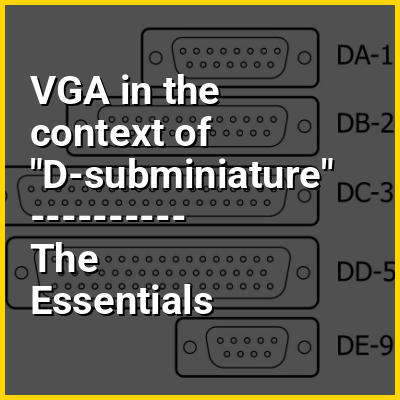
Video Graphics Array (VGA) is a video display controller and accompanying de facto graphics standard, first introduced with the IBM PS/2 line of computers in 1987, which became ubiquitous in the IBM PC compatible industry within three years. The term can now refer to the computer display standard, the 15-pin D-subminiature VGA connector, or the 640 × 480 resolution characteristic of the VGA hardware.

VGA was the last IBM graphics standard to which the majority of IBM PC compatible computer manufacturers conformed, making it the lowest common denominator that virtually all post-1990 PC graphics hardware can be expected to implement.
↓ Menu

In this Dossier

VGA in the context of Digital Visual Interface

Digital Visual Interface (DVI) is a video display interface developed by the Digital Display Working Group (DDWG). The digital interface is used to connect a video source, such as a video display controller, to a display device, such as a computer monitor. It was developed with the intention of creating an industry standard for the transfer of uncompressed digital video content.

DVI devices manufactured as DVI-I have support for analog connections, and are compatible with the analog VGA interface by including VGA pins, while DVI-D devices are digital-only. This compatibility, along with other advantages, led to its widespread acceptance over competing digital display standards Plug and Display (P&D) and Digital Flat Panel (DFP). Although DVI is predominantly associated with computers, it is sometimes used in other consumer electronics such as television sets and DVD players.

↑ Return to Menu

VGA in the context of Mini-VGA

Mini-VGA connectors are proprietary and non-standard alternative video connectors that were used on some laptops and other computer systems in place of a standard VGA connector. Apple, HP, and Asus each introduced separate connectors using the same moniker of "mini-VGA", but which are otherwise physically incompatible with each other (though all of them are compatible with standard VGA using the correct adapter).

Apple's mini-VGA ports may be found on some older Apple computers, including iBooks, eMacs, certain PowerBooks (e.g., early G4 12-inch), and some iMacs (e.g., iMac G4, G5). In addition to a more compact form-factor, Apple's mini-VGA ports also have the added ability to output composite as well as S-Video, in addition to VGA signals, through the use of EDID. When used for S-Video, S-Video's chrominance (C) and luminance (Y) signals replace VGA's red (R) and green (G) channels, while for composite video, the signal is output through VGA's blue (B) channel. (The horizontal and vertical sync pins of VGA are left unused.)

↑ Return to Menu