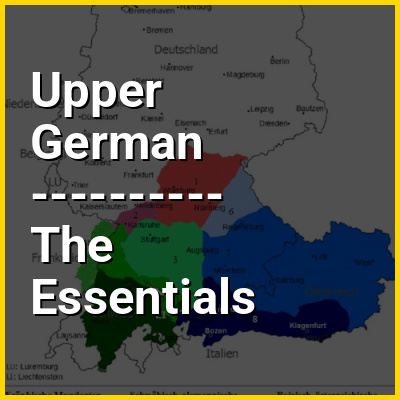
Upper German (German: Oberdeutsch [ˈoːbɐdɔʏtʃ] ) is a family of High German dialects spoken primarily in the southern German-speaking area (Sprachraum).
>>>PUT SHARE BUTTONS HERE<<<
In this Dossier
- ⭐ Core Definition: Upper German
- Upper German in the context of German dialects
- Upper German in the context of Bavarian language
- Upper German in the context of Low Alemannic German
- Upper German in the context of East Franconian German
- Upper German in the context of Southern Germany
- Upper German in the context of Swabian German
- Upper German in the context of South Franconian German
- Upper German in the context of Isogloss
Upper German in the context of German dialects
German dialects are the various traditional local varieties of the German language. Though varied by region, those of the southern half of Germany beneath the Benrath line are dominated by the geographical spread of the High German consonant shift, and the dialect continuum that connects High German to the neighboring varieties of Low Franconian (Dutch) and Low German.
The varieties of German are conventionally grouped into Upper German, Central German and Low German; Upper and Central German form the High German subgroup. Standard German is a standardized form of High German, developed in the early modern period based on a combination of Central German and Upper German varieties.
Upper German in the context of Bavarian language
Bavarian (Boarisch or Bairisch; German: Bayrisch [ˈbaɪʁɪʃ] ), alternately Austro-Bavarian, is a group of Upper German varieties spoken in the south-east of the German language area, including the German state of Bavaria, most of Austria, and South Tyrol in Italy. Prior to 1945, Bavarian was also prevalent in parts of the southern Sudetenland and western Hungary. Bavarian is spoken by approximately 12 million people in an area of around 125,000 square kilometres (48,000 sq mi), making it the largest of all German dialects. In 2008, 45 percent of Bavarians claimed to use only dialect in everyday communication.
Upper German in the context of Low Alemannic German
Low Alemannic German (German: Niederalemannisch) is a branch of Alemannic German, which is part of Upper German. Its varieties are only partly intelligible to non-Alemannic speakers.
Upper German in the context of East Franconian German
East Franconian (German: Ostfränkisch [ˈɔstfʁɛŋkɪʃ] ), usually referred to as Franconian in German (Fränkisch [ˈfʁɛŋkɪʃ] ), is a dialect spoken in Franconia, the northern part of the federal state of Bavaria and other areas in Germany around Nuremberg, Bamberg, Coburg, Würzburg, Hof, Bayreuth, Meiningen, Bad Mergentheim, and Crailsheim. The major subgroups are Unterostfränkisch (spoken in Lower Franconia and southern Thuringia), Oberostfränkisch (spoken in Upper and Middle Franconia) and Südostfränkisch (spoken in some parts of Middle Franconia and Hohenlohe). Until the wholesale expulsion of Germans from Bohemia, the dialect was also spoken around Saaz (today: Žatec).
In the transitional area between Rhine Franconian in the northwest and the Austro-Bavarian dialects in the southeast, East Franconian has elements of Central German and Upper German. The same goes only for South Franconian German in adjacent Baden-Württemberg. East Franconian is one of the German dialects with the highest number of speakers.
Upper German in the context of Southern Germany
Southern Germany (German: Süddeutschland, [ˈzyːtˌdɔʏtʃlant] ) is a region of Germany that includes the areas in which Upper German dialects are spoken, which includes the stem duchies of Bavaria and Swabia in present-day Bavaria, Baden-Württemberg, and the southern portion of Hesse and Rhineland-Palatinate that were part of the Duchy of Franconia.
German-speaking Switzerland, Austria, Liechtenstein, Alsace, and South Tyrol are also historically, culturally, and linguistically associated with the region.
Upper German in the context of Swabian German
Swabian (German: Schwäbisch [ˈʃvɛːbɪʃ] ) is one of the dialect groups of Upper German, sometimes one of the dialect groups of Alemannic German (in the broad sense), that belong to the High German dialect continuum. It is mainly spoken in Swabia, which is located in central and southeastern Baden-Württemberg (including its capital Stuttgart and the Swabian Jura region) and the southwest of Bavaria (Bavarian Swabia). Furthermore, Swabian German dialects are spoken by Caucasus Germans in Transcaucasia. The dialects of the Danube Swabian population of Hungary, the former Yugoslavia and Romania are only nominally Swabian and can be traced back not only to Swabian but also to Franconian, Bavarian and Hessian dialects, with locally varying degrees of influence of the initial dialects.
Upper German in the context of South Franconian German
South Franconian (German: Südfränkisch) or South Rhine Franconian (German: Südrheinfränkisch) is an Upper German dialect which is spoken in the northernmost part of Baden-Württemberg in Germany, around Karlsruhe, Mosbach and Heilbronn. Like closely related East Franconian, it is a transitional dialect, which unites elements of Central German and Upper German.
The language area is located in the transient zone between Rhine Franconian dialects (Hessian and Palatinate German) in the north and Alemannic German (Low Alemannic and Swabian German) in the south. South Franconian is one of the High German dialects with the lowest number of speakers. South Franconian is not considered a separate dialect by some observers. The scope of South Franconian is disputed.
Upper German in the context of Isogloss
An isogloss, also called a heterogloss, is the geographic boundary of a certain linguistic feature, such as the pronunciation of a vowel, the meaning of a word, or the use of some morphological or syntactic feature. Isoglosses are a subject of study in dialectology, in which they demarcate the differences between regional dialects of a language; in areal linguistics, in which they represent the extent of borrowing of features between languages in contact with one another; and in the wave model of historical linguistics, in which they indicate the similarities and differences between members of a language family.
Major dialects are typically demarcated by bundles of isoglosses, such as the Benrath line that distinguishes High German from the other West Germanic languages and the La Spezia–Rimini Line that divides the Northern Italian languages and Romance languages west of Italy from Central Italian dialects and Romance languages east of Italy. However, an individual isogloss may or may not have any coterminus with a language border. For example, the front-rounding of /y/ cuts across France and Germany, while the /y/ is absent from Italian and Spanish words that are cognates with the /y/-containing French words.