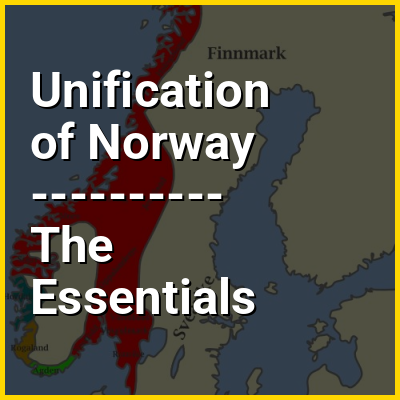
The Unification of Norway (Norwegian Bokmål: Rikssamlingen) is the process by which Norway merged from several petty kingdoms into a single kingdom, predecessor to the modern Kingdom of Norway.
>>>PUT SHARE BUTTONS HERE<<<
In this Dossier
Unification of Norway in the context of Petty kingdoms of Norway
The petty kingdoms of Norway (Bokmål: smårike) were the entities from which the later Kingdom of Norway was founded. Before the unification of Norway in 872 and during the period of fragmentation after King Harald Fairhair's death, Norway was divided in several small kingdoms. Some could have been as small as a cluster of villages, and others comprised several of today's counties.
By the time of the first historical records of Scandinavia, about the 8th century, a number of small political entities existed in Norway. The exact number is unknown, and would probably also fluctuate with time. It has been estimated that there were 9 petty realms in Western Norway during the early Viking Age. Archaeologist Bergljot Solberg on this basis estimates that there would have been at least 20 in the whole country.
Unification of Norway in the context of List of monarchs of Norway
The list of monarchs of Norway (Norwegian: kongerekken or kongerekka) begins in 872: the traditional dating of the Battle of Hafrsfjord, after which victorious King Harald Fairhair merged several petty kingdoms into that of his father. Named after the homonymous geographical region, Harald's realm was later to be known as the Kingdom of Norway.
Traditionally established in 872 and existing continuously for over 1,100 years, the Kingdom of Norway is one of the oldest states of Europe: King Harald V, who has reigned since 1991, is the 64th monarch according to the official list. During interregna, Norway has been ruled by variously titled regents.
Unification of Norway in the context of Bohuslän
Bohuslän (Swedish pronunciation: [ˈbûːhʉːsˌlɛːn] ) is a Swedish province in Götaland, on the northernmost part of the country's west coast. It is bordered by Dalsland to the northeast, Västergötland to the southeast, the Skagerrak arm of the North Sea to the west, and the county of Østfold, in Norway, to the north. In English it literally means Bohus County, although it shared counties with the city of Gothenburg prior to the 1998 county merger and thus was not an administrative unit in its own right.
Bohuslän is named after the medieval Norwegian castle of Bohus (Norwegian: Båhus). Under the name Båhuslen (Bohuslen in Danish), it was a Norwegian county from the Norwegian conquest of the region from the Geats and subsequent unification of the country in the 870s until the Treaty of Roskilde in 1658, when the union of Denmark–Norway was forced to cede this county, as well as Skåneland (part of Denmark proper), to Sweden.
Unification of Norway in the context of Battle of Hafrsfjord
The Battle of Hafrsfjord (Norwegian: Slaget i Hafrsfjord) was a naval battle fought in Hafrsfjord sometime between 872 and 900 that resulted in the unification of Norway, later known as the Kingdom of Norway. After the battle, the victorious Viking chief Harald Fairhair proclaimed himself the first king of the Norwegians, merging several petty kingdoms under a single monarch for the first time.