Umayyad invasion of Gaul in the context of "Paladins"

Play Trivia Questions online!

or

Skip to study material about Umayyad invasion of Gaul in the context of "Paladins"

Ad spacer

⭐ Core Definition: Umayyad invasion of Gaul

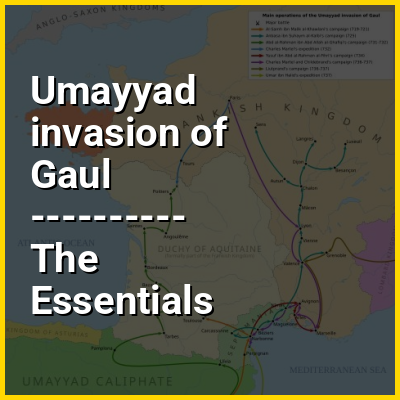
The Umayyad invasion of Gaul followed the Umayyad conquest of the Iberian peninsula (711–718). The Umayyad invasion occurred in two main phases, from AD 719 and from 732. Although the Umayyads secured control of Septimania, their incursions beyond this region into the Loire and Rhône valleys failed. In 759, Muslim forces lost Septimania to the Christian Frankish Empire and retreated to the Iberian Peninsula which they called al-Andalus.

The 719 Umayyad invasion of Gaul was the continuation of their conquest of the Visigothic Kingdom of Hispania. Septimania, in southern Gaul, was the last unconquered province of the Visigothic Kingdom. Muslim armies began to campaign in Septimania in 719. After the fall, in 720, of Narbonne, the capital of the Visigothic rump state, Umayyad armies composed of Arabs and Berbers turned north against Aquitaine. Their advance was stopped at the Battle of Toulouse in 721, but they sporadically raided the southern half of Gaul as far as Avignon and Lyon.

↓ Menu

>>>PUT SHARE BUTTONS HERE<<<
In this Dossier

Umayyad invasion of Gaul in the context of Paladin

The Paladins, also called the Twelve Peers (French: Douze Pairs), are twelve legendary knights, the foremost members of Charlemagne's court in the 8th century. They first appear in the medieval (12th century) chanson de geste cycle of the Matter of France, where they play a similar role to the Knights of the Round Table in Arthurian romance. In these romantic portrayals, the chivalric paladins represent Christianity against a Saracen (Muslim) invasion of Europe. The names of the paladins vary between sources, but there are always twelve of them (a number with Christian associations) led by Roland (spelled Orlando in later Italian sources). The paladins' most influential appearance is in The Song of Roland, written between 1050 and 1115, which narrates the heroic death of Roland at the Battle of Roncevaux Pass.

The legend is based on the historical Umayyad invasion of Gaul and subsequent conflict in the Marca Hispanica between the Frankish Empire and the Emirate of Córdoba. The term paladin is from Old French, deriving from the Latin comes palatinus (count palatine), a title given to close retainers.

↑ Return to Menu

Umayyad invasion of Gaul in the context of Septimania

Septimania is a historical region in modern-day southern France. It referred to the western part of the Roman province of Gallia Narbonensis that passed to the control of the Visigoths in 462, when Septimania was ceded to their king, Theodoric II. During the Early Middle Ages, the region was variously known as Gallia Narbonensis, Gallia, or Narbonensis. The territory of Septimania roughly corresponds with the modern French former administrative region of Languedoc-Roussillon that merged into the new administrative region of Occitanie. In the Visigothic Kingdom, which became centred on Toledo by the end of the reign of Leovigild, Septimania was both an administrative province of the central royal government and an ecclesiastical province whose metropolitan was the Archbishop of Narbonne. Originally, the Goths may have maintained their hold on the Albigeois, but if so it was conquered by the time of Chilperic I. There is archaeological evidence that some enclaves of Visigothic population remained in Frankish Gaul, near the Septimanian border, after 507.

The region of Septimania was invaded by the Andalusian Muslims in 719, renamed as Arbūnah and turned into a military base for future operations by the Andalusian military commanders. It passed briefly to the Emirate of Córdoba, which had been expanding from the south during the same century, before its subsequent conquest by the Christian Franks in 759, who by the end of the 9th century renamed it as Gothia or the Gothic March (Marca Gothica). Eventually, the Christian Franks chased the Muslim Arabs and Berbers away from Septimania and conquered Narbonne in 759, and the Carolingian king Pepin the Short came up reinforced. Septimania became a march of the Carolingian Empire and then West Francia down to the 13th century, though it was culturally and politically autonomous from the northern France-based central royal government. The region was under the influence of the people from the count territories of Toulouse, Provence, and ancient County of Barcelona. It was part of the wider cultural and linguistic region comprising the southern third of France known as Occitania. This area was finally brought under effective control of the French kings in the early 13th century as a result of the Albigensian Crusade, after which it was assigned governors. From the end of the thirteenth century Septimania evolved into the royal province of Languedoc.
↑ Return to Menu

Umayyad invasion of Gaul in the context of Siege of Narbonne (752–759)

The siege of Narbonne took place in France between 752 and 759, led by the Frankish king Pepin the Short against the Umayyad temporary camp defended by a small garrison of Arab and Berber Muslim troops who had invaded Septimania and occupied the Visigothic Kingdom and its Gallo-Roman inhabitants since 719. The siege remained as a key battlefield in the context of the Carolingian expedition south to Provence and conquest of Septimania starting in 752.

The region of Septimania was up to that point in the hands of Andalusi military commanders and the local Visigothic and Gallo-Roman nobility, who had concluded different military and political arrangements to oppose the expanding Frankish realm. Umayyad rule collapsed by 750, and Umayyad territories in Europe were ruled autonomously by Yusuf ibn Abd al-Rahman al-Fihri and his supporters.

↑ Return to Menu

Umayyad invasion of Gaul in the context of Battle of Tours

The Battle of Tours, also called the Battle of Poitiers and the Battle of the Highway of the Martyrs (Arabic: معركة بلاط الشهداء, romanizedMaʿrakat Balāṭ ash-Shuhadā'), was fought on 10 October 732, and was an important battle during the Umayyad invasion of Gaul. It resulted in victory for the Frankish and Aquitanian forces, led by Charles Martel, over the invading Umayyad forces, led by Abd al-Rahman al-Ghafiqi, governor of al-Andalus. Several historians, such as Edward Gibbon, have credited the Christian victory in the battle as an important factor in curtailing the spread of Islam in Western Europe.

Details of the battle, including the number of combatants and its exact location, are unclear from the surviving sources. Most sources agree that the Umayyads had a larger force and suffered heavier casualties. Notably, the Frankish troops apparently fought without heavy cavalry. The battlefield was located somewhere between the cities of Poitiers and Tours, in northern Aquitaine in western France, near the border of the Frankish realm and the then-independent Duchy of Aquitaine under Odo the Great.

↑ Return to Menu