Ukrainian refugee crisis in the context of "UNHCR"

Play Trivia Questions online!

or

Skip to study material about Ukrainian refugee crisis in the context of "UNHCR"

Ad spacer

⭐ Core Definition: Ukrainian refugee crisis

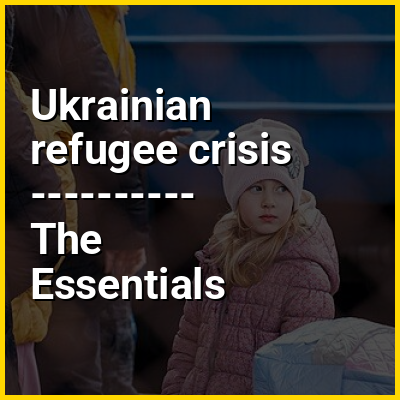
The Ukrainian refugee crisis began with the Russian invasion of Ukraine in February 2022. As of September 2025, the UNHCR has recorded 5.7 million Ukrainian refugees around the world, with 90% of this figure residing in various European countries outside of Ukraine. Older reports by the International Organization for Migration in May 2022 show approximately eight million Ukrainians as internally displaced persons. By 20 March 2022, nearly one-quarter of Ukraine's total population had been displaced due to active military hostilities with Russia. About 90% of all Ukrainian refugees are women and children; by 24 March, more than half of all children in Ukraine had left their homes, of whom a quarter had left the country as well. Men between the ages of 18 and 60 have been banned from leaving the country under Ukrainian martial law, which came into force a few hours into Russia's first military offensive into Ukraine. This ongoing escalation of the Russo-Ukrainian War has caused the largest refugee crisis in the 21st century and the fourth-largest refugee crisis in modern history as a whole, with the highest refugee flight rate globally. It is also the first European refugee crisis since the Yugoslav Wars in the 1990s and the largest one to have occurred in Europe since World War II.

The vast majority of Ukrainian refugees initially entered neighbouring countries to the west of Ukraine (Poland, Slovakia, Hungary, Romania, and Moldova). Around three million of these people then moved further west to other European countries. As of May 2025, the UNHCR reports that the countries in which the largest numbers of Ukrainians had applied for asylum, or other temporary protection, are Germany (1.2 million), Poland (1 million), and the Czech Republic (0.4 million). As of September 2022, Human Rights Watch has documented that Ukrainian civilians, particularly children, have been forcibly transferred to Russia. The OHCHR has corroborated this claim, stating that "There have been credible allegations of forced transfers of unaccompanied children to Russian-occupied territory, or to the Russian Federation itself." The United States Department of State estimated that at least 900,000 Ukrainian citizens (including children) were forcibly transferred to Russia in the first six months after the invasion. Around the same time in late 2022, more than 4.5 million Ukrainians had returned to Ukraine, owing to the withdrawal of Russian troops from all fronts but the Donbas and parts of southern Ukraine.
↓ Menu

>>>PUT SHARE BUTTONS HERE<<<
In this Dossier

Ukrainian refugee crisis in the context of Russo-Ukrainian War

The Russo-Ukrainian war began in February 2014 and is ongoing. Following Ukraine's Revolution of Dignity, Russia occupied Crimea and annexed it from Ukraine. It then supported Russian paramilitaries who started a war in the eastern Donbas region against Ukraine's military. In 2018, Ukraine declared the region to be occupied by Russia. The first eight years of conflict also involved naval incidents and cyberwarfare. In February 2022, Russia launched a full-scale invasion of Ukraine and began occupying more of the country, starting the current phase of the war, the biggest conflict in Europe since World War II. The war has resulted in a refugee crisis and hundreds of thousands of deaths.

In early 2014, the Euromaidan protests led to the Revolution of Dignity and the ousting of Ukraine's pro-Russian president Viktor Yanukovych. Shortly after, pro-Russian protests began in parts of southeastern Ukraine, while unmarked Russian troops occupied Crimea. Russia soon annexed Crimea after a highly disputed referendum. In April 2014, Russian-backed militants seized towns and cities in Ukraine's eastern Donbas region and proclaimed the Donetsk People's Republic (DPR) and the Luhansk People's Republic (LPR) as independent states, starting the Donbas war. Russia covertly supported the separatists with its own troops, tanks and artillery, preventing Ukraine from fully retaking the territory. The International Criminal Court (ICC) judged that the war was both a national and international armed conflict involving Russia, and the European Court of Human Rights judged that Russia controlled the DPR and LPR from 2014 onward. In February 2015, Russia and Ukraine signed the Minsk II agreements, but they were never fully implemented in the following years. The Donbas war became a static conflict likened to trench warfare; ceasefires were repeatedly broken but the frontlines did not move.

↑ Return to Menu

Ukrainian refugee crisis in the context of Russo-Ukrainian war (2022–present)

On 24 February 2022, Russia invaded Ukraine, starting the largest and deadliest war in Europe since World War II. It is a major escalation of the war between the two countries that began in 2014. The fighting has caused hundreds of thousands of military casualties and tens of thousands of Ukrainian civilian casualties. As of 2025, Russian troops occupy about 20% of Ukraine. From a population of 41 million, about 8 million Ukrainians had been internally displaced and more than 8.2 million had fled the country by April 2023, creating Europe's largest refugee crisis since World War II.

In late 2021, Russia massed troops near Ukraine's borders and issued demands to the West, including a ban on Ukraine ever joining NATO. After repeatedly denying having plans to attack Ukraine, on 24 February 2022, Russian president Vladimir Putin announced a "special military operation", saying that it was to support the Russian-backed breakaway republics of Donetsk and Luhansk, whose paramilitary forces had been fighting Ukraine in the war in Donbas since 2014. Putin espoused irredentist and imperialist views challenging Ukraine's legitimacy as a state, baselessly claimed that the Ukrainian government were neo-Nazis committing genocide against the Russian minority in the Donbas, and said that Russia's goal was to "demilitarise and denazify" Ukraine. Russian air strikes and a ground invasion were launched on a northern front from Belarus towards the capital Kyiv, a southern front from occupied Crimea, and an eastern front from the Donbas towards Kharkiv. Ukraine enacted martial law, ordered a general mobilisation, and severed diplomatic relations with Russia.

↑ Return to Menu

Ukrainian refugee crisis in the context of Immigration to Germany

Immigration to Germany, including both the territory of modern Germany and its numerous predecessor states, has been a significant part of the country’s history. Historically, migration was mainly from other European countries, such as Poland, Italy, and Austria, while contemporary immigration is predominantly from non-European countries, including Turkey, Syria, Iraq, and nations in Africa and Asia. Since 2012, more than one million people have relocated to Germany annually, with the number exceeding two million in both 2015 and 2022, making it the world’s second most popular destination for immigrants after the United States. As of 2024, around 17.4 million people living in Germany, or 20.9% of the population, are first-generation immigrants, while the population with a migrant background in the wider sense stood at approximately 25.2 million, accounting for 30.2% of the total population of 83.5 million.

Even before Germany's formal founding in 1871, its predecessor states, such as the Holy Roman Empire and the German Confederation, were common destinations for the persecuted or migrant workers. Early examples include Protestants seeking religious freedom and refugees from the partitions of Poland. Jewish migrants, mostly from Eastern Europe, was also significant in successive waves. In the 20th century, rising antisemitism and xenophobia resulted in the mass emigration of German Jews and culminated in the Holocaust, in which almost all remaining German Jews and many other religious or ethnic groups, such as German Roma, were systematically murdered. In the decades since, Germany has experienced renewed immigration, particularly from Eastern and Southern Europe, Turkey and the Middle East. Since 1990, Germany has consistently ranked as one of the five most popular destination countries for immigrants in the world. According to the federal statistics office in 2016, over one in five Germans has at least partial roots outside of the country.

↑ Return to Menu