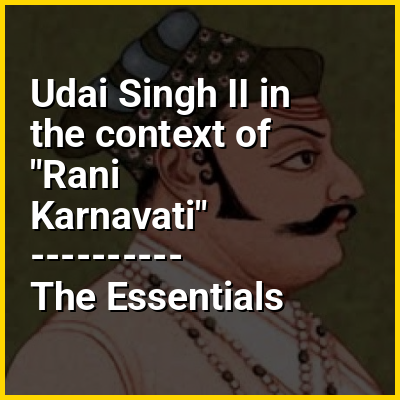
Udai Singh II (Mewari pronunciation: [ʊ.d̪əj sɪŋʱ]; 4 August 1522 – 28 February 1572) was the 12th Maharana of the Kingdom of Mewar from 1540 until his death in 1572. He was also the founder of the city of Udaipur in the present-day state of Rajasthan, India. He was the fourth son of Rana Sanga and Rani Karnavati, a princess of Bundi.
HINT:
In this Dossier
Udai Singh II in the context of Udaipur
Udaipur (Hindi: IPA: [ʊdəjpʊɾ], ) (ISO 15919: Udayapura) is a city in the north-western Indian state of Rajasthan, about 415 km (258 mi) south of the state capital Jaipur. It serves as the administrative headquarters of Udaipur district. It is the historic capital of the kingdom of Mewar in the former Rajputana Agency. It was founded in 1559 by Udai Singh II of the Sisodia clan of Rajputs, when he shifted his capital from the city of Chittorgarh to Udaipur after Chittorgarh was besieged by Akbar. It remained as the capital city till 1818 when Mewar became a British princely state, and thereafter the Mewar province became a part of Rajasthan when India gained independence in 1947. It is also known as the City of Lakes, as it is surrounded by five major artificial lakes.
The city is located in the southernmost part of Rajasthan, near the Gujarat border. To its west is the Aravali Range, which separates it from the Thar Desert. It is placed close to the median point between two major Indian metro cities, around 660 km from Delhi and 800 km from Mumbai. Besides, connectivity with Gujarat ports gives Udaipur a strategic geographical advantage. Udaipur is well connected with nearby cities and states by means of road, rail and air transportation facilities. The city is served by the Maharana Pratap Airport. Common languages spoken include Hindi, English and Rajasthani (Mewari).
View the full Wikipedia page for Udaipur