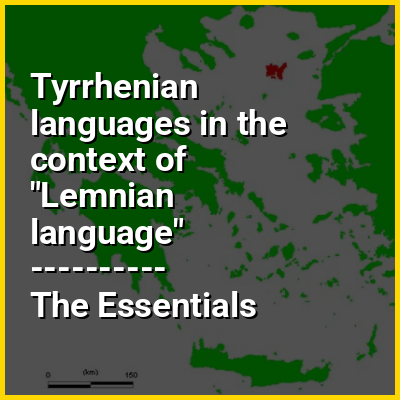
Tyrsenian (also Tyrrhenian or Common Tyrrhenic), named after the Tyrrhenians (Ancient Greek, Ionic: Τυρσηνοί Tyrsenoi), an exonym used by the ancient Greeks to refer to the Etruscans, is a language family of closely related extinct ancient languages, proposed by linguist Helmut Rix in 1998, that has gained acceptance. The family would consist of the Etruscan language of northern, central and south-western Italy, and eastern Corsica; the Raetic language of the Alps, in northern Italy and Austria, named after the Rhaetian people; and the Lemnian language attested in Lemnos in the northern Aegean Sea. Camunic in northern Lombardy, between Etruscan and Raetic, may belong to the family as well, but evidence of such is limited. The Tyrsenian languages are generally considered Pre-Indo-European, and more specifically Paleo-European.
HINT:
In this Dossier
Tyrrhenian languages in the context of Helmut Rix
Helmut Rix (4 July 1926, in Amberg – 3 December 2004, in Colmar) was a German linguist and professor of the Sprachwissenschaftliches Seminar of Albert-Ludwigs-Universität, Freiburg, Germany.
He is best known for his research into Indo-European and Etruscan languages, as well as for being the author of the hypothesis of Tyrrhenian languages.
View the full Wikipedia page for Helmut Rix