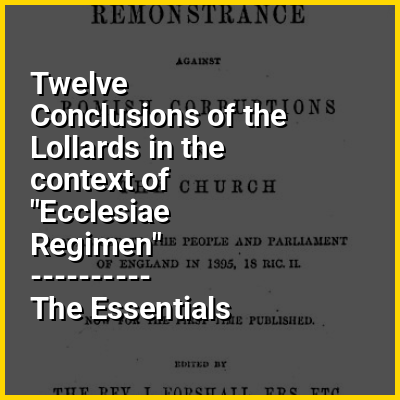
The Twelve Conclusions of the Lollards is a Middle English religious text written in 1395 containing statements by leaders of the English medieval movement, the Lollards, inspired by some of the teachings of John Wycliffe. The text was presented to the Parliament of England and nailed to the doors of Westminster Abbey and St Paul's Cathedral as a placard (a typical medieval method for publishing). The manifesto suggests the expanded treatise Thirty-Seven Conclusions (Thirty-seven Articles against Corruptions in the Church), for those that wished more in-depth information.
HINT:
In this Dossier
- ⭐ Core Definition: Twelve Conclusions of the Lollards
- Twelve Conclusions of the Lollards in the context of Lollardy
Twelve Conclusions of the Lollards in the context of Lollardy
Lollardy was a proto-Protestant Christian religious movement that was active in England from the mid-14th century until the 16th-century English Reformation. It was initially led by John Wycliffe, a Catholic theologian who was later dismissed from the University of Oxford in 1381 for heresy. The Lollards' demands were primarily for reform of Western Christianity. They formulated their beliefs in the Twelve Conclusions of the Lollards. Early it became associated with regime change uprisings and assassinations of high government officials, and was suppressed.
View the full Wikipedia page for Lollardy