Turkmens in the context of "Kandahar Province"

Play Trivia Questions online!

or

Skip to study material about Turkmens in the context of "Kandahar Province"

Ad spacer

⭐ Core Definition: Turkmens

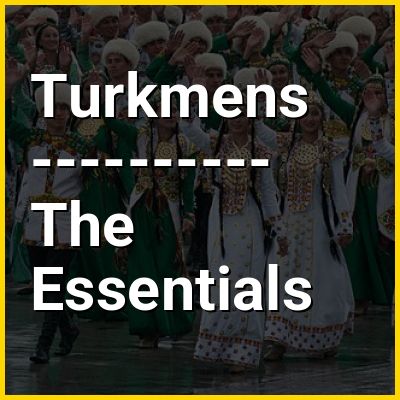
Turkmens (Turkmen: Türkmenler, Түркменлер, توركمنلر‎, [tʏɾkmønˈløɾ]) are a Turkic ethnic group native to Central Asia, living mainly in Turkmenistan, northern and northeastern regions of Iran and north-western Afghanistan. Sizeable groups of Turkmens are found also in Uzbekistan, Kazakhstan, and the North Caucasus (Stavropol Krai). They speak the Turkmen language, which is classified as a part of the Eastern Oghuz branch of the Turkic languages.

In the early Middle Ages, Turkmens called themselves Oghuz; in the Middle Ages, they took the ethnonym Turkmen. These early Oghuz Turkmens moved westward from the Altai Mountains through the Siberian steppes, and settled in the region now known as Turkmenistan. Further westward migration of the Turkmen tribes from the territory of modern Turkmenistan and the rest of Central Asia started from the 11th century and continued until the 18th century. These Turkmen tribes played a significant role in the ethnic formation of such peoples as Anatolian Turks, Turkmens of Iraq, and Syria, as well as the Turkic population of Iran and Azerbaijan. To preserve their independence, those tribes that remained in Turkmenistan were united in military alliances, although remnants of tribal relations remained until the 20th century. Their traditional occupations were farming, cattle breeding, and various crafts. Ancient samples of applied art (primarily carpets and jewelry) indicate a high level of folk art culture.
↓ Menu

>>>PUT SHARE BUTTONS HERE<<<
In this Dossier

Turkmens in the context of Central Asia

Central Asia is a region of Asia consisting of Kazakhstan, Kyrgyzstan, Tajikistan, Turkmenistan, and Uzbekistan. The countries as a group are also colloquially referred to as the "-stans" as all have names ending with the Persian suffix "-stan" (meaning 'land') in both respective native languages and most other languages. The region is bounded by the Caspian Sea to the southwest, European Russia to the northwest, China and Mongolia to the east, Afghanistan and Iran to the south, and Siberia to the north. Together, the five Central Asian countries have a total population of around 76 million.

In the pre-Islamic and early Islamic eras (c. 1000 and earlier) Central Asia was inhabited predominantly by Iranian peoples, populated by Eastern Iranian-speaking Bactrians, Sogdians, Chorasmians, and the semi-nomadic Scythians and Dahae. As the result of Turkic migration, Central Asia also became the homeland for the Kazakhs, Kyrgyzs, Tatars, Turkmens, Uyghurs, and Uzbeks; Turkic languages largely replaced the Iranian languages spoken in the area, with the exception of Tajikistan and areas where Tajik is spoken.

↑ Return to Menu

Turkmens in the context of Iraqi Turkmen

The Iraqi Turkmen (Turkish: Irak Türkmenleri, عراق تورکمنلری; Arabic: تركمان العراق), also referred to as Iraqi Turks, (Turkish: Irak Türkleri, عراق توركلری; Arabic: أتراك العراق) are the third largest ethnic group in Iraq. They make up to 10%–13% of the Iraqi population. Iraqi Turkmens are descendants of Turkish settlers from the time of Ottoman Iraq, and are closely related to Syrian Turkmens. Iraqi Turkmens in Iraq do not identify with the traditionally-nomadic Turkmens of Central Asia.

↑ Return to Menu

Turkmens in the context of Oghuz Turks

The Oghuz Turks (Middle Turkic: ٱغُز, romanized: Oγuz) were a western Turkic people who spoke the Oghuz branch of the Turkic language family. In the 8th century, they formed a tribal confederation conventionally named the Oghuz Yabgu State in Central Asia. Today, much of the populations of Turkey, Azerbaijan and Turkmenistan are descendants of Oghuz Turks. The term Oghuz was gradually supplanted by the terms Turkmen and Turcoman (Ottoman Turkish: تركمن, romanizedTürkmen or Türkmân) by the 13th century.

The Oghuz confederation migrated westward from the Jeti-su area after a conflict with the Karluk allies of the Uyghurs. In the 9th century, the Oghuz from the Aral steppes drove Pechenegs westward from the Emba and Ural River region. In the 10th century, the Oghuz inhabited the steppe of the rivers Sari-su, Turgai and Emba north of Lake Balkhash in modern-day Kazakhstan.

↑ Return to Menu

Turkmens in the context of Kayı tribe

The Kayı (Karakhanid: قَيِغْ, romanized: qayïġ; Turkish: Kayı boyu, Turkmen: Gaýy taýpasy) were an Oghuz Turkic ethnic group and a sub-branch of the Bozok tribal federation. In his Dīwān Lughāt al-Turk, the 11th century Kara-Khanid scholar Mahmud al-Kashgari cited Kayı as of one of 22 Oghuz tribes, saying that Oghuz were also called Turkomans.

The name Kayı means "the one who has might and power by relationship" and a Turkmen proverb says that "the people shall be governed by Kayı and Bayat tribes" (Turkmen: Il başy - gaýy-baýat).

↑ Return to Menu

Turkmens in the context of Asian Americans

Asian Americans are Americans with ancestry from the continent of Asia (including naturalized Americans who are immigrants from specific regions in Asia and descendants of those immigrants). According to annual estimates from the U.S. Census Bureau, as of July 1, 2024, the Asian population was estimated at 22,080,844, representing approximately 6.49% of the total U.S. population, making them the fastest growing and fourth largest racial and ethnic group in the United States after African Americans, Hispanic and Latino Americans and non-Hispanic White Americans.

Although this term had historically been used for all the indigenous peoples of the continent of Asia, the usage of the term "Asian" by the United States Census Bureau denotes a racial category that includes people with origins or ancestry from East Asia, South Asia, Southeast Asia, and Central Asia. It excludes people with ethnic origins from West Asia, who were historically classified as "white" and will be categorized as Middle Eastern Americans starting from the 2030 census. Central Asian ancestries (including Afghan, Kazakh, Kyrgyz, Tajik, Turkmen, and Uzbek) were previously not included in any racial category but have been designated as "Asian" as of 2024.

↑ Return to Menu

Turkmens in the context of Bayat (tribe)

Bayat (Azerbaijani: Bayat tayfası; Persian: بیات; Turkish: Bayat boyu; Turkmen: Baýat taýpasy) is one of the Oghuz tribes in Turkmenistan, Iran, Turkey, Azerbaijan, Iraq, Afghanistan, and Syria. When Oghuz Turks started to migrate from the Aral steppes to Khorasan in the 11th and 13th centuries, Bayat people spread throughout the region. They are sub-ethnic groups of Turkmens and Azerbaijanis. The Bayats are Muslim and speak a southern dialect of Azerbaijani language in Azerbaijan and Iran, or their own dialect of Turkish in Turkey, and Ersari dialect of Turkmen in Turkmenistan and Uzbekistan. The ancient Turkmen proverb says: "Kayı and Bayat tribes shall lead the people" (Turkmen: "Il başy - gaýy-baýat").

↑ Return to Menu

Turkmens in the context of Turkmen language

Turkmen (türkmençe, түркменче, تۆرکمنچه, [tʏɾkˈmøntʃø] or türkmen dili, түркмен дили, تۆرکمن ديلی, [tʏɾkˈmøn dɪˈlɪ]) is a Turkic language of the Oghuz branch spoken by the Turkmens of Central Asia. It has an estimated 4.7 million native speakers in Turkmenistan (where it is the official language), and a further 359,000 speakers in northeastern Iran and 1.2 million people in northwestern Afghanistan, where it has no official status. Turkmen is also spoken to lesser varying degrees in Turkmen communities of Uzbekistan and Tajikistan and by diaspora communities, primarily in Turkey and Russia.

Turkmen is a member of the Oghuz branch of the Turkic languages. It is closely related to Azerbaijani, Gagauz, Qashqai, and Turkish, sharing varying degrees of mutual intelligibility with each of those languages. However, the closest relative of Turkmen is considered Khorasani Turkic, spoken in northeastern regions of Iran and with which it shares the eastern subbranch of Oghuz languages, as well as Khorazm, the Oghuz dialect of Uzbek spoken mainly in Khorezm along the Turkmenistan border. Elsewhere in Iran, the Turkmen language comes second after the Azerbaijani language in terms of the number of speakers of Turkic languages of Iran.

↑ Return to Menu