Turbo generator in the context of "Alternator"

Play Trivia Questions online!

or

Skip to study material about Turbo generator in the context of "Alternator"


⭐ Core Definition: Turbo generator

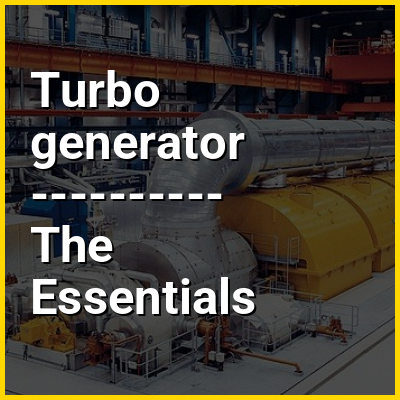
A turbo generator is an electric generator connected to the shaft of a turbine (water, steam, or gas) for the generation of electric power. Large steam-powered turbo generators provide the majority of the world's electricity and are also used by steam-powered turbo-electric and gas-turbine-electric powered ships.

Small turbo-generators driven by gas turbines are often used as auxiliary power units (APU, mainly for aircraft).

↓ Menu

In this Dossier

Turbo generator in the context of Steam turbine

A steam turbine or steam turbine engine is a machine or heat engine that extracts thermal energy from pressurized steam and uses it to do mechanical work utilising a rotating output shaft. Its modern manifestation was invented by Sir Charles Parsons in 1884. It revolutionized marine propulsion and navigation to a significant extent. Fabrication of a modern steam turbine involves advanced metalwork to form high-grade steel alloys into precision parts using technologies that first became available in the 20th century; continued advances in durability and efficiency of steam turbines remains central to the energy economics of the 21st century. The largest steam turbine ever built is the 1,770 MW Arabelle steam turbine built by Arabelle Solutions (previously GE Steam Power), two units of which will be installed at Hinkley Point C Nuclear Power Station, England.

The steam turbine is a form of heat engine that derives much of its improvement in thermodynamic efficiency from the use of multiple stages in the expansion of the steam, which results in a closer approach to the ideal reversible expansion process. Because the turbine generates rotary motion, it can be coupled to a generator to harness its motion into electricity. Such turbogenerators are the core of thermal power stations which can be fueled by fossil fuels, nuclear fuels, geothermal, or solar energy. About 42% of all electricity generation in the United States in 2022 was by the use of steam turbines. Technical challenges include rotor imbalance, vibration, bearing wear, and uneven expansion (various forms of thermal shock).

↑ Return to Menu

Turbo generator in the context of Electricity generation

Electricity generation is the process of generating electric power from sources of primary energy. For utilities in the electric power industry, it is the stage prior to its delivery (transmission, distribution, etc.) to end users or its storage, using for example, the pumped-storage method.

Consumable electricity is not freely available in nature, so it must be "produced", transforming other forms of energy to electricity. Production is carried out in power stations, also called "power plants". Electricity is most often generated at a power plant by electromechanical generators, primarily driven by heat engines fueled by combustion or nuclear fission, but also by other means such as the kinetic energy of flowing water and wind. Other energy sources include solar photovoltaics and geothermal power. There are exotic and speculative methods to recover energy, such as proposed fusion reactor designs which aim to directly extract energy from intense magnetic fields generated by fast-moving charged particles generated by the fusion reaction (see magnetohydrodynamics).

↑ Return to Menu

Turbo generator in the context of Ottó Bláthy

Ottó Titusz Bláthy (11 August 1860 – 26 September 1939) was a Hungarian electrical engineer. During his career he became the co-inventor of the modern electric transformer, the voltage regulator, the AC watt-hour meter, the turbo generator, the high-efficiency turbo generator and the motor capacitor for the single-phase (AC) electric motor.

Bláthy's career as an inventor began during his time at the Ganz Works in 1883. There, he conducted experiments for creating a transformer. The name "transformer" was created by Bláthy. In 1885 the ZBD model alternating-current transformer was invented by three Hungarian engineers: Ottó Bláthy, Miksa Déri and Károly Zipernowsky. (ZBD comes from the initials of their names). In the autumn of 1889 he patented the AC watt-meter.

↑ Return to Menu

Turbo generator in the context of Emergency Relief and Construction Act

The Emergency Relief and Construction Act (ch. 520, 47 Stat. 709, enacted July 21, 1932), was the United States's first major-relief legislation, enabled under Herbert Hoover and later adopted and expanded by Franklin D. Roosevelt as part of his New Deal.

The Emergency Relief and Construction Act was an amendment to the Reconstruction Finance Corporation Act which was signed on January 22, 1932. It created the Reconstruction Finance Corporation which released funds for public works projects across the country. The Brooklyn Navy Yard received an allotment of $880,000, marked for specific projects such as $215,000 for repairs and the maintenance of roofs, waterfront quays and docks, and Yard's railroad system. The biggest chunk, $855,000, was designated for a major overhaul of the power plant, to put in a new turbo generator, piping, boilers, and other engines. The Act was designed to be a temporary means of providing employment and all the positions created in the navy yard to service the projects were therefore classified as temporary. In another preview of New Deal spending, the government even authorized the Act funds to start building a number of destroyers in the navy yards.

↑ Return to Menu