Tuned mass damper in the context of "Resonant frequency"

Play Trivia Questions online!

or

Skip to study material about Tuned mass damper in the context of "Resonant frequency"


⭐ Core Definition: Tuned mass damper

A tuned mass damper (TMD), also known as a harmonic absorber or seismic damper, is a device mounted in structures to reduce mechanical vibrations, consisting of a mass mounted on one or more damped springs. Its oscillation frequency is tuned to be similar to the resonant frequency of the object it is mounted to, and reduces the object's maximum amplitude while weighing much less than it.

TMDs can prevent discomfort, damage, or outright structural failure. They are frequently used in power transmission, automobiles and buildings.
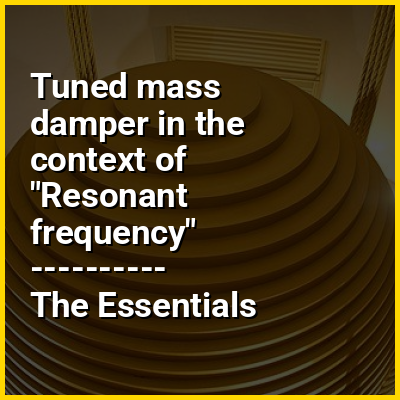
↓ Menu

In this Dossier

Tuned mass damper in the context of Weight (object)

A weight (also known as a mass) is an object, normally with high density, whose chief task is to have mass and exert weight (through gravity). It is used for different purposes, such as in:

↑ Return to Menu

Tuned mass damper in the context of Mechanical resonance

Mechanical resonance is the tendency of a mechanical system to respond at greater amplitude when the frequency of its oscillations matches the system's natural frequency of vibration (its resonance frequency or resonant frequency) closer than it does other frequencies. It may cause violent swaying motions and potentially catastrophic failure in improperly constructed structures including bridges, buildings and airplanes. This is a phenomenon known as resonance disaster.

Avoiding resonance disasters is a major concern in every building, tower and bridge construction project. The Taipei 101 building for instance relies on a 660-ton pendulum—a tuned mass damper—to modify the response at resonance. The structure is also designed to resonate at a frequency which does not typically occur. Buildings in seismic zones are often constructed to take into account the oscillating frequencies of expected ground motion. Engineers designing objects that have engines must ensure that the mechanical resonant frequencies of the component parts do not match driving vibrational frequencies of the motors or other strongly oscillating parts.

↑ Return to Menu