Tschirnhausen cubic in the context of Bézier curve


Tschirnhausen cubic in the context of Bézier curve

⭐ Core Definition: Tschirnhausen cubic

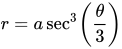
In mathematics, the Tschirnhausen cubic is a cubic plane curve defined by the polar equationor the equivalent algebraic equation
It is a nodal cubic, meaning that it crosses itself at one point, its node. The angle at this crossing point, inside the loop formed by the crossing, is 60°. Because the Tschirnhausen cubic has this singularity, it can be given a parametric equation, and any arc of it can be drawn as a cubic Bézier curve. It is a special case of a sinusoidal spiral, of a pursuit curve, and of a Pythagorean hodograph curve.

↓ Menu
HINT:

In this Dossier

Tschirnhausen cubic in the context of Algebraic curve

In mathematics, an affine algebraic plane curve is the zero set of a polynomial in two variables. A projective algebraic plane curve is the zero set in a projective plane of a homogeneous polynomial in three variables. An affine algebraic plane curve can be completed in a projective algebraic plane curve by homogenizing its defining polynomial. Conversely, a projective algebraic plane curve of homogeneous equation h(x, y, t) = 0 can be restricted to the affine algebraic plane curve of equation h(x, y, 1) = 0. These two operations are each inverse to the other; therefore, the phrase algebraic plane curve is often used without specifying explicitly whether it is the affine or the projective case that is considered.

If the defining polynomial of a plane algebraic curve is irreducible, then one has an irreducible plane algebraic curve. Otherwise, the algebraic curve is the union of one or several irreducible curves, called its components, that are defined by the irreducible factors.

View the full Wikipedia page for Algebraic curve
↑ Return to Menu