Trịnh–Nguyễn War in the context of "Trịnh lords"

Play Trivia Questions online!

or

Skip to study material about Trịnh–Nguyễn War in the context of "Trịnh lords"


⭐ Core Definition: Trịnh–Nguyễn War

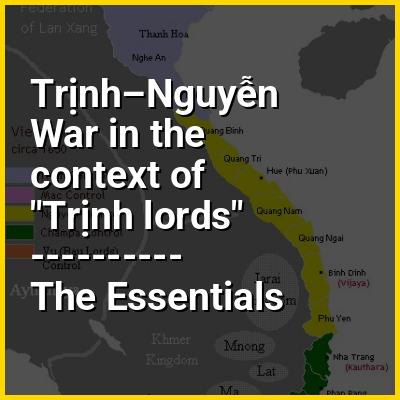
The Trịnh–Nguyễn Civil War (Vietnamese: Trịnh-Nguyễn phân tranh; chữ Hán: 鄭阮紛爭, lit. Trịnh–Nguyễn contention) was a lengthy civil war during the 17th-18th centuries waged between the two ruling families in Vietnam, the Trịnh lords of Đàng Ngoài and the Nguyễn lords of Đàng Trong, centered in today's Central Vietnam. The wars resulted in a long stalemate and century of peace before conflicts resumed in 1774 resulting in the emergence of the Tây Sơn forces following Trịnh Lords at the time, Nguyễn Lords collapsed in Saigon in 1777. During the division of Vietnam, Gianh River was used as the de facto border between both sides in peacetime.

↓ Menu

In this Dossier

Trịnh–Nguyễn War in the context of Nguyễn lords

The Nguyễn lords (Vietnamese: Chúa Nguyễn, 主阮; 1558–1777, 1780–1802), also known as the Nguyễn clan (Vietnamese: Nguyễn thị; chữ Hán: 阮氏), were Nguyễn dynasty's forerunner and a feudal noble clan ruling southern Đại Việt in the Revival Lê dynasty. The Nguyễn lords were members of the House of Nguyễn Phúc. The territory they ruled was known contemporarily as Đàng Trong (Inner Realm) and known by Europeans as the Kingdom of Cochinchina and as Kingdom of Quảng Nam (Vietnamese: Quảng Nam Quốc; chữ Hán: 廣南國) by Imperial China, in opposition to the Trịnh lords ruling northern Đại Việt as Đàng Ngoài (Outer Realm), known as the "Kingdom of Tonkin" by Europeans and "Kingdom of Annam" (Vietnamese: An Nam Quốc; chữ Hán: 安南國) by Imperial China in bilateral diplomacy. They were officially entitled, in Sino-Vietnamese, the Nguyễn Vương (chữ Hán: 阮王) in 1744 when lord Nguyễn Phúc Khoát self-proclaimed himself to elevate his status equally to Trịnh lords's title known as the Trịnh Vương (Vietnamese: Trịnh Vương; chữ Hán: 鄭王). Both Nguyễn and Trịnh clans were de jure subordinates and fief of the Lê dynasty. However, the de jure submission of the Nguyễn lords to the Trịnh lords ended in 1627 sparked the war between them.

While they recognized the authority of and claimed to be loyal subjects of the revival Lê dynasty, they were de facto rulers of southern Đại Việt. Meanwhile, the Trịnh lords ruled northern Đại Việt in the name of the Lê emperor, who was in reality a puppet ruler. They fought a series of long and bitter wars that pitted the two halves of Vietnam against each other. The Nguyễn were finally overthrown in the Tây Sơn wars, but one of their descendants would eventually come to unite all of Vietnam. Their rule consolidated earlier southward expansion into Champa and pushed southwest into Cambodia.

↑ Return to Menu

Trịnh–Nguyễn War in the context of Tây Sơn dynasty

The Tây Sơn dynasty (Vietnamese: [təj ʂəːn]; Vietnamese: "Nhà Tây Sơn" or "Triều Tây Sơn", (chữ Hán: 朝西山; Chữ Nôm: 茹西山), officially Đại Việt (Chữ Hán: 大越), was an imperial dynasty of Vietnam. It originated in a revolt led by three peasant brothers with the surname Nguyễn, rebelling against the Lê dynasty, Trịnh lords and Nguyễn lords (no relation). The Tây Sơn would later be succeeded by the Nguyễn dynasty.

The Tây Sơn dynasty ended the century-long war between the Trịnh and Nguyễn families, overthrew the Lê dynasty, and united the country for the first time in 200 years. They acknowledged Qing suzerainty and gained recognition from the Qianlong Emperor as the legitimate rulers of Vietnam. Under the most prominent of the Tây Sơn brothers Nguyễn Huệ (Emperor Quang Trung) Vietnam experienced several years of relative peace and prosperity. But Quang Trung died relatively young at the age of 40 and his successor Cảnh Thịnh, aged 9, was unable to prevent civil conflict among the Tây Sơn court which allowed the last Nguyễn lord Nguyễn Ánh to retake the south of Vietnam, extinguish the Tây Sơn and establish the Nguyễn dynasty.

↑ Return to Menu

Trịnh–Nguyễn War in the context of Đàng Ngoài

Đàng Ngoài (chữ Hán: 唐外, lit. "Outer Land"), also known as Bắc Hà (北河, "North of the River") or Kingdom of Annam (安南國) by foreigners, was an area in northern Đại Việt (now Vietnam) during the 17th and 18th centuries as the result of Trịnh–Nguyễn War. The name Đàng Ngoài was first recorded in the Dictionarium Annamiticum Lusitanum et Latinum by Alexandre de Rhodes.

Đàng Ngoài was de facto ruled by the Trịnh lords with the Lê emperors acting as titular rulers. The capital was Thăng Long (now Hanoi). Thăng Long was also known as Đông Kinh 東京, meaning "Eastern Capital", from which the common European name for Đàng Ngoài "Tonkin" originated. It was bordered by Đàng Trong (under the Nguyễn lords) along the Gianh River in Quảng Bình province. The names gradually fell into disuse after Nguyễn Ánh reunified Đại Việt.

↑ Return to Menu

Trịnh–Nguyễn War in the context of Lê dynasty

The Lê dynasty, also known in historiography as the Later Lê dynasty (Vietnamese: "Nhà Hậu Lê" or "Triều Hậu Lê", chữ Hán: 朝後黎, chữ Nôm: 茹後黎), officially Đại Việt (Chữ Hán: 大越), was the longest-ruling Vietnamese dynasty, having ruled from 1428 to 1789, with an interregnum between 1527 and 1533. The Lê dynasty is divided into two historical periods: the Initial Lê dynasty (Vietnamese: triều Lê sơ, chữ Hán: 朝黎初, or Vietnamese: nhà Lê sơ, chữ Nôm: 茹黎初; 1428–1527) before the usurpation by the Mạc dynasty, in which emperors ruled in their own right, and the Revival Lê dynasty (Vietnamese: triều Lê Trung hưng, chữ Hán: 朝黎中興, or Vietnamese: nhà Lê trung hưng, chữ Nôm: 茹黎中興; 1533–1789), in which the emperors were figures who reigned under the auspices of the powerful Trịnh family. The Revival Lê dynasty was marked by two lengthy civil wars: the Lê–Mạc War (1533–1592) in which two dynasties battled for legitimacy in northern Vietnam and the Trịnh–Nguyễn Wars (1627–1672, 1774–1777) between the Trịnh lords in North and the Nguyễn lords of the South.

The dynasty officially began in 1428 with the enthronement of Lê Lợi after he drove the Ming Chinese army from Vietnam. The dynasty reached its peak during the reign of Lê Thánh Tông and declined after his death in 1497. In 1527, the Mạc dynasty usurped the throne; when the Lê dynasty was restored in 1533, the Mạc fled to the far north and continued to claim the throne during the period known as Southern and Northern Dynasties. The restored Lê emperors held no real power, and by the time the Mạc dynasty was finally eradicated in 1677, actual power lay in the hands of the Trịnh lords in the North and Nguyễn lords in the South, both ruling in the name of the Lê emperor while fighting each other. The Lê dynasty officially ended in 1789, when the peasant uprising of the Tây Sơn brothers defeated both the Trịnh and the Nguyễn, ironically in order to restore power to the Lê dynasty.

↑ Return to Menu

Trịnh–Nguyễn War in the context of Gianh River

The Gianh River (vernacular Vietnamese: sông Gianh, also known as Gianh giang; Sino-Vietnamese: Linh Giang 靈江) is a river in the Quảng Bình province of Vietnam's North Central Coast (Bắc Trung Bộ). The river is 268 kilometres (167 mi) in length.

The Gianh–Son River served as the boundary between Đàng Ngoài and Đàng Trong, ruled by rival families, during the partition of Vietnam in the 17th and 18th centuries following the Trịnh–Nguyễn War. The 17th parallel, used as the border between North Vietnam and South Vietnam from 1954 to 1975, was located just south of the Gianh River, at the Bến Hải River in Quảng Trị province.

↑ Return to Menu