Triphylia in the context of "Thryoessa"

Play Trivia Questions online!

or

Skip to study material about Triphylia in the context of "Thryoessa"

Ad spacer

⭐ Core Definition: Triphylia

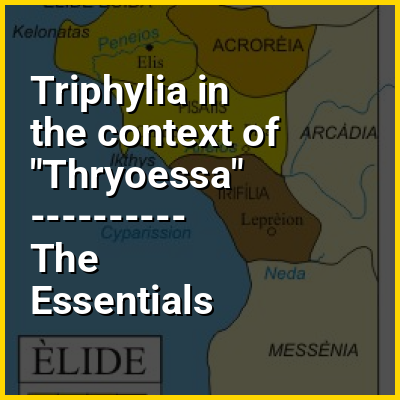
Triphylia (Greek: Τριφυλία, Trifylia, "the country of the three tribes") was an area of the ancient Peloponnese. Strabo and Pausanias both describe Triphylia as part of Elis, and it fell at times under the domination of the city of Elis, but Pausanias claims that the residents reckoned themselves Arcadian, not Elean. They fell under the rule of Elis in the 8th century BC, and remained under Elean rule until the Spartans asserted their control in 402 BC. When the Spartans were defeated by the Thebans at the Battle of Leuctra in 371 BC, the Eleans attempted to reassert their control, but the Triphylians, in order to maintain their independence from Elis, joined the Arcadian League in 368 BC. In this period, their political fortunes were often shared by the areas on the border between Elis and Arcadia but to the north of the River Alpheus; Xenophon mentions the Amphidolians and Acrorians and the city-states of Lasion, Margana, and Letrini in this context. The Amphidolians, Marganians, and Letrinians are remarkable in Xenophon for fielding slingers for the Peloponnesian army.

The most important city in Triphylia was Lepreum, which maintained its self-government in the 5th century BC. In his accounts of wars between the Eleans and their enemies in Sparta and Arcadia in this period, Xenophon also mentions Scillus, Macistus, Epium, Phrixa, and Epitalium as cities in Triphylia.
↓ Menu

>>>PUT SHARE BUTTONS HERE<<<
In this Dossier

Triphylia in the context of Epitalion

37°38′02″N 21°28′54″E / 37.633865°N 21.481638°E / 37.633865; 21.481638Epitalium or Epitalion (Ancient Greek: Ἐπιτάλιον) was a town of Triphylia in ancient Elis, near the coast and a little south of the river Alpheius. It was identified with the Homeric Thryon (Θρύον) or Thryoessa (Θρυόεσσα), a town listed in the Catalogue of Ships in the Iliad as in the dominions of Nestor, which the poet describes as a place upon a lofty hill near the ford of the river Alpheius.

Epitalium was an important military post, because it commanded the ford of the Alpheius and the road leading along the coast. Xenophon relates that, like the other dependent townships of Triphylia, it revolted from Elis when Agis II, the Spartan king, invaded the country in 401 BCE; and when Agis returned home, after ravaging Elis, he left a garrison in Epitalium. It is also mentioned by Polybius; in the year 218 BCE, Philip V of Macedon took several cities of Elis among which was Epitalium.

↑ Return to Menu

Triphylia in the context of Thryon

Thyron (Ancient Greek: Θρύον), sometimes Latinized as Thryum, or Thryoessa (Θρυόεσσα) was a town in Triphylia in ancient Elis, mentioned by Homer in the Catalogue of Ships of the Iliad, where the town is noted to be in the dominions of Nestor. The town is also noted in the Homeric Hymn to Apollo. Later in the Iliad, the poet describes Thyron was at the ford of the river Alpheius. In the same passage, Homer calls the town Thryoessa, places it upon a lofty hill, and relates how it withstood a siege by the Epeii during their war against the Eleans. Strabo identified Thyron with the later Epitalium or strefi ; but the identity is uncertain.

↑ Return to Menu

Triphylia in the context of Clytius

Clytius (Ancient Greek: Κλυτίος), also spelled Klythios, Klytios, Clytios, and Klytius, is the name of multiple people in Greek mythology:

To these can be added several figures not mentioned in extant literary sources and only known from various vase paintings:

↑ Return to Menu

Triphylia in the context of Caucon

In Greek mythology, the name Caucon (/ˈkɔːkən, ˈkɔːkɒn/; Ancient Greek: Καύκων) may refer to:

  • Caucon, an Arcadian prince as one of the 50 sons of the impious King Lycaon either by the naiad Cyllene, Nonacris or by unknown woman. He was an ancestral hero and eponym of the Caucones that were believed to have settled in Triphylia. His tomb was shown at Lepreus, with a statue of a man with a lyre standing over it. Other traditions made him son of Poseidon and father of Lepreus by Astydameia. Caucon and his brothers were the most nefarious and carefree of all people. To test them, Zeus visited them in the form of a peasant. These brothers mixed the entrails of a child into the god's meal, whereupon the enraged Zeus threw the meal over the table. Caucon was killed, along with his brothers and their father, by a lightning bolt of the god.
  • Caucon, son of Celaenus and grandson of the autochthon Phlyus, from Eleusis. He was said to have brought the rites of the Great Goddesses from Eleusis to Andania in Messene. Legend had it that he appeared to Epaminondas in a dream, prophesying him success in restoration of the Messenian state; the Messenian allies of Epaminondas offered sacrifices to Caucon.
↑ Return to Menu