Treaty of Turkmenchay in the context of "Tehran"

Play Trivia Questions online!

or

Skip to study material about Treaty of Turkmenchay in the context of "Tehran"

Ad spacer

⭐ Core Definition: Treaty of Turkmenchay

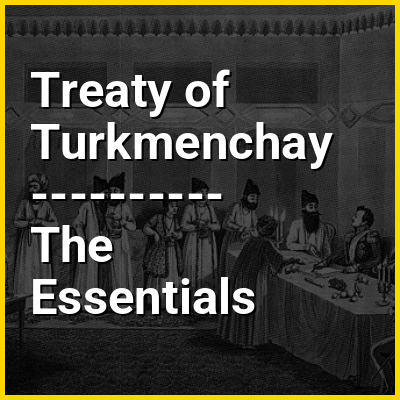
The Treaty of Turkmenchay was an agreement between Qajar Iran and the Russian Empire, which concluded the Russo-Persian War (1826–1828). It was second of the series of treaties (the first was the 1813 Treaty of Gulistan and the last, the 1881 Treaty of Akhal) signed between Qajar Iran and Imperial Russia that forced Iran to cede or recognize Russian influence over the territories that formerly were part of Iran.

The treaty was signed on 22 February 1828 (5 Sha'ban 1243) in Torkamanchay (a village between Tabriz and Tehran). It made Iran cede the control of several areas in the South Caucasus to Russia: the Erivan Khanate, the Nakhchivan Khanate and the remainder of the Talysh Khanate. The boundary between Russia and Iran was set at the Aras River. These territories are now Armenia, the south of the Republic of Azerbaijan, Nakhchivan and Iğdır Province (now part of Turkey).
↓ Menu

>>>PUT SHARE BUTTONS HERE<<<
In this Dossier

Treaty of Turkmenchay in the context of Azerbaijan

Azerbaijan, officially the Republic of Azerbaijan, is a transcontinental and landlocked country at the boundary of Western Asia and Eastern Europe. It is a part of the South Caucasus region and is bounded by the Caspian Sea to the east, Russia's republic of Dagestan to the north, Georgia to the northwest, Armenia and Turkey to the west, and Iran to the south. Baku is the capital and largest city.

The territory of what is now Azerbaijan was ruled first by Caucasian Albania and later by various Persian empires. Until the 19th century, it remained part of Qajar Iran, but the Russo-Persian wars of 1804–1813 and 1826–1828 forced the Qajar Empire to cede its Caucasian territories to the Russian Empire; the treaties of Gulistan in 1813 and Turkmenchay in 1828 defined the border between Russia and Iran. The region north of the Aras was part of Iran until it was conquered by Russia in the 19th century, where it was administered as part of the Caucasus Viceroyalty.

↑ Return to Menu

Treaty of Turkmenchay in the context of Nakhchivan Autonomous Republic

The Nakhchivan Autonomous Republic (Azerbaijani: Naxçıvan Muxtar Respublikası, pronounced [nɑxtʃɯˈvɑn muxˈtɑɾ ɾesˈpublikɑsɯ]) is a landlocked exclave of the Republic of Azerbaijan. The region covers 5,502.75 km (2,124.62 sq mi) with a population of 459,600. It is bordered by Armenia to the east and north, Iran to the southwest, and Turkey to the west. It is the sole autonomous republic of Azerbaijan, governed by its own elected legislature.

The republic, especially the capital city of Nakhchivan, has a long history dating back to about 1500 BC. Nakhijevan was one the cantons of the historical Armenian province of Vaspurakan in the Kingdom of Armenia. Historically, the Persians, Armenians, Mongols, and Turks all competed for the region. The area that is now Nakhchivan became part of Safavid Iran in the 16th century. The semi-autonomous Nakhchivan Khanate was established there in the mid-18th century. In 1828, after the last Russo-Persian War and the Treaty of Turkmenchay, the Nakhchivan Khanate passed from Iranian into Imperial Russian possession.

↑ Return to Menu

Treaty of Turkmenchay in the context of Azerbaijanis

Azerbaijanis (/ˌæzərbˈæni, -ɑːni/; Azerbaijani: Azərbaycanlılar, آذربایجانلیلار), Azeris or Azerbaijani Turks (Azərbaycan türkləri, آذربایجان تۆرکلری) are a Turkic ethnic group living mainly in the Azerbaijan region of northwestern Iran and the Republic of Azerbaijan. They are predominantly Shia Muslims. They comprise the largest ethnic group in the Republic of Azerbaijan and the second-largest ethnic group in neighboring Iran and Georgia. They speak the Azerbaijani language, belonging to the Oghuz branch of the Turkic languages.

Following the Russo-Persian Wars of 1813 and 1828, the territories of Qajar Iran in the Caucasus were ceded to the Russian Empire and the treaties of Gulistan in 1813 and Turkmenchay in 1828 finalized the borders between Russia and Iran. After more than 80 years of being under the Russian Empire in the Caucasus, the Azerbaijan Democratic Republic was established in 1918 which defined the territory of the Republic of Azerbaijan.

↑ Return to Menu

Treaty of Turkmenchay in the context of Fath Ali Shah

Fath-Ali Shah Qajar (Persian: فتحعلى‌شاه قاجار, romanizedFatḥ-ʻAli Šâh Qâjâr; 5 August 1772 – 24 October 1834) was the second Shah of Qajar Iran. He reigned from 17 June 1797 until his death on 24 October 1834. His reign saw the irrevocable ceding of Iran's northern territories in the Caucasus, comprising what is nowadays Georgia, Dagestan, Azerbaijan, and Armenia, to the Russian Empire following the Russo-Persian Wars of 1804–1813 and 1826–1828 and the resulting treaties of Gulistan and Turkmenchay. These two treaties are closely tied to Fath-Ali Shah's legacy amongst Iranians, who often view him as a weak ruler.

Fath-Ali Shah successfully restructured a mostly Turkic tribal khanship into a centralized and stable monarchy based on the old imperial design. This brought to Iran a relatively calm and prosperous period, secured a mutually beneficial relationship between state and religion, established foundational principles of state administration, and supported cultural and artistic revival which remained a distinctive feature of the Qajar dynasty. At the end of his reign, his mounting economic problems and declining military power took Iran to the verge of ruin, the situation was made worse by the subsequent struggle for the throne which ensued after his death.

↑ Return to Menu

Treaty of Turkmenchay in the context of Nakhichevan Khanate

The Nakhichevan Khanate (Persian: خانات نخجوان, romanizedKhānāt-e Nakhjavān) was a khanate under Iranian suzerainty, which controlled the city of Nakhichevan and its surroundings from 1747 to 1828. It was established by Heydar Qoli Khan after death of Nader Shah and was abolished following Treaty of Turkmenchay.

The territory of the khanate corresponded to most of the present-day Nakhchivan Autonomous Republic and Vayots Dzor Province of present-day Armenia.

↑ Return to Menu

Treaty of Turkmenchay in the context of Torkamanchay

Torkamanchay (Persian: تركمانچای) is a city in the Central District of Torkamanchay County, East Azerbaijan province, Iran, serving as capital of both the county and the district. It was the administrative center for Barvanan-e Markazi Rural District until its capital was transferred to the village of Khvajeh Ghias. A suburb of Mianeh, it is well known for the Treaty of Turkmenchay of 1828.

↑ Return to Menu

Treaty of Turkmenchay in the context of Russo-Persian Wars

The Russo-Persian Wars (Russian: Русско-персидские войны Rússko-Persídskije Vóiny), or the Russo-Iranian Wars (Persian: جنگ‌های ایران و روسیه Janghâ-ye Irân va Russīye), began in 1651 and continued intermittently until 1828. They consisted of five conflicts in total, each rooted in both sides' disputed governance of territories and countries in the Caucasus, particularly Arran (modern-day Azerbaijan), Georgia, and Armenia, as well as much of Dagestan. Generally referred to as Transcaucasia, this region was considered to be part of Persia prior to the 17th century. Between the War of 1722–1723 and the War of 1796, there was an interbellum period in which a number of treaties were drawn up between the two nations themselves and between them and the neighbouring Ottoman Empire; Turkish interest in the Caucasian territories further complicated the Russo-Persian Wars, as the two belligerents started forming alliances with the Ottoman Empire at different points of the conflict. Finally, as a consequence of the Treaty of Turkmenchay, the Persians ceded much of their Transcaucasian holdings to Russia, thus concluding the War of 1826–1828 and resolving their dispute.

↑ Return to Menu