Transatlantic telegraph cable in the context of Victoria of the United Kingdom


Transatlantic telegraph cable in the context of Victoria of the United Kingdom

⭐ Core Definition: Transatlantic telegraph cable

Transatlantic telegraph cables were undersea cables running under the Atlantic Ocean for telegraph communications. Telegraphy is a largely obsolete form of communication, and the cables have long since been decommissioned, but telephone and data are still carried on other transatlantic telecommunications cables.

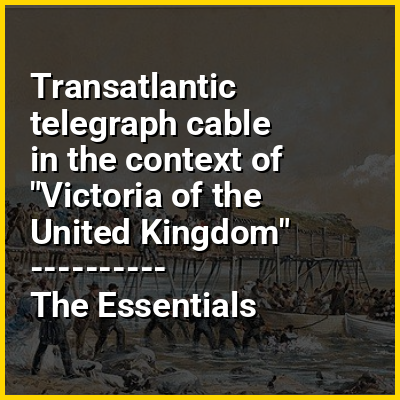
The Atlantic Telegraph Company led by Cyrus West Field constructed the first transatlantic telegraph cable. The project began in 1854 with the first cable laid from Valentia Island off the west coast of Ireland to Bay of Bulls, Trinity Bay, Newfoundland. The first communications occurred on August 16, 1858, but the line speed was poor. The first official telegram to pass between two continents that day was a letter of congratulations from Queen Victoria of the United Kingdom to President of the United States James Buchanan. Signal quality declined rapidly, slowing transmission to an almost unusable speed. The cable was destroyed after three weeks when Wildman Whitehouse applied excessive voltage to it while trying to achieve faster operation. It has been argued that the cable's faulty manufacture, storage and handling would have caused its premature failure in any case. Its short life undermined public and investor confidence and delayed efforts to restore a connection.
↓ Menu
HINT:

In this Dossier

Transatlantic telegraph cable in the context of Peter Cooper

Peter Cooper (February 12, 1791 – April 4, 1883) was an American industrialist, inventor, philanthropist, and politician. He designed and built the first American steam locomotive, the Tom Thumb, founded the Cooper Union for the Advancement of Science and Art, served as its first president, and stood for election as the Greenback Party's candidate in the 1876 presidential election.

Cooper began tinkering at a young age while working in various positions in New York City. He purchased a glue factory in 1821 and used that factory's profits to found the Canton Iron Works, where he earned even larger profits by fabricating machinery such as the Tom Thumb. Cooper's success as a businessman and inventor continued over the ensuing decades, and he became the first mill operator to successfully use anthracite coal to puddle iron. He also developed numerous patents for products such as gelatin and participated in the laying of the first transatlantic telegraph cable.

View the full Wikipedia page for Peter Cooper
↑ Return to Menu

Transatlantic telegraph cable in the context of Submarine telegraph cable

A submarine communications cable is a cable laid on the seabed between land-based stations to carry telecommunication signals across stretches of ocean and sea. The first submarine communications cables were laid beginning in the 1850s and carried telegraphy traffic, establishing the first instant telecommunications links between continents, such as the first transatlantic telegraph cable which became operational on 16 August 1858.

Submarine cables first connected all the world's continents (except Antarctica) when Java was connected to Darwin, Northern Territory, Australia, in 1871 in anticipation of the completion of the Australian Overland Telegraph Line in 1872 connecting to Adelaide, South Australia and thence to the rest of Australia.

View the full Wikipedia page for Submarine telegraph cable
↑ Return to Menu

Transatlantic telegraph cable in the context of Chamber of Commerce of the State of New York

The New York Chamber of Commerce was founded in 1768 by twenty New York City merchants. As the first such commercial organization in the United States, it attracted the participation of a number of New York's most influential business leaders, including John Jacob Astor, Peter Cooper, and J. Pierpont Morgan. The chamber's members were instrumental in the realization of several key initiatives in the region – including the Erie Canal, the Atlantic cable, and the New York City Transit Authority. The Chamber of Commerce survives today as the Partnership for New York City, which was formed from the 2002 merger of the New York Chamber of Commerce and Industry and the New York City Partnership.

View the full Wikipedia page for Chamber of Commerce of the State of New York
↑ Return to Menu

Transatlantic telegraph cable in the context of SS Great Eastern

SS Great Eastern was an iron-hulled steamship designed by Isambard Kingdom Brunel, and built by John Scott Russell & Co. at Millwall Iron Works on the River Thames, London, England. Powered by both sidewheels and a screw propeller, she was by far the largest ship ever built at the time of her 1858 launch, and had the capacity to carry 4,000 passengers from England to Australia without refuelling. Her length of 692 feet (211 m) was surpassed only in 1899, by the 705-foot (215 m) 17,274-gross-ton RMS Oceanic, her gross tonnage of 18,915 was surpassed only in 1901, by the 701-foot (214 m) 20,904-gross-ton RMS Celtic and her 4,000-passenger capacity was surpassed only in 1913, by the 4,234-passenger SS Imperator. Her five funnels (later reduced to four) was unusual for the time. She also had the largest set of paddle wheels in existence.

Brunel knew her affectionately as the "Great Babe". He died in 1859 shortly after her maiden voyage, during which she was damaged by an explosion. After repairs, she plied for several years in her intended use as a passenger liner between Britain and North America, her voyages made largely unprofitable by her high initial and operating costs. Within a few years she was repurposed to lay underwater cable, laying the first lasting transatlantic telegraph cable in 1866. Finishing her life as a floating music hall and advertising hoarding (for the department store Lewis's) in Liverpool, she was broken up on Merseyside in 1889.

View the full Wikipedia page for SS Great Eastern
↑ Return to Menu

Transatlantic telegraph cable in the context of Cable layer

A cable layer or cable ship is a deep-sea vessel designed and used to lay underwater cables for telecommunications, for electric power transmission, military, or other purposes. Cable ships are distinguished by large cable sheaves for guiding cable over bow or stern or both. Bow sheaves, some very large, were characteristic of all cable ships in the past, but newer ships are tending toward having stern sheaves only, as seen in the photo of CS Cable Innovator at the Port of Astoria on this page. The names of cable ships are often preceded by "C.S." as in CS Long Lines.

The first transatlantic telegraph cable was laid by cable layers in 1857 to 1858. It briefly enabled telecommunication between Europe and North America before misuse resulted in failure of the line. In 1866 the SS Great Eastern successfully laid two transatlantic cables, securing future communication between the continents.

View the full Wikipedia page for Cable layer
↑ Return to Menu

Transatlantic telegraph cable in the context of Field, British Columbia

Field is an unincorporated community of approximately 169 people located in the Kicking Horse River valley of southeastern British Columbia,Canada, within the confines of Yoho National Park. At an elevation of 1,256 m (4,121 ft), it is 27 km (17 mi) west of Lake Louise along the Trans-Canada Highway, which provides the only road access to the town. The community is named for Cyrus West Field of Transatlantic telegraph cable fame, who visited the area in 1884.

View the full Wikipedia page for Field, British Columbia
↑ Return to Menu