Trajan's Market in the context of "Ruin"

Play Trivia Questions online!

or

Skip to study material about Trajan's Market in the context of "Ruin"

Ad spacer

⭐ Core Definition: Trajan's Market

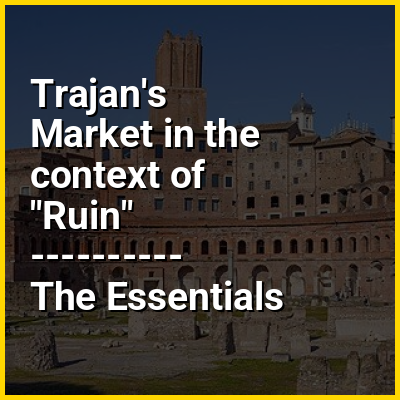
Trajan's Market (Latin: Mercatus Traiani; Italian: Mercati di Traiano) is a large complex of ruins in the city of Rome, Italy, located on the Via dei Fori Imperiali, at the opposite end to the Colosseum. The surviving buildings and structures, built as an integral part of Trajan's Forum and nestled against the excavated flank of the Quirinal Hill, present a living model of life in the Roman capital and a glimpse at the restoration in the city, which reveals new treasures and insights about ancient Roman architecture.

Thought to be the world's oldest shopping mall, the arcades in Trajan's Market are now believed by many to be administrative offices for Emperor Trajan. The shops and apartments were built in a multi-level structure and it is still possible to visit several of the levels. Highlights include delicate marble floors and the remains of a library.
↓ Menu

>>>PUT SHARE BUTTONS HERE<<<
In this Dossier

Trajan's Market in the context of Antonio da Sangallo the Younger

Antonio da Sangallo the Younger (12 April 1484 – 3 August 1546), also known as Antonio Cordiani, was an Italian architect active during the Renaissance, mainly in Rome and the Papal States. He worked on the design of St. Peter's Basilica in the Vatican City, and was also an engineer who restored several buildings. His success was greatly due to his contracts with renowned artists during his time. Sangallo died in Terni, Italy, and was buried in St. Peter’s Basilica.

↑ Return to Menu

Trajan's Market in the context of Via dei Fori Imperiali

The Via dei Fori Imperiali (formerly Via dei Monti, then Via dell'Impero) is a road in the centre of the city of Rome, Italy, that is in a straight line from the Piazza Venezia to the Colosseum. The road was built in 1932 to rediscover and made visible the Imperial fora: Forum of Trajan, Forum of Augustus and Forum of Nerva, as well as Trajan's Market, previously hidden under the buildings. Most of these monuments can be seen on both sides of the road. The street is lined with stone pines (Pinus pinea). Since the 1990s, there has been a new deal of archaeological excavation along the road and in its gardens.

↑ Return to Menu